
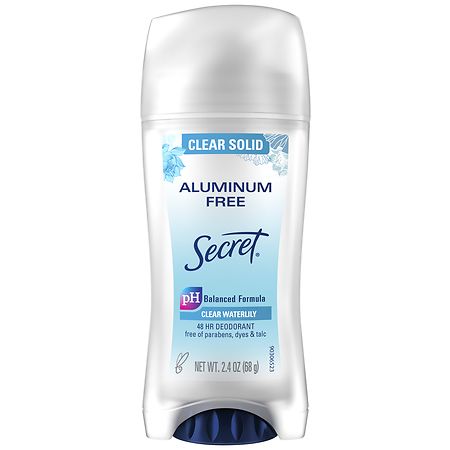
Secret Aluminum Free Deodorant Clear Solid Waterlily 2.4 oz
Summary
This deodorant is free from aluminum, which is a positive aspect, but it contains propylene glycol and synthetic fragrance, both of which can cause skin irritation and allergic reactions. While it avoids some of the most harmful additives, the presence of these synthetic ingredients prevents it from being considered a clean, natural product.
At a glance
Key ingredients 8
dipropylene glycolNeutral
Dipropylene glycol is a common solvent used in personal care products to help dissolve other ingredients. It is generally considered safe for use in cosmetics. However, it is a synthetic compound derived from petroleum.
Risks
There are minimal risks associated with dipropylene glycol, though it may cause irritation in sensitive individuals.
Benefits
It helps in the even distribution of the product on the skin.
waterNeutral
Water is used as a solvent in many cosmetic products, providing a base for other ingredients. It is essential for dissolving and mixing other components. Water itself is neutral and poses no risks.
Risks
There are no inherent risks associated with water in cosmetic formulations.
Benefits
Water helps in hydrating the skin and acts as a carrier for other ingredients.
propylene glycolBad
Propylene glycol is a synthetic liquid substance that absorbs water and is used to maintain moisture in products. It is derived from petroleum and can be an irritant to the skin. It is often criticized for its potential to cause skin irritation.
Risks
Propylene glycol can cause skin irritation and allergic reactions in some individuals.
Benefits
It helps in keeping the product from drying out and enhances the penetration of other ingredients.
sodium stearateNeutral
Sodium stearate is a common soap ingredient used as a thickener and stabilizer in cosmetics. It is generally considered safe and is derived from stearic acid, a fatty acid. It helps in forming the solid structure of the deodorant.
Risks
There are minimal risks associated with sodium stearate, though it may cause irritation in sensitive individuals.
Benefits
It provides structure to the product and helps in stabilizing the formulation.
poloxamine 1307Neutral
Poloxamine 1307 is a surfactant used to help mix oil and water-based ingredients. It is a synthetic compound used in various personal care products. It is generally considered safe for use in cosmetics.
Risks
There are minimal risks associated with poloxamine 1307, though it may cause irritation in sensitive individuals.
Benefits
It helps in improving the texture and spreadability of the product.
PPG-3 myristyl etherNeutral
PPG-3 myristyl ether is a synthetic compound used as an emollient and conditioning agent in cosmetics. It is derived from petroleum and is used to improve the texture of products. It is generally considered safe for use in cosmetics.
Risks
There are minimal risks associated with PPG-3 myristyl ether, though it may cause irritation in sensitive individuals.
Benefits
It helps in conditioning the skin and improving the product's feel.
fragranceBad
Fragrance in cosmetics is often a blend of various synthetic chemicals used to impart a pleasant scent. It is a common cause of allergic reactions and skin irritation. The exact composition is usually not disclosed, which raises concerns about potential harmful substances.
Risks
Fragrance can cause skin irritation, allergic reactions, and may contain phthalates linked to reproductive harm.
Benefits
It provides a pleasant scent to the product, enhancing user experience.
tetrasodium EDTANeutral
Tetrasodium EDTA is a chelating agent used to improve the stability and shelf life of cosmetics by binding metal ions. It is a synthetic compound that is generally considered safe in low concentrations. It helps in preventing the degradation of the product.
Risks
There are minimal risks associated with tetrasodium EDTA, though it may cause irritation in sensitive individuals.
Benefits
It enhances the stability of the product and prevents spoilage.
Processing
Ultra-Processed Foods
Get the full breakdown in the Scout app
Scan any product to see lab results, healthy alternatives, and your personalized analysis.
Download on theApp Store