
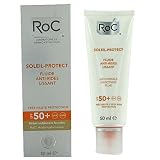


Roc Soleil-protect Anti-wrinkle Smoothing Fluid Spf 50+, Face, 50ml
Summary
This sunscreen contains several synthetic UV filters like octocrylene and butyl methoxydibenzoylmethane, which are effective but can be concerning due to potential endocrine disruption. While it includes beneficial ingredients such as hyaluronic acid, the presence of synthetic chemicals and the processed nature of the product limit its score. The ingredient list lacks natural oils and botanicals that would enhance its safety profile.
At a glance
Key ingredients 10
Aqua
Aqua, or water, is a common solvent used in cosmetic formulations. It helps dissolve other ingredients and provides a base for the product. It is generally considered safe and non-irritating.
Risks
There are no significant risks associated with water in cosmetics.
Benefits
Water helps hydrate the skin and is essential for the formulation of many cosmetic products.
Octocrylene
Octocrylene is a chemical sunscreen agent that absorbs UVB and short UVA rays. It is often used to stabilize other sunscreen ingredients. However, it can cause skin irritation in some individuals.
Risks
Potential risks include skin irritation and allergic reactions, especially in sensitive individuals.
Benefits
It provides effective UV protection and helps stabilize other sunscreen ingredients, enhancing their efficacy.
C12-15 Alkyl Benzoate
C12-15 Alkyl Benzoate is an emollient that helps improve the texture and spreadability of cosmetic products. It is commonly used in sunscreens and moisturizers. It is generally considered safe for use in cosmetics.
Risks
There are minimal risks associated with this ingredient, though it may cause mild irritation in very sensitive skin.
Benefits
It enhances the feel of the product on the skin and helps in the even distribution of sunscreen agents.
Dimethicone
Dimethicone is a type of silicone used to provide a smooth application and form a protective barrier on the skin. It is widely used in skincare products for its ability to improve texture and lock in moisture. It is generally non-irritating and safe for most skin types.
Risks
There is a potential for pore-clogging in acne-prone skin, though it is generally considered non-comedogenic.
Benefits
It helps to smooth the skin's surface and retain moisture, making it beneficial for dry skin.
Ethylhexyl Salicylate
Ethylhexyl Salicylate is a chemical sunscreen agent that absorbs UVB rays. It is often used in combination with other sunscreen agents to enhance UV protection. It is generally considered safe but can cause irritation in sensitive skin.
Risks
Potential risks include skin irritation and allergic reactions in sensitive individuals.
Benefits
It provides effective UVB protection, contributing to the overall sun protection factor of the product.
Butylene Glycol
Butylene Glycol is a common solvent and conditioning agent in cosmetics. It helps improve the texture and spreadability of products. It is generally considered safe and non-irritating.
Risks
There are minimal risks, though it can cause mild irritation in very sensitive skin.
Benefits
It helps to improve the texture of the product and enhances the penetration of other active ingredients.
Butyl Methoxydibenzoylmethane
Butyl Methoxydibenzoylmethane, also known as Avobenzone, is a chemical sunscreen agent that provides broad-spectrum UVA protection. It is commonly used in sunscreens for its effectiveness. However, it can degrade in sunlight unless stabilized by other ingredients.
Risks
Potential risks include skin irritation and degradation in sunlight, which can reduce its effectiveness.
Benefits
It provides broad-spectrum UVA protection, which is crucial for preventing long-term skin damage.
Methyl
Methyl is likely a fragment of a larger compound, possibly a preservative or stabilizer. Without more context, it is difficult to assess its specific role or impact. Generally, methyl groups are part of various compounds used in cosmetics.
Risks
Incomplete information makes it difficult to assess specific risks.
Benefits
Incomplete information makes it difficult to assess specific benefits.
Bis-Ethylhexyloxyphenol Methoxyphenyl Triazine
Bis-Ethylhexyloxyphenol Methoxyphenyl Triazine is a broad-spectrum UV filter that provides excellent UVA and UVB protection. It is photostable and often used in combination with other sunscreens. It is considered safe and effective.
Risks
There are minimal risks, though it may cause mild irritation in sensitive skin.
Benefits
It offers strong and stable UV protection, enhancing the overall efficacy of the sunscreen.
Hyaluronic Acid
Hyaluronic Acid is a powerful humectant that attracts and retains moisture in the skin. It is widely used in skincare for its hydrating properties. It is considered very safe and beneficial for all skin types.
Risks
There are no significant risks associated with hyaluronic acid.
Benefits
It provides deep hydration and helps maintain skin elasticity, making it a valuable ingredient in skincare.
Processing
Processed Foods
Get the full breakdown in the Scout app
Scan any product to see lab results, healthy alternatives, and your personalized analysis.
Download on theApp Store