
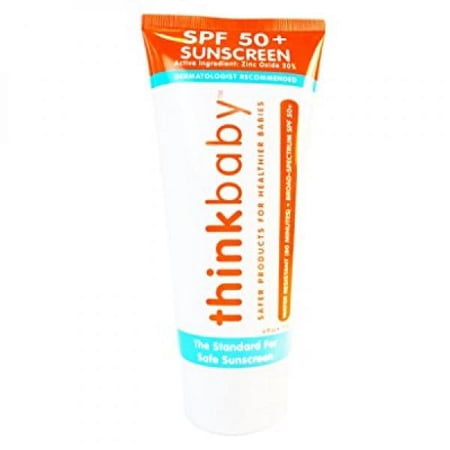


Thinkbaby Sunscreen - Safe - Baby - Spf 50 Plus - 6 Oz
Summary
Thinkbaby Sunscreen features zinc oxide as its active ingredient, which is a safer alternative to chemical UV filters. The product avoids harmful substances like oxybenzone and homosalate, which are common in many sunscreens. However, it is still a processed product with some synthetic components, which slightly lowers its overall score compared to more natural formulations.
At a glance
Key ingredients 8
Zinc Oxide
Zinc Oxide is a mineral sunscreen agent that provides broad-spectrum protection against UVA and UVB rays. It is considered safe and effective for sensitive skin, including babies. It works by sitting on top of the skin and reflecting UV radiation.
Risks
There are minimal risks associated with Zinc Oxide, primarily related to potential whitening effect on the skin.
Benefits
Zinc Oxide is beneficial for its non-irritating properties and effectiveness in sun protection.
Purified WaterNeutral
Purified Water is used as a solvent in cosmetic formulations. It helps to dissolve other ingredients and provides a base for the product. It is essential for creating the desired consistency and texture.
Risks
There are no significant risks associated with Purified Water.
Benefits
Purified Water is beneficial as it hydrates and helps in the application of the product.
Medium-Chain Triglycerides
Medium-Chain Triglycerides are used as an emollient and skin-conditioning agent. They help to improve the spreadability of the product and provide a lightweight, non-greasy feel. They are derived from coconut oil and are well-tolerated by most skin types.
Risks
There are minimal risks associated with Medium-Chain Triglycerides, primarily related to potential allergic reactions in sensitive individuals.
Benefits
They are beneficial for their moisturizing properties and ability to enhance the texture of the product.
Glycerin
Glycerin is a humectant that attracts moisture to the skin, helping to keep it hydrated. It is widely used in skincare products for its ability to improve skin barrier function. It is non-irritating and suitable for all skin types.
Risks
There are minimal risks associated with Glycerin, though it may cause irritation in very rare cases.
Benefits
Glycerin is beneficial for its excellent moisturizing properties and ability to improve skin hydration.
Sunflower Oil
Sunflower Oil is a natural oil rich in essential fatty acids and vitamin E. It is used as an emollient to help maintain the skin's natural barrier and prevent moisture loss. It is non-comedogenic and suitable for all skin types.
Risks
There are minimal risks associated with Sunflower Oil, primarily related to potential allergic reactions in sensitive individuals.
Benefits
Sunflower Oil is beneficial for its nourishing and moisturizing properties, as well as its ability to support skin health.
Jojoba Oil
Jojoba Oil is a natural oil that closely resembles the skin's natural sebum. It is used as an emollient and moisturizer, helping to balance oil production and improve skin texture. It is non-comedogenic and suitable for all skin types.
Risks
There are minimal risks associated with Jojoba Oil, primarily related to potential allergic reactions in sensitive individuals.
Benefits
Jojoba Oil is beneficial for its moisturizing properties and ability to balance skin oil levels.
Alpha-Tocopherol
Alpha-Tocopherol, also known as Vitamin E, is an antioxidant that helps protect the skin from free radical damage. It is used in skincare products for its moisturizing and anti-inflammatory properties. It supports skin health and improves the appearance of scars and fine lines.
Risks
There are minimal risks associated with Alpha-Tocopherol, though it may cause irritation in very rare cases.
Benefits
Alpha-Tocopherol is beneficial for its antioxidant properties and ability to support skin health.
Hyaluronate Sodium
Hyaluronate Sodium, a form of hyaluronic acid, is a powerful humectant that attracts and retains moisture in the skin. It is used in skincare products for its ability to hydrate and plump the skin, reducing the appearance of fine lines and wrinkles. It is suitable for all skin types and is non-irritating.
Risks
There are minimal risks associated with Hyaluronate Sodium, though it may cause irritation in very rare cases.
Benefits
Hyaluronate Sodium is beneficial for its excellent hydrating properties and ability to improve skin texture.
Processing
Processed Foods
Get the full breakdown in the Scout app
Scan any product to see lab results, healthy alternatives, and your personalized analysis.
Download on theApp Store