
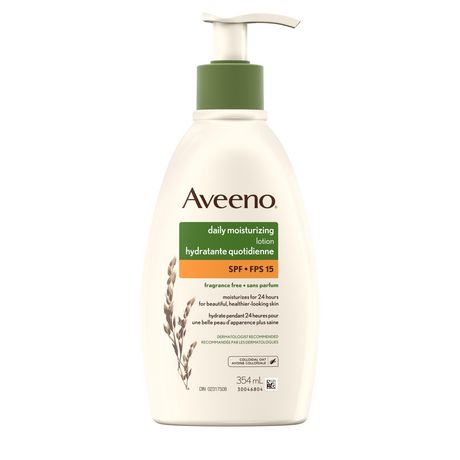

Aveeno Daily Moisturizing Body Lotion Spf 15 354Ml
Summary
This moisturizer contains beneficial ingredients like oatmeal and glycerin, which are known for their skin-soothing and moisturizing properties. However, it also includes synthetic preservatives and emulsifiers, which are common in processed skincare products. The presence of these synthetic components slightly reduces its overall safety profile compared to more natural formulations.
At a glance
Key ingredients 13
Water
Water is a universal solvent used to dissolve other ingredients in the formulation. It helps in spreading the lotion evenly on the skin. It is generally considered safe and non-irritating.
Risks
There are no significant risks associated with water in cosmetic formulations.
Benefits
Water helps to hydrate the skin and acts as a carrier for other beneficial ingredients.
Glycerin
Glycerin is a humectant that attracts moisture to the skin, helping to keep it hydrated. It is widely used in skincare products for its moisturizing properties. It is considered safe and beneficial for most skin types.
Risks
In rare cases, glycerin can cause irritation if used in very high concentrations.
Benefits
Glycerin helps to maintain skin hydration and improve skin barrier function.
Distearyldimonium Chloride
Distearyldimonium Chloride is a conditioning agent that helps to soften and smooth the skin. It is commonly used in lotions and creams for its emollient properties. It is generally considered safe for use in cosmetics.
Risks
It may cause mild irritation in sensitive individuals.
Benefits
It helps to improve the texture and feel of the skin by providing a smooth finish.
Petrolatum
Petrolatum is a moisturizing agent that forms a barrier on the skin to prevent moisture loss. It is effective in treating dry and cracked skin. However, it is a petroleum-derived product and can be occlusive.
Risks
There are concerns about potential contamination with polycyclic aromatic hydrocarbons (PAHs) if not properly refined.
Benefits
Petrolatum is highly effective in locking in moisture and protecting the skin from environmental factors.
Isopropyl Palmitate
Isopropyl Palmitate is an emollient that helps to soften and smooth the skin. It is used to enhance the texture of lotions and creams. It is generally considered safe for use in cosmetics.
Risks
It may cause acne or irritation in some individuals with sensitive skin.
Benefits
It improves the spreadability of products and provides a silky feel to the skin.
Cetyl Alcohol
Cetyl Alcohol is a fatty alcohol used as an emollient and thickening agent in skincare products. It helps to stabilize formulations and improve texture. It is considered safe and non-irritating for most skin types.
Risks
Rarely, it can cause mild irritation in very sensitive skin.
Benefits
It provides a smooth, creamy texture and helps to lock in moisture.
Dimethicone
Dimethicone is a silicone-based polymer used to provide a smooth application and protect the skin barrier. It is commonly used in skincare for its ability to create a protective layer on the skin. It is generally considered safe and non-comedogenic.
Risks
Some individuals may experience mild irritation or breakouts.
Benefits
It helps to fill in fine lines and create a smooth, even surface on the skin.
Colloidal Oatmeal
Colloidal Oatmeal is a natural ingredient known for its soothing and anti-inflammatory properties. It is often used to relieve dry, itchy, or irritated skin. It is considered safe and beneficial for sensitive skin.
Risks
There are minimal risks associated with colloidal oatmeal, though allergies are possible.
Benefits
It helps to soothe and protect the skin, reducing redness and irritation.
Benzyl Alcohol
Benzyl Alcohol is used as a preservative and solvent in cosmetic formulations. It helps to prevent microbial growth and extend the shelf life of products. It is generally recognized as safe in low concentrations.
Risks
It can cause irritation or allergic reactions in sensitive individuals.
Benefits
It acts as an effective preservative, ensuring product safety and longevity.
Sodium Chloride
Sodium Chloride, or table salt, is used as a thickening agent and to enhance the stability of emulsions. It is commonly used in small amounts in skincare products. It is considered safe for use in cosmetics.
Risks
In high concentrations, it can be drying to the skin.
Benefits
It helps to improve the texture and consistency of formulations.
Avena Sativa (Oat) Kernel Flour
Avena Sativa (Oat) Kernel Flour is known for its soothing and anti-inflammatory properties. It is used to calm irritated skin and provide relief from itching. It is considered safe and beneficial for sensitive skin.
Risks
Allergic reactions are possible but rare.
Benefits
It helps to soothe and protect the skin, making it ideal for sensitive or irritated skin.
Allantoin
Allantoin is a skin conditioning agent known for its soothing and healing properties. It is used to promote skin repair and improve skin texture. It is considered safe and beneficial for most skin types.
Risks
Allantoin is generally well-tolerated with minimal risk of irritation.
Benefits
It helps to soothe and protect the skin, promoting healing and reducing irritation.
Isopropyl Alcohol
Isopropyl Alcohol is used as a solvent and to enhance the absorption of other ingredients. It is effective in dissolving oils and improving product texture. However, it can be drying and irritating to the skin.
Risks
It can cause dryness, irritation, and disrupt the skin barrier with prolonged use.
Benefits
It helps to improve the texture and absorption of products, though benefits are limited.
Processing
Processed Foods
Get the full breakdown in the Scout app
Scan any product to see lab results, healthy alternatives, and your personalized analysis.
Download on theApp Store