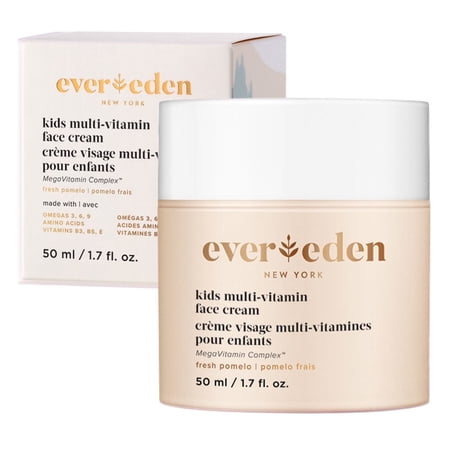
Evereden Kids Face Cream: Fresh Pomelo 1.7 oz. | Non-toxic and Natural Kids Face Lotion | Gentle Kids Face Moisturizer | Multi-Vitamin Skin Care for Kids
At a glance
Summary
This moisturizer features a clean and natural ingredient list, including beneficial components like jojoba oil, niacinamide, and squalane, which are known for their moisturizing and skin-nourishing properties. The absence of harsh chemicals, synthetic fragrances, and harmful preservatives contributes to its high rating, making it a safe and effective choice for children's skincare.
Key ingredients 47
Simmondsia Chinensis (Jojoba) Seed OilVery Good
Jojoba oil is a natural oil that closely resembles the skin's own sebum. It is highly moisturizing and helps to balance oil production. It is rich in vitamins and minerals that nourish the skin.
Risks
Rarely, it may cause allergic reactions in sensitive individuals.
Benefits
Deeply moisturizes and nourishes the skin, promoting a healthy complexion.
Helianthus Annuus (Sunflower) Seed OilVery Good
Sunflower seed oil is a natural oil rich in essential fatty acids and vitamins. It is highly moisturizing and helps to maintain the skin's barrier function. It is suitable for all skin types and is non-comedogenic.
Risks
Rarely, it may cause allergic reactions in sensitive individuals.
Benefits
Nourishes and hydrates the skin, promoting a healthy complexion.
SqualaneVery Good
Squalane is a highly effective emollient that mimics the skin's natural oils. It provides deep hydration and helps to maintain skin elasticity. It is lightweight and non-greasy, suitable for all skin types.
Benefits
Moisturizes and softens the skin, improving its texture and appearance.
PanthenolVery Good
Panthenol, also known as provitamin B5, is a humectant that attracts and retains moisture in the skin. It helps to improve skin hydration and elasticity. It is well-tolerated by most skin types and is non-irritating.
Benefits
Enhances skin hydration and promotes a healthy skin barrier.
Linoleic AcidVery Good
Linoleic Acid is an essential fatty acid that helps to maintain the skin's barrier function. It is highly moisturizing and helps to reduce inflammation. It is suitable for all skin types and is non-comedogenic.
Benefits
Nourishes and hydrates the skin, promoting a healthy complexion.
Caryodendron Orinocense Seed OilVery Good
Caryodendron Orinocense Seed Oil, also known as Cacay oil, is rich in essential fatty acids and vitamins. It is highly moisturizing and helps to improve skin elasticity. It is suitable for all skin types and is non-comedogenic.
Risks
Rarely, it may cause allergic reactions in sensitive individuals.
Benefits
Deeply nourishes and hydrates the skin, promoting a youthful appearance.
Linolenic AcidVery Good
Linolenic Acid is an essential fatty acid that helps to maintain the skin's barrier function. It is highly moisturizing and helps to reduce inflammation. It is suitable for all skin types and is non-comedogenic.
Benefits
Nourishes and hydrates the skin, promoting a healthy complexion.
GlycerinGood
Glycerin is a humectant that attracts moisture to the skin, helping to keep it hydrated. It is widely used in skincare for its moisturizing properties. It is safe and effective for all skin types.
Benefits
Helps maintain skin hydration and improves skin barrier function.
Caprylic/Capric TriglycerideGood
This ingredient is derived from coconut oil and glycerin, used as an emollient and texture enhancer. It helps to smooth and soften the skin. It is lightweight and non-greasy, making it suitable for all skin types.
Risks
Generally considered safe with minimal risk of irritation.
Benefits
Provides a silky feel and enhances the spreadability of the product.
NiacinamideGood
Niacinamide is a form of Vitamin B3 that offers multiple skin benefits, including improving skin tone and texture. It helps to reduce inflammation and enhance the skin barrier. It is well-tolerated by most skin types.
Risks
Minimal risk of irritation at high concentrations.
Benefits
Improves skin elasticity, reduces redness, and enhances overall skin health.
Tocopheryl AcetateGood
Tocopheryl Acetate is a form of Vitamin E that acts as an antioxidant in cosmetics. It helps to protect the skin from oxidative damage and improve skin health. It is well-tolerated by most skin types.
Risks
Minimal risk of irritation or allergic reactions.
Benefits
Protects the skin from environmental stressors and enhances skin health.
Lactobacillus FermentGood
Lactobacillus Ferment is a probiotic ingredient that helps to balance the skin's microbiome. It can improve skin barrier function and reduce inflammation. It is considered safe and beneficial for most skin types.
Benefits
Supports a healthy skin microbiome and enhances skin resilience.
Beta-GlucanGood
Beta-Glucan is a polysaccharide that helps to soothe and hydrate the skin. It has antioxidant properties and can improve skin barrier function. It is well-tolerated by most skin types.
Benefits
Soothes and hydrates the skin, promoting a healthy complexion.
Ceramide NPGood
Ceramide NP is a lipid that helps to restore the skin's natural barrier. It improves skin hydration and reduces transepidermal water loss. It is suitable for all skin types and is non-irritating.
Benefits
Strengthens the skin barrier and enhances moisture retention.
Sodium HyaluronateGood
Sodium Hyaluronate is a form of hyaluronic acid that attracts and retains moisture in the skin. It helps to improve skin hydration and elasticity. It is well-tolerated by most skin types and is non-irritating.
Benefits
Enhances skin hydration and promotes a plump, youthful appearance.
Sodium PCAGood
Sodium PCA is a humectant that helps to attract and retain moisture in the skin. It is a natural component of the skin's natural moisturizing factor. It is well-tolerated by most skin types and is non-irritating.
Benefits
Enhances skin hydration and promotes a healthy skin barrier.
Ascorbic AcidGood
Ascorbic Acid, also known as Vitamin C, is a powerful antioxidant that helps to protect the skin from oxidative damage. It can improve skin tone and texture and promote collagen production. It is well-tolerated by most skin types.
Risks
May cause irritation in sensitive individuals at high concentrations.
Benefits
Brightens the skin and enhances overall skin health.
TocopherolGood
Tocopherol, also known as Vitamin E, is a powerful antioxidant that helps to protect the skin from oxidative damage. It can improve skin texture and promote skin health. It is well-tolerated by most skin types.
Risks
Minimal risk of irritation or allergic reactions.
Benefits
Protects the skin from environmental stressors and enhances skin health.
GlycineGood
Beneficial ingredient — whole-food or functional value in this product class.
Benefits
Enhances skin hydration and promotes a healthy skin barrier.
Water (Aqua)Neutral
Water is a common solvent used in cosmetics to dissolve other ingredients. It helps in the application and absorption of the product. It does not have any direct benefits or risks.
Benefits
Acts as a base for the formulation, allowing other ingredients to be absorbed.
Cetearyl AlcoholNeutral
Cetearyl Alcohol is a fatty alcohol used as an emollient and thickener in cosmetics. It helps to soften and smooth the skin. It is generally considered safe and non-irritating.
Risks
Rarely, it may cause mild irritation in sensitive individuals.
Benefits
Improves the texture and feel of the product on the skin.
PropanediolNeutral
Propanediol is a glycol used as a solvent and skin-conditioning agent. It enhances the absorption of other ingredients. It is generally considered safe and non-irritating.
Risks
Low risk of irritation or sensitization.
Benefits
Improves the penetration of active ingredients into the skin.
Microcrystalline CelluloseNeutral
Microcrystalline Cellulose is used as a thickener and stabilizer in cosmetic formulations. It helps to improve the texture and consistency of the product. It is inert and does not react with other ingredients.
Benefits
Contributes to the stability and texture of the formulation.
1,2-HexanediolNeutral
1,2-Hexanediol is a synthetic preservative and moisture-binding agent. It helps to maintain the product's stability and extend its shelf life. It is considered safe for use in cosmetics.
Risks
Low risk of irritation or allergic reactions.
Benefits
Enhances product preservation and moisture retention.
Cetearyl GlucosideNeutral
Cetearyl Glucoside is an emulsifier derived from coconut oil and glucose. It helps to blend oil and water components in formulations. It is considered safe and non-irritating.
Risks
Low risk of irritation or sensitization.
Benefits
Stabilizes emulsions and improves product consistency.
MaltodextrinNeutral
Maltodextrin is a polysaccharide used as a binding and stabilizing agent in cosmetics. It helps to improve the texture and consistency of the product. It is generally considered safe for use in cosmetics.
Benefits
Enhances the stability and texture of the formulation.
HydroxyacetophenoneNeutral
Hydroxyacetophenone is an antioxidant and preservative used in cosmetics. It helps to protect the product from degradation and extend its shelf life. It is considered safe for use in cosmetics.
Risks
Low risk of irritation or allergic reactions.
Benefits
Protects the formulation from oxidative damage and enhances product stability.
Cellulose GumNeutral
Cellulose Gum is a thickening agent used to improve the texture and consistency of cosmetic products. It is derived from cellulose and is considered safe for use. It helps to stabilize emulsions and prevent separation.
Benefits
Contributes to the stability and texture of the formulation.
Glyceryl CaprylateNeutral
Glyceryl Caprylate is an emollient and co-emulsifier used in cosmetics. It helps to stabilize formulations and improve skin feel. It is derived from glycerin and caprylic acid and is considered safe.
Risks
Low risk of irritation or sensitization.
Benefits
Enhances product stability and provides a smooth skin feel.
Xanthan GumNeutral
Xanthan Gum is a natural thickening agent used to improve the texture and consistency of cosmetic products. It is derived from fermentation and is considered safe for use. It helps to stabilize emulsions and prevent separation.
Benefits
Contributes to the stability and texture of the formulation.
Sodium Dilauramidoglutamide LysineNeutral
Sodium Dilauramidoglutamide Lysine is a skin-conditioning agent used in cosmetics. It helps to improve the texture and feel of the product. It is considered safe for use in cosmetics.
Benefits
Enhances the texture and feel of the formulation.
Sodium PhytateNeutral
Sodium Phytate is a chelating agent used to stabilize cosmetic formulations. It helps to prevent the degradation of active ingredients. It is considered safe for use in cosmetics.
Benefits
Enhances product stability and extends shelf life.
Oleic AcidNeutral
Oleic Acid is a fatty acid used as an emollient and texture enhancer in cosmetics. It helps to soften and smooth the skin. It is generally considered safe for use in cosmetics.
Risks
May cause irritation in sensitive individuals when used in high concentrations.
Benefits
Improves skin texture and provides a smooth feel.
GeraniolNeutral
Geraniol is a naturally occurring fragrance compound found in essential oils. It is used to impart a pleasant scent to cosmetic products. It is considered safe for use in cosmetics.
Risks
May cause allergic reactions in sensitive individuals.
Benefits
Provides a natural fragrance to the product.
Palmitic AcidNeutral
Palmitic Acid is a fatty acid used as an emollient and texture enhancer in cosmetics. It helps to soften and smooth the skin. It is generally considered safe for use in cosmetics.
Risks
May cause irritation in sensitive individuals when used in high concentrations.
Benefits
Improves skin texture and provides a smooth feel.
Stearic AcidNeutral
Stearic Acid is a fatty acid used as an emollient and texture enhancer in cosmetics. It helps to soften and smooth the skin. It is generally considered safe for use in cosmetics.
Risks
May cause irritation in sensitive individuals when used in high concentrations.
Benefits
Improves skin texture and provides a smooth feel.
Sodium LactateNeutral
Standard formulation ingredient — neither beneficial nor harmful at typical use.
Benefits
Enhances skin hydration and promotes a healthy skin barrier.
Citric AcidNeutral
Citric Acid is an alpha hydroxy acid used to adjust the pH of cosmetic formulations. It can also act as an exfoliant to improve skin texture. It is generally considered safe for use in cosmetics.
Risks
May cause irritation in sensitive individuals at high concentrations.
Benefits
Helps to maintain the stability and pH balance of the formulation.
ArginineNeutral
Arginine is an amino acid used as a conditioning agent in cosmetics. It helps to improve skin hydration and elasticity. It is generally considered safe for use in cosmetics.
Benefits
Enhances skin hydration and promotes a healthy skin barrier.
Aspartic AcidNeutral
Aspartic Acid is an amino acid used as a conditioning agent in cosmetics. It helps to improve skin hydration and elasticity. It is generally considered safe for use in cosmetics.
Benefits
Enhances skin hydration and promotes a healthy skin barrier.
PCANeutral
PCA is a humectant that helps to attract and retain moisture in the skin. It is a natural component of the skin's natural moisturizing factor. It is well-tolerated by most skin types and is non-irritating.
Benefits
Enhances skin hydration and promotes a healthy skin barrier.
AlanineNeutral
Alanine is an amino acid used as a conditioning agent in cosmetics. It helps to improve skin hydration and elasticity. It is generally considered safe for use in cosmetics.
Benefits
Enhances skin hydration and promotes a healthy skin barrier.
SerineNeutral
Serine is an amino acid used as a conditioning agent in cosmetics. It helps to improve skin hydration and elasticity. It is generally considered safe for use in cosmetics.
Benefits
Enhances skin hydration and promotes a healthy skin barrier.
ValineNeutral
Valine is an amino acid used as a conditioning agent in cosmetics. It helps to improve skin hydration and elasticity. It is generally considered safe for use in cosmetics.
Benefits
Enhances skin hydration and promotes a healthy skin barrier.
IsoleucineNeutral
Isoleucine is an amino acid used as a conditioning agent in cosmetics. It helps to improve skin hydration and elasticity. It is generally considered safe for use in cosmetics.
Benefits
Enhances skin hydration and promotes a healthy skin barrier.
ProlineNeutral
Proline is an amino acid used as a conditioning agent in cosmetics. It helps to improve skin hydration and elasticity. It is generally considered safe for use in cosmetics.
Benefits
Enhances skin hydration and promotes a healthy skin barrier.
DimethiconeBad
Occlusive silicone film-former — flagged under clean-beauty doctrine.
Risks
May cause build-up on the skin with prolonged use.
Benefits
Provides a smooth, silky feel and helps to lock in moisture.
Get the full breakdown in the Scout appTake Scout shopping
Scan any product to see lab results, healthy alternatives, and your personalized analysis.
Are you Evereden? Fix an error Get the badge Get tested
Amazon pricing & content
Amazon price as of . Product prices and availability are accurate as of the date/time indicated and are subject to change. Any price and availability information displayed on Amazon.com at the time of purchase will apply to the purchase of this product.
CERTAIN CONTENT THAT APPEARS ON THIS SITE COMES FROM AMAZON. THIS CONTENT IS PROVIDED “AS IS” AND IS SUBJECT TO CHANGE OR REMOVAL AT ANY TIME.