
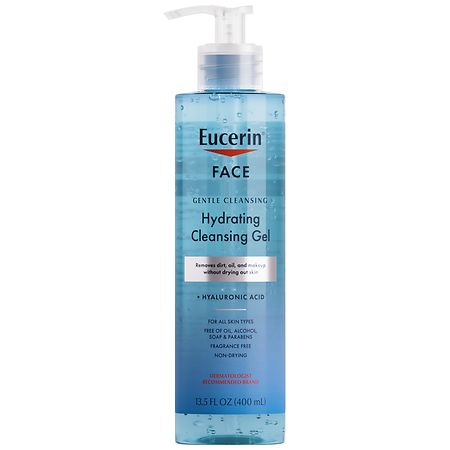

Eucerin Gentle Hydrating Face Cleansing Gel - 13.5 fl oz
Summary
This face cleansing gel contains some safe and effective ingredients like glycerin and panthenol, which are beneficial for skin hydration. However, it also includes synthetic preservatives and surfactants that can be irritating to sensitive skin. The presence of these processed ingredients lowers its overall safety profile, despite the inclusion of some skin-friendly components.
At a glance
Key ingredients 10
Water
Water is a universal solvent used as a base in many cosmetic formulations. It helps dissolve other ingredients and provides hydration. It is essential for the consistency and application of the product.
Risks
There are no significant risks associated with water in cosmetics.
Benefits
Water hydrates the skin and helps in the even distribution of other ingredients.
Glycerin
Glycerin is a humectant that attracts moisture to the skin, helping to keep it hydrated. It is commonly used in skincare products for its moisturizing properties. It also helps to improve the skin barrier function.
Risks
Glycerin is generally safe, but in very high concentrations, it can cause irritation.
Benefits
Glycerin helps maintain skin hydration and improves skin texture.
Coco-Betaine
Coco-Betaine is a mild surfactant derived from coconut oil, used to cleanse the skin without stripping natural oils. It is often used in gentle formulations for sensitive skin. It helps to create a lather and improve the texture of the product.
Risks
Coco-Betaine can cause mild irritation in some individuals with very sensitive skin.
Benefits
It provides gentle cleansing and is less irritating than harsher surfactants.
Coco-Glucoside
Coco-Glucoside is a non-ionic surfactant derived from coconut oil and glucose. It is used for its mild cleansing properties and ability to stabilize foams. It is suitable for sensitive skin formulations.
Risks
Generally considered safe, but may cause mild irritation in rare cases.
Benefits
Coco-Glucoside is gentle on the skin and helps maintain moisture balance.
Glyceryl Glucoside
Glyceryl Glucoside is a compound that combines glycerin and glucose, known for its moisturizing properties. It helps to enhance skin hydration and improve skin barrier function. It is often used in formulations aimed at dry or sensitive skin.
Risks
There are minimal risks associated with Glyceryl Glucoside.
Benefits
It provides long-lasting hydration and supports skin health.
Acrylates/C10-30 Alkyl Acrylate Crosspolymer
This ingredient is used as a thickening agent and stabilizer in cosmetic formulations. It helps to create a smooth, gel-like texture and improve product spreadability. It is commonly used in a wide range of skincare products.
Risks
May cause mild irritation if used in high concentrations.
Benefits
It enhances the texture and stability of the product.
Sodium Hyaluronate
Sodium Hyaluronate is a form of hyaluronic acid that is easily absorbed by the skin. It is known for its excellent moisture-retaining properties, helping to keep the skin hydrated and plump. It is a popular ingredient in anti-aging and hydrating skincare products.
Risks
Generally safe, but may cause irritation in very sensitive skin.
Benefits
It provides deep hydration and reduces the appearance of fine lines.
Trisodium EDTA
Trisodium EDTA is a chelating agent used to improve the stability and shelf life of cosmetic products. It binds to metal ions, preventing them from affecting the product's performance. It is commonly used in formulations to enhance product safety and efficacy.
Risks
May cause mild irritation in sensitive individuals.
Benefits
It helps maintain product integrity and prevents degradation.
Sodium Chloride
Sodium Chloride, or table salt, is used as a thickening agent in cosmetic formulations. It helps to adjust the viscosity of products and improve their texture. It is a common ingredient in many skincare and haircare products.
Risks
In high concentrations, it can be drying to the skin.
Benefits
It helps to improve product consistency and application.
Sodium Benzoate
Sodium Benzoate is a preservative used to prevent microbial growth in cosmetic products. It helps to extend the shelf life and ensure the safety of the product. It is widely used in both food and cosmetic industries.
Risks
May cause irritation in sensitive skin when used in high concentrations.
Benefits
It effectively preserves the product and prevents spoilage.
Processing
Processed Foods
Get the full breakdown in the Scout app
Scan any product to see lab results, healthy alternatives, and your personalized analysis.
Download on theApp Store