
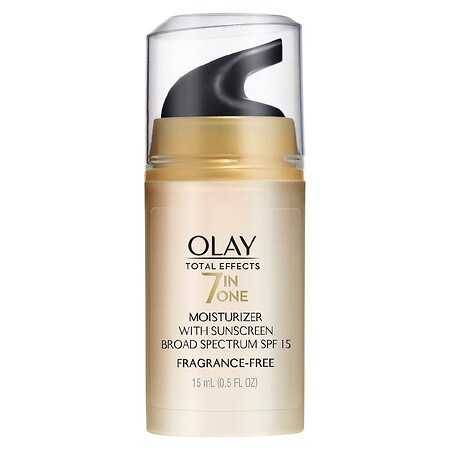
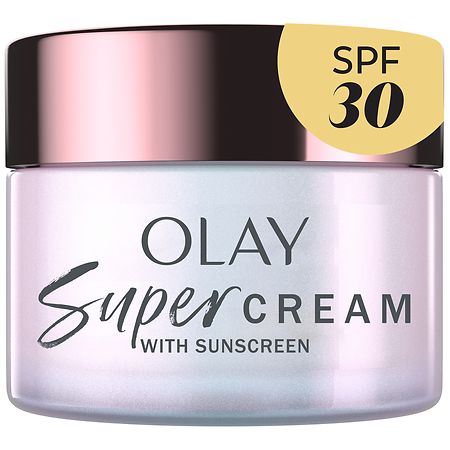
Olay Total Effects 7 In One Face Moisturizer SPF 15, Fragrance-Free, 0.5 fl oz
Summary
This moisturizer contains beneficial skin actives such as niacinamide and Vitamin C, which are known for their positive effects on skin health. However, it also includes synthetic emulsifiers and preservatives, which are common in processed skincare products. The absence of fragrance is a positive aspect, reducing the risk of irritation for sensitive skin.
At a glance
Key ingredients 13
Aqua
Aqua, or water, is a common solvent used in cosmetics to dissolve other ingredients. It helps in the application and absorption of the product. It is generally considered safe and non-irritating.
Risks
There are no significant risks associated with water in cosmetics.
Benefits
Water helps to hydrate the skin and improve the texture of the product.
Glycerin
Glycerin is a humectant that attracts moisture to the skin, helping to keep it hydrated. It is widely used in skincare products for its moisturizing properties. It is considered safe and beneficial for most skin types.
Risks
Glycerin is generally safe, but in rare cases, it may cause irritation if used in high concentrations.
Benefits
It helps to maintain skin hydration and improve skin barrier function.
Niacinamide
Niacinamide is a form of Vitamin B3 that is known for its anti-inflammatory and skin-soothing properties. It helps to improve skin texture and reduce the appearance of pores. It is well-tolerated by most skin types and is considered a beneficial ingredient.
Risks
Niacinamide is generally safe, but it may cause mild irritation in sensitive individuals.
Benefits
It can improve skin elasticity, enhance barrier function, and even out skin tone.
Isohexadecane
Isohexadecane is a lightweight emollient that provides a silky feel to the skin. It is used to enhance the texture and spreadability of cosmetic products. It is considered safe for use in cosmetics.
Risks
There are minimal risks associated with isohexadecane, though it may cause mild irritation in sensitive skin.
Benefits
It helps to improve the texture of the product and provides a non-greasy finish.
Dimethicone
Dimethicone is a silicone-based polymer used to provide a smooth application and protect the skin barrier. It helps to lock in moisture and improve the feel of the product. It is generally considered safe and non-comedogenic.
Risks
Dimethicone can potentially cause breakouts in acne-prone skin due to its occlusive nature.
Benefits
It provides a silky texture and helps to prevent moisture loss from the skin.
Isopropyl Isostearate
Isopropyl Isostearate is an emollient that helps to soften and smooth the skin. It is used to improve the texture and spreadability of skincare products. It is generally considered safe for use in cosmetics.
Risks
It may cause mild irritation or breakouts in sensitive or acne-prone skin.
Benefits
It enhances the skin's smoothness and provides a lightweight feel.
Stearyl Alcohol
Stearyl Alcohol is a fatty alcohol used as an emollient and thickener in cosmetics. It helps to stabilize formulations and improve texture. It is considered safe and non-irritating for most skin types.
Risks
Stearyl Alcohol is generally safe, but it may cause mild irritation in sensitive individuals.
Benefits
It provides moisturizing properties and helps to improve the consistency of the product.
Panthenol
Panthenol, also known as pro-vitamin B5, is a humectant that attracts moisture to the skin. It is known for its soothing and moisturizing properties. It is considered safe and beneficial for most skin types.
Risks
Panthenol is generally safe, but in rare cases, it may cause mild irritation.
Benefits
It helps to improve skin hydration and reduce inflammation.
Tocopheryl Acetate
Tocopheryl Acetate is a form of Vitamin E that acts as an antioxidant. It helps to protect the skin from environmental damage and improve skin health. It is generally considered safe and beneficial for the skin.
Risks
In rare cases, it may cause skin irritation or allergic reactions.
Benefits
It provides antioxidant protection and helps to maintain skin health.
Avobenzone
Avobenzone is a chemical sunscreen agent that provides broad-spectrum UVA protection. It is commonly used in sunscreens to prevent skin damage from UV exposure. However, it can degrade in sunlight, reducing its effectiveness.
Risks
Avobenzone may cause skin irritation and is known to degrade in sunlight, potentially reducing its efficacy.
Benefits
It offers protection against UVA rays, which are responsible for skin aging and damage.
Homosalate
Homosalate is a chemical sunscreen agent that absorbs UVB rays, protecting the skin from sunburn. It is commonly used in combination with other sunscreen agents. However, it is considered a potential endocrine disruptor.
Risks
Homosalate may act as an endocrine disruptor and can cause skin irritation.
Benefits
It helps to protect the skin from UVB-induced sunburn.
Octisalate
Octisalate is a chemical sunscreen agent that stabilizes other sunscreen ingredients and provides UVB protection. It is often used to enhance the water resistance of sunscreen formulations. It is generally considered safe but may cause irritation in sensitive skin.
Risks
Octisalate may cause skin irritation, especially in sensitive individuals.
Benefits
It helps to stabilize sunscreen formulations and provides UVB protection.
Octocrylene
Octocrylene is a chemical sunscreen agent that absorbs UVB and short UVA rays. It is used to stabilize other sunscreen ingredients and improve water resistance. However, it may cause skin irritation and is a potential allergen.
Risks
Octocrylene may cause skin irritation and allergic reactions in sensitive individuals.
Benefits
It provides UV protection and helps to stabilize sunscreen formulations.
Processing
Processed Foods
Get the full breakdown in the Scout app
Scan any product to see lab results, healthy alternatives, and your personalized analysis.
Download on theApp Store