
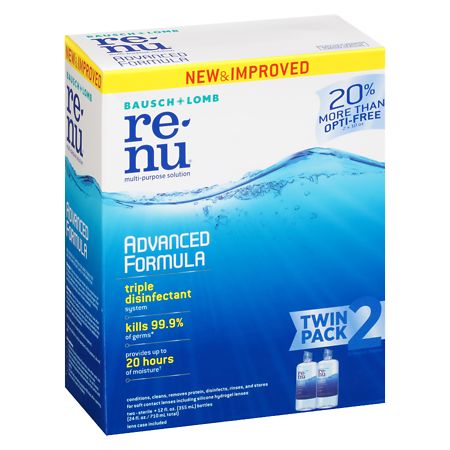
Soft Contact Lens Disinfecting Solution, Two 12 FL OZ Bottles, 1 Lens Case
Summary
This contact lens disinfecting solution likely contains preservatives and surfactants necessary for its function, which can be considered safe but are not natural. The product's processing level involves chemical formulations typical for disinfecting solutions, which may include synthetic ingredients. While these ingredients are effective for disinfection, they do not align with the criteria for minimal processing or natural ingredient use.
At a glance
Key ingredients 8
poloxamineNeutral
Poloxamine is a surfactant used to enhance the cleaning efficacy of solutions. It helps in removing debris and proteins from contact lenses. It is generally considered safe for use in eye care products.
Risks
There are minimal risks associated with poloxamine when used as directed.
Benefits
It effectively aids in cleaning and maintaining the hygiene of contact lenses.
poloxamer 181Neutral
Poloxamer 181 is a nonionic surfactant used for its emulsifying and solubilizing properties. It helps in the removal of lipids and proteins from contact lenses. It is widely used in ophthalmic solutions due to its safety profile.
Risks
Poloxamer 181 is generally safe, but overuse may cause mild irritation.
Benefits
It enhances the cleaning efficiency of lens solutions without causing irritation.
diglycineNeutral
Diglycine is an amino acid derivative used as a buffering agent in solutions. It helps maintain the pH balance of the solution, ensuring comfort during lens wear. It is considered safe for use in contact lens solutions.
Risks
There are no significant risks associated with diglycine in the concentrations used.
Benefits
It contributes to the stability and comfort of the lens solution.
sodium citrateNeutral
Sodium citrate acts as a buffering agent and helps maintain the pH of the solution. It also has chelating properties that can bind metal ions, enhancing the stability of the solution. It is safe for use in contact lens solutions.
Risks
Sodium citrate is generally safe, with minimal risk of irritation.
Benefits
It helps stabilize the solution and maintain comfort during lens wear.
boric acidNeutral
Boric acid is used as an antimicrobial agent and pH adjuster in contact lens solutions. It helps prevent microbial contamination and maintains the solution's acidity. It is safe in the concentrations used for eye care products.
Risks
Excessive exposure to boric acid can cause irritation, but it is safe in regulated amounts.
Benefits
It provides antimicrobial protection and pH balance to the solution.
sodium borateNeutral
Sodium borate is used as a buffering agent and preservative in contact lens solutions. It helps maintain the pH and stability of the solution. It is considered safe for use in eye care products.
Risks
Sodium borate can cause irritation if used in high concentrations, but it is safe in regulated amounts.
Benefits
It stabilizes the solution and helps preserve its efficacy.
edetate disodiumNeutral
Edetate disodium is a chelating agent that binds metal ions, preventing them from interfering with the solution's stability. It is used to enhance the preservative efficacy of the solution. It is safe for use in contact lens solutions.
Risks
There are minimal risks associated with edetate disodium when used as directed.
Benefits
It helps maintain the stability and effectiveness of the solution.
sodium chlorideNeutral
Sodium chloride is used to adjust the tonicity of the solution, making it isotonic with natural tears. It ensures that the solution is comfortable for the eyes. It is safe and commonly used in ophthalmic solutions.
Risks
Sodium chloride is generally safe, with no significant risks at the concentrations used.
Benefits
It ensures the solution is comfortable and compatible with the eye's natural environment.
Processing
Processed Foods
Get the full breakdown in the Scout app
Scan any product to see lab results, healthy alternatives, and your personalized analysis.
Download on theApp Store