
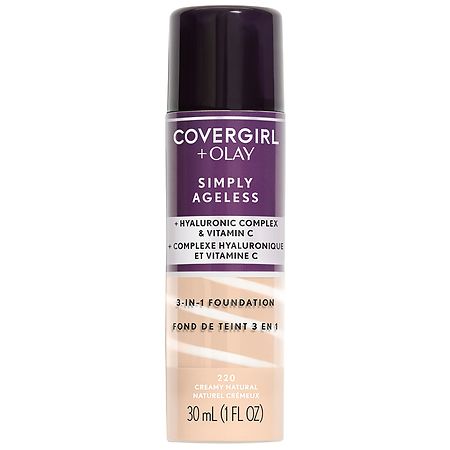

COVERGIRL + Olay Simply Ageless 3-in-1 Liquid Foundation with Hyaluronic Complex + Vitamin C - 220 Creamy - 1 fl oz
Summary
This foundation contains beneficial ingredients like hyaluronic acid and Vitamin C, which are known for their skin-enhancing properties. However, the presence of synthetic fragrance and other synthetic chemicals lowers its safety profile. The product is moderately processed, which affects its overall rating, despite the inclusion of some skin-friendly components.
At a glance
Key ingredients 13
Cyclopentasiloxane
Cyclopentasiloxane is a silicone-based compound used to provide a smooth application and silky feel. It helps to temporarily fill in fine lines and wrinkles, creating a more even skin texture. It evaporates quickly, leaving no residue.
Risks
There are concerns about its potential to bioaccumulate in the environment.
Benefits
It enhances the spreadability of the product and provides a lightweight feel.
Glycerin
Glycerin is a humectant that attracts moisture to the skin, helping to keep it hydrated. It is commonly used in skincare products for its moisturizing properties. It is derived from natural sources and is generally considered safe.
Risks
There are minimal risks associated with glycerin, though it can cause irritation in very sensitive skin.
Benefits
It helps maintain skin hydration and improves skin barrier function.
Dimethicone Crosspolymer
Dimethicone Crosspolymer is a silicone derivative used to improve the texture and feel of cosmetic products. It provides a smooth, silky finish and helps to fill in fine lines. It is non-comedogenic and widely used in skincare.
Risks
There are minimal risks, but it can cause build-up on the skin if not properly cleansed.
Benefits
It enhances the product's texture and provides a matte finish.
Niacinamide
Niacinamide is a form of Vitamin B3 that is known for its anti-inflammatory and brightening properties. It helps to improve skin elasticity, enhance the skin barrier, and even out skin tone. It is well-tolerated by most skin types.
Risks
There are minimal risks, though it can cause mild irritation in very sensitive skin.
Benefits
It improves skin texture, reduces redness, and enhances overall skin health.
Ethylhexyl Methoxycinnamate
Ethylhexyl Methoxycinnamate is a chemical sunscreen agent that absorbs UVB radiation. It helps to protect the skin from sun damage and is commonly used in sun protection products. It is effective in preventing sunburn.
Risks
There are concerns about its potential to disrupt hormones and cause skin irritation.
Benefits
It provides effective UVB protection, reducing the risk of sunburn.
Talc
Talc is a mineral used in cosmetics for its absorbent properties and ability to improve product texture. It helps to control shine and provides a smooth application. However, its safety has been questioned due to potential contamination with asbestos.
Risks
There are significant concerns about contamination with asbestos, which is a known carcinogen.
Benefits
It provides a smooth, matte finish and helps control oil.
Panthenol
Panthenol is a provitamin of B5 that is used for its moisturizing and soothing properties. It helps to improve skin hydration and reduce inflammation. It is commonly used in skincare for its ability to enhance skin barrier function.
Risks
There are minimal risks, though it can cause irritation in very sensitive skin.
Benefits
It enhances skin hydration and soothes irritated skin.
Palmitoyl Pentapeptide-4
Palmitoyl Pentapeptide-4 is a peptide used in anti-aging products for its ability to stimulate collagen production. It helps to reduce the appearance of fine lines and wrinkles. It is considered a gentle and effective anti-aging ingredient.
Risks
There are minimal risks associated with its use.
Benefits
It promotes collagen production and reduces signs of aging.
Tocopheryl Acetate
Tocopheryl Acetate is a form of Vitamin E that acts as an antioxidant, protecting the skin from free radical damage. It helps to moisturize and soothe the skin. It is widely used in skincare for its protective properties.
Risks
There are minimal risks, though it can cause irritation in very sensitive skin.
Benefits
It provides antioxidant protection and enhances skin moisture.
Fragrance/Parfum
Fragrance/Parfum is used to impart a pleasant scent to cosmetic products. It is a mixture of various aromatic compounds. However, it is a common cause of allergic reactions and skin irritation.
Risks
There are significant concerns about skin irritation and allergic reactions.
Benefits
It enhances the sensory experience of the product.
Methylparaben
Methylparaben is a preservative used to prevent microbial growth in cosmetics. It is effective in extending the shelf life of products. However, there are concerns about its potential endocrine-disrupting effects.
Risks
There are concerns about its potential to disrupt hormones and cause allergic reactions.
Benefits
It effectively prevents microbial growth, extending product shelf life.
Ethylparaben
Ethylparaben is a preservative used to prevent the growth of bacteria and mold in cosmetics. It is effective in maintaining product integrity. However, it is associated with potential endocrine-disrupting effects.
Risks
There are concerns about its potential to disrupt hormones and cause allergic reactions.
Benefits
It helps maintain product safety by preventing microbial contamination.
Propylparaben
Propylparaben is a preservative used to inhibit microbial growth in cosmetic products. It is effective in extending the shelf life of products. However, it is associated with potential endocrine-disrupting effects.
Risks
There are concerns about its potential to disrupt hormones and cause allergic reactions.
Benefits
It effectively prevents microbial growth, ensuring product safety.
Processing
Processed Foods
Get the full breakdown in the Scout app
Scan any product to see lab results, healthy alternatives, and your personalized analysis.
Download on theApp Store