
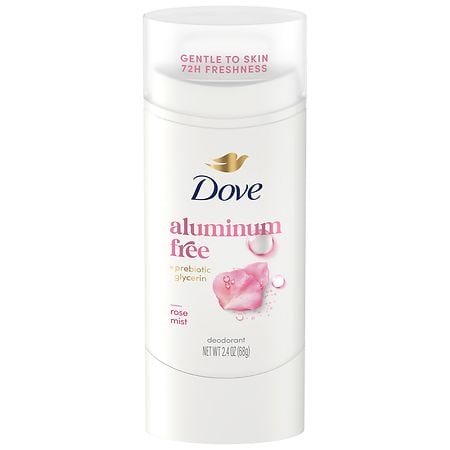
Dove Deodorant Stick for 72 Hour Odor Protection Rose Mist Aluminum Free 2.4 oz
Summary
This deodorant is aluminum-free, which is a significant positive factor for ingredient safety. However, it contains some synthetic chemicals that slightly lower its overall rating. The product is processed, but it maintains a relatively clean label with no major harmful additives, making it a mostly healthy choice in its category.
At a glance
Key ingredients 9
Dipropylene Glycol
Dipropylene Glycol is a synthetic compound used as a solvent and skin conditioning agent. It helps to evenly distribute other ingredients in the formula. It is generally considered safe for use in cosmetics.
Risks
There is a potential for skin irritation in sensitive individuals.
Benefits
It helps in maintaining the stability and consistency of the product.
Water (aqua)
Water is used as a solvent in many cosmetic products. It helps to dissolve other ingredients and provides a base for the formulation. It is essential for the product's texture and application.
Risks
There are no significant risks associated with water in cosmetic formulations.
Benefits
Water is hydrating and helps in the application of the product.
Helianthus Annuus (Sunflower) Seed Oil
Sunflower Seed Oil is a natural oil used for its emollient properties. It helps to moisturize and nourish the skin. It is rich in vitamins and fatty acids.
Risks
There is a low risk of allergic reactions in individuals with sunflower seed allergies.
Benefits
It provides skin conditioning and antioxidant benefits.
Cyclopentasiloxane
Cyclopentasiloxane is a silicone-based compound used to give a smooth application. It helps to spread the product evenly on the skin. It evaporates quickly, leaving a silky feel.
Risks
There are concerns about bioaccumulation in the environment.
Benefits
It provides a lightweight, non-greasy feel to the product.
BHT
BHT is a synthetic antioxidant used to preserve the product. It prevents the oxidation of other ingredients, extending the product's shelf life. It is commonly used in small concentrations.
Risks
There are concerns about potential endocrine disruption and skin irritation.
Benefits
It helps maintain the stability and effectiveness of the product.
PEG-8
PEG-8 is a polyethylene glycol compound used as a solvent and humectant. It helps to retain moisture in the skin. It also aids in the solubility of other ingredients.
Risks
There is a potential for contamination with harmful impurities like ethylene oxide and 1,4-dioxane.
Benefits
It provides moisturizing benefits and improves product texture.
Fragrance (Parfum)
Fragrance is used to impart a pleasant scent to the product. It is a mixture of various aromatic compounds. The exact composition is often proprietary.
Risks
Fragrance can cause skin irritation and allergic reactions in sensitive individuals.
Benefits
It enhances the sensory experience of using the product.
Steareth-100
Steareth-100 is an emulsifier used to stabilize formulations. It helps to blend oil and water-based ingredients. It is derived from stearic acid and ethylene oxide.
Risks
There is a potential for contamination with ethylene oxide and 1,4-dioxane.
Benefits
It improves the texture and consistency of the product.
Alpha-Isomethyl Ionone
Alpha-Isomethyl Ionone is a fragrance ingredient used for its floral scent. It is commonly used in perfumes and personal care products. It is a synthetic compound.
Risks
It can cause allergic reactions and skin sensitization in some individuals.
Benefits
It provides a pleasant floral aroma to the product.
Processing
Processed Foods
Get the full breakdown in the Scout app
Scan any product to see lab results, healthy alternatives, and your personalized analysis.
Download on theApp Store