
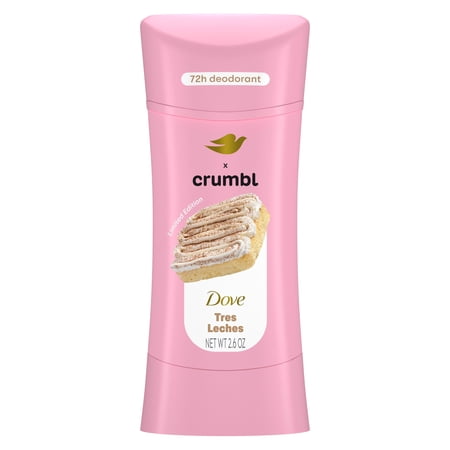
Dove & Crumbl Limited Edition Deodorant Crumbl Tres Leches For Odor Protection 2.6 oz
Summary
This deodorant contains propylene glycol and synthetic fragrance, both of which are criticized for potential skin irritation and undisclosed chemical content. While it lacks aluminum, which is a positive aspect, the presence of these synthetic ingredients prevents it from being considered a clean, natural product. The product's formulation is more processed compared to top-tier natural deodorants, which focus on organic and naturally derived ingredients.
At a glance
Key ingredients 10
Dipropylene GlycolNeutral
Dipropylene Glycol is a solvent and viscosity-decreasing agent commonly used in cosmetics. It is generally considered safe for use in personal care products. However, it is a petroleum-derived compound.
Risks
There is a potential for skin irritation in sensitive individuals.
Benefits
It helps to evenly distribute other ingredients in the formulation.
Water (Aqua)Neutral
Water is used as a solvent in many cosmetic products. It helps to dissolve other ingredients and provides a base for the formulation. It is essential for the consistency of the product.
Risks
There are no significant risks associated with water in cosmetic formulations.
Benefits
Water hydrates the skin and helps in the application of the product.
GlycerinNeutral
Glycerin is a humectant that attracts moisture to the skin. It is widely used in skincare products for its moisturizing properties. It is generally considered safe and non-irritating.
Risks
There are minimal risks associated with glycerin, though it can cause irritation in very rare cases.
Benefits
Glycerin helps to keep the skin hydrated and soft.
Propylene GlycolBad
Propylene Glycol is a petroleum-derived compound used as a humectant and solvent. It is known to cause skin irritation in some individuals. Despite its effectiveness in retaining moisture, it is often criticized for its synthetic origin.
Risks
It can cause skin irritation and allergic reactions, especially in sensitive skin.
Benefits
It helps to maintain moisture levels in the skin.
Sodium StearateNeutral
Sodium Stearate is a salt of stearic acid used as a surfactant and emulsifying agent. It helps to stabilize the formulation and improve texture. It is generally considered safe for use in cosmetics.
Risks
There are minimal risks associated with sodium stearate.
Benefits
It contributes to the product's consistency and stability.
Poloxamine 1307Neutral
Poloxamine 1307 is a surfactant and emulsifier used to stabilize formulations. It helps to mix oil and water-based ingredients. It is generally regarded as safe for use in cosmetics.
Risks
There are no significant risks associated with this ingredient.
Benefits
It aids in the even distribution of ingredients in the product.
Fragrance (Parfum)Bad
Fragrance is a mixture of various scent chemicals and ingredients. It is often criticized for containing phthalates and other potentially harmful chemicals. The exact composition is usually undisclosed, leading to concerns about safety.
Risks
Fragrance can cause skin irritation and allergic reactions, and may contain endocrine disruptors.
Benefits
It provides a pleasant scent to the product.
Stearic AcidNeutral
Stearic Acid is a fatty acid used as an emulsifier and thickener in cosmetics. It helps to stabilize and thicken formulations. It is generally considered safe and non-irritating.
Risks
There are minimal risks associated with stearic acid.
Benefits
It contributes to the product's texture and stability.
Disodium EDTANeutral
Disodium EDTA is a chelating agent that binds metal ions, improving product stability. It is commonly used in cosmetics to enhance the efficacy of preservatives. It is generally considered safe in low concentrations.
Risks
There are concerns about its environmental impact and potential skin irritation.
Benefits
It helps to maintain the product's integrity by preventing metal ion contamination.
SimethiconeNeutral
Simethicone is an anti-foaming agent used to reduce surface tension and prevent foaming. It is widely used in both pharmaceuticals and cosmetics. It is considered safe and non-irritating.
Risks
There are no significant risks associated with simethicone.
Benefits
It helps to improve the texture and application of the product.
Get the full breakdown in the Scout app
Scan any product to see lab results, healthy alternatives, and your personalized analysis.
Download on theApp Store