
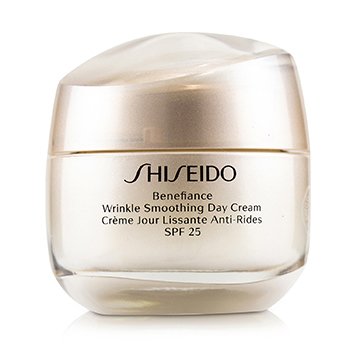


Shiseido Benefiance Wrinkle Smoothing Day Cream SPF 25 1.8oz
Summary
This moisturizer contains beneficial skin actives such as hyaluronic acid and peptides, which are known for their hydrating and anti-aging properties. However, the presence of synthetic fragrance and some preservatives slightly lowers its rating due to potential skin irritation and sensitivity concerns. The product is moderately processed, which also impacts its overall score.
At a glance
Key ingredients 13
Water
Water is a universal solvent used to dissolve other ingredients. It helps in the distribution of the product on the skin. It is generally considered safe and non-irritating.
Risks
There are no significant risks associated with water in cosmetics.
Benefits
Water hydrates the skin and helps in the absorption of other beneficial ingredients.
Cetyl Ethylhexanoate
Cetyl Ethylhexanoate is an emollient that helps to soften and smooth the skin. It is used to improve the texture and spreadability of the product. It is generally considered safe for use in cosmetics.
Risks
There are minimal risks, though it may cause mild irritation in sensitive individuals.
Benefits
It provides a silky feel and helps to lock in moisture, enhancing skin softness.
Glycerin
Glycerin is a humectant that attracts moisture to the skin. It is widely used in skincare for its hydrating properties. It is considered safe and beneficial for most skin types.
Risks
There are minimal risks, though excessive use may lead to a sticky feel.
Benefits
Glycerin helps maintain skin hydration and improves skin barrier function.
Dipropylene Glycol
Dipropylene Glycol is a solvent and viscosity-decreasing agent. It helps to improve the texture and stability of the product. It is generally considered safe for use in cosmetics.
Risks
There are minimal risks, though it may cause irritation in very sensitive skin.
Benefits
It enhances the absorption of other ingredients and provides a smooth application.
Xylitol
Xylitol is a sugar alcohol used as a humectant and skin conditioning agent. It helps to retain moisture in the skin. It is generally considered safe and non-irritating.
Risks
There are minimal risks, though it may cause irritation if used in high concentrations.
Benefits
Xylitol helps to improve skin hydration and can enhance the skin's natural barrier.
Silica
Silica is used as an absorbent and anti-caking agent. It helps to control the viscosity and improve the texture of the product. It is generally considered safe for use in cosmetics.
Risks
Inhalation of silica particles can be harmful, but this is not a concern in topical applications.
Benefits
Silica provides a matte finish and helps to absorb excess oil on the skin.
Dimethicone
Dimethicone is a silicone-based polymer used as an emollient and skin protectant. It forms a barrier on the skin to prevent moisture loss. It is generally considered safe and non-irritating.
Risks
There are minimal risks, though it may cause breakouts in acne-prone skin.
Benefits
Dimethicone provides a smooth application and helps to protect the skin from environmental damage.
Dextrin Palmitate
Dextrin Palmitate is an ester used as an emollient and thickening agent. It helps to improve the texture and stability of the product. It is generally considered safe for use in cosmetics.
Risks
There are minimal risks, though it may cause irritation in sensitive individuals.
Benefits
It enhances the spreadability of the product and provides a smooth feel on the skin.
Behenyl Alcohol
Behenyl Alcohol is a fatty alcohol used as an emollient and thickener. It helps to stabilize emulsions and improve the texture of the product. It is generally considered safe and non-irritating.
Risks
There are minimal risks, though it may cause irritation in very sensitive skin.
Benefits
Behenyl Alcohol provides a creamy texture and helps to soften the skin.
Glyceryl Stearate SE
Glyceryl Stearate SE is an emulsifier that helps to blend oil and water components. It improves the texture and stability of the product. It is generally considered safe for use in cosmetics.
Risks
There are minimal risks, though it may cause irritation in sensitive individuals.
Benefits
It enhances the spreadability of the product and provides a smooth application.
Ethylhexyl Methoxycinnamate
Ethylhexyl Methoxycinnamate is a UV filter used to protect the skin from sun damage. It absorbs UVB radiation and helps to prevent sunburn. It is generally considered safe, but there are concerns about its environmental impact.
Risks
It may cause skin irritation and has been linked to hormonal disruption in some studies.
Benefits
It provides effective sun protection, reducing the risk of sunburn and skin cancer.
Caprylic/Capric Triglyceride
Caprylic/Capric Triglyceride is an emollient derived from coconut oil and glycerin. It helps to moisturize and condition the skin. It is generally considered safe and non-irritating.
Risks
There are minimal risks, though it may cause irritation in very sensitive skin.
Benefits
It provides a lightweight, non-greasy feel and helps to improve skin hydration.
Butylene Glycol
Butylene Glycol is a solvent and humectant used to improve the texture and moisture content of the skin. It helps to enhance the absorption of other ingredients. It is generally considered safe for use in cosmetics.
Risks
There are minimal risks, though it may cause irritation in sensitive skin.
Benefits
Butylene Glycol helps to maintain skin hydration and provides a smooth application.
Processing
Processed Foods
Get the full breakdown in the Scout app
Scan any product to see lab results, healthy alternatives, and your personalized analysis.
Download on theApp Store