
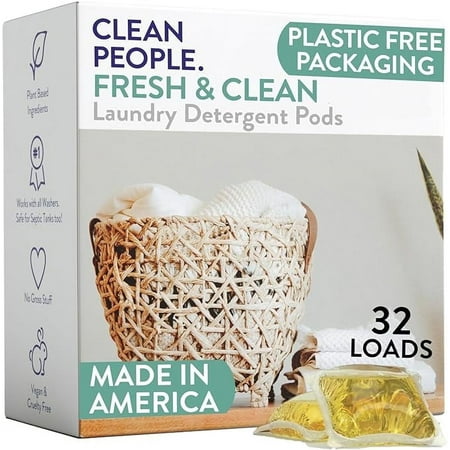

Clean People Laundry Detergent Pods - Clean Ingredients Ultra-Concentrated - Fresh Scent 32 Pack
Summary
This laundry detergent features plant-derived surfactants like alkyl polyglucoside and lauryl glucoside, which are mild and biodegradable, making it eco-friendly. The inclusion of enzymes such as protease and amylase enhances cleaning efficiency without harsh chemicals. However, the presence of synthetic fragrance slightly detracts from its overall environmental and health profile, preventing it from achieving a top-tier score.
At a glance
Key ingredients 15
Alcohol EthoxylateNeutral
Alcohol ethoxylates are nonionic surfactants used for their cleaning properties. They are effective in removing oily soils and stains. However, they can be irritating to the skin in high concentrations.
Risks
Potential skin irritation if used in high concentrations.
Benefits
Effective in removing oily soils and stains.
Alkyl PolyglucosideGood
Alkyl polyglucosides are plant-derived surfactants known for their mildness and biodegradability. They are effective in cleaning without being harsh on the skin. This makes them a preferred choice in eco-friendly formulations.
Risks
Generally considered safe with minimal risks.
Benefits
Mild, biodegradable, and effective in cleaning.
GlycerinGood
Glycerin is a humectant that helps retain moisture. It is often used in formulations to prevent drying out of the skin. In cleaning products, it can help maintain the moisture balance of fabrics.
Risks
Generally considered safe with minimal risks.
Benefits
Helps retain moisture and prevents drying.
Tetrasodium Glutamate DiacetateNeutral
Tetrasodium glutamate diacetate is a chelating agent that enhances the effectiveness of preservatives. It helps in stabilizing the formulation by binding metal ions. It is considered safe for use in cleaning products.
Risks
Generally considered safe with minimal risks.
Benefits
Enhances preservative effectiveness and stabilizes formulations.
WaterNeutral
Water is a universal solvent used as a base in many formulations. It helps dissolve other ingredients and facilitates their application. It is essential for the consistency and usability of the product.
Benefits
Acts as a solvent and facilitates ingredient application.
ProteaseGood
Protease is an enzyme that breaks down protein stains, making it effective in cleaning. It is derived from natural sources and enhances the cleaning power of detergents. Its use is common in eco-friendly and enzyme-based formulations.
Risks
Generally considered safe with minimal risks.
Benefits
Effective in breaking down protein stains and enhancing cleaning power.
AmylaseGood
Amylase is an enzyme that breaks down starches, aiding in the removal of carbohydrate-based stains. It is derived from natural sources and is a common ingredient in enzyme-based cleaning products. Its inclusion improves the overall cleaning efficiency.
Risks
Generally considered safe with minimal risks.
Benefits
Aids in removing starch-based stains and improves cleaning efficiency.
Polyvinyl AlcoholNeutral
Polyvinyl alcohol is a synthetic polymer used as a film-forming agent. It helps in the encapsulation of detergent ingredients. It is water-soluble and considered safe for use in cleaning products.
Risks
Generally considered safe with minimal risks.
Benefits
Used as a film-forming agent and helps in ingredient encapsulation.
StarchNeutral
Starch is a natural carbohydrate used as a filler or thickening agent. It is biodegradable and considered safe for use in cleaning products. Its inclusion helps in achieving the desired consistency of the product.
Risks
Generally considered safe with minimal risks.
Benefits
Biodegradable and helps achieve desired product consistency.
Vegetable GlycerinGood
Vegetable glycerin is a plant-derived humectant that helps retain moisture. It is used in formulations to prevent drying out of the skin and fabrics. Its natural origin makes it a preferred choice in eco-friendly products.
Risks
Generally considered safe with minimal risks.
Benefits
Helps retain moisture and is plant-derived.
Glycereth-6 CocoateNeutral
Glycereth-6 cocoate is an emollient and surfactant derived from coconut oil. It is used to improve the texture and spreadability of formulations. It is considered safe for use in cleaning products.
Risks
Generally considered safe with minimal risks.
Benefits
Improves texture and spreadability of formulations.
Cocamidopropyl BetaineNeutral
Cocamidopropyl betaine is a surfactant derived from coconut oil. It is used for its foaming and cleansing properties. While generally considered safe, it can cause irritation in sensitive individuals.
Risks
Potential skin irritation in sensitive individuals.
Benefits
Provides foaming and cleansing properties.
Lauryl GlucosideGood
Lauryl glucoside is a mild, plant-derived surfactant known for its gentle cleansing properties. It is biodegradable and suitable for sensitive skin. Its use is common in eco-friendly and natural formulations.
Risks
Generally considered safe with minimal risks.
Benefits
Mild, biodegradable, and suitable for sensitive skin.
Sodium GluconateNeutral
Sodium gluconate is a chelating agent that helps in stabilizing formulations by binding metal ions. It is biodegradable and considered safe for use in cleaning products. Its inclusion enhances the effectiveness of other ingredients.
Risks
Generally considered safe with minimal risks.
Benefits
Enhances formulation stability and effectiveness.
Propylene Glycol Dicaprylate/DicaprateNeutral
Propylene glycol dicaprylate/dicaprate is an emollient used to improve the texture and spreadability of formulations. It is considered safe for use in cleaning products. Its inclusion helps in achieving a smooth and even application.
Risks
Generally considered safe with minimal risks.
Benefits
Improves texture and spreadability of formulations.
Processing
Processed Foods
Get the full breakdown in the Scout app
Scan any product to see lab results, healthy alternatives, and your personalized analysis.
Download on theApp Store