
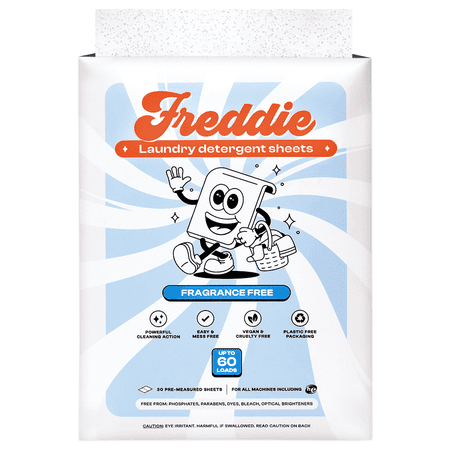


Freddie Laundry Detergent Sheets - Fragrance Free Unscented - 60 Loads (30 Sheets) - Concentrated Eco Friendly Liquid-less Strips
Analysis updated September 2026 · How Scout scores
At a glance
Summary
This laundry detergent contains a mix of beneficial and harmful ingredients. While it includes plant-derived surfactants like lauryl glucoside and saponins, which are safe and biodegradable, it also contains sodium dodecyl sulphate, a harsh surfactant known for causing skin irritation. The presence of this ingredient, despite the product being fragrance-free and eco-friendly, impacts its overall safety and environmental score.
Key ingredients 18
Lauryl GlucosideGood
Lauryl glucoside is a mild, plant-derived surfactant. It is used for its gentle cleaning properties and is considered safe and biodegradable. It is suitable for sensitive skin.
Risks
There are minimal risks associated with lauryl glucoside in cleaning products.
Benefits
It is biodegradable and provides gentle cleaning suitable for sensitive skin.
SaponinsGood
Saponins are natural surfactants derived from plants. They are used for their foaming and cleaning properties. They are considered safe and biodegradable.
Risks
There are minimal risks associated with saponins in cleaning products.
Benefits
They are biodegradable and provide natural cleaning and foaming properties.
Quillaja BarkGood
Quillaja bark is a natural source of saponins, used for its foaming and cleaning properties. It is considered safe and biodegradable. It is derived from a renewable plant source.
Risks
There are minimal risks associated with quillaja bark in cleaning products.
Benefits
It is biodegradable and provides natural cleaning and foaming properties.
Sunflower Seed OilGood
Sunflower seed oil is used as an emollient and conditioning agent. It is safe, non-toxic, and derived from a natural source. It helps in maintaining product consistency.
Risks
There are minimal risks associated with sunflower seed oil in cleaning products.
Benefits
It is biodegradable and provides conditioning properties.
Green Tea Leaf OilGood
Green tea leaf oil is used for its antioxidant properties. It is safe, non-toxic, and derived from a natural source. It helps in preserving the product and providing a mild scent.
Risks
There are minimal risks associated with green tea leaf oil in cleaning products.
Benefits
It is biodegradable and provides antioxidant properties.
ProteaseGood
Protease is an enzyme used to break down protein-based stains. It is safe, non-toxic, and enhances cleaning performance. It is derived from natural sources.
Risks
There are minimal risks associated with protease in cleaning products.
Benefits
It is biodegradable and enhances cleaning performance by breaking down protein stains.
StarchNeutral
Starch is used as a filler or thickening agent in cleaning products. It is generally considered safe and non-toxic. It does not contribute to cleaning efficacy directly.
Risks
There are minimal risks associated with starch in cleaning products.
Benefits
It is biodegradable and environmentally friendly.
WaterNeutral
Water is used as a solvent in many cleaning products. It helps dissolve other ingredients and facilitates application. It is safe and non-toxic.
Risks
There are no significant risks associated with water in cleaning products.
Benefits
It is essential for dissolving and distributing other ingredients.
Polyvinyl alcoholNeutral
Polyvinyl alcohol is a synthetic polymer used as a film-forming agent. It is generally considered safe for use in cleaning products. It helps in forming a stable product structure.
Risks
There are minimal risks associated with polyvinyl alcohol in cleaning products.
Benefits
It is biodegradable and helps in maintaining product stability.
Sodium citrateNeutral
Standard formulation ingredient — neither beneficial nor harmful at typical use.
Risks
There are minimal risks associated with sodium citrate in cleaning products.
Benefits
It is biodegradable and improves cleaning performance by softening water.
GlycerinNeutral
Standard formulation ingredient — neither beneficial nor harmful at typical use.
Risks
There are minimal risks associated with glycerin in cleaning products.
Benefits
It is biodegradable and helps in maintaining product consistency.
Ethoxylated C12-14 alcoholsNeutral
Ethoxylated C12-14 alcohols are surfactants used for their cleaning properties. They are effective at removing oils and dirt. They are generally considered safe but can be irritating to the skin.
Risks
They may cause skin irritation with prolonged exposure.
Benefits
They are effective surfactants that enhance cleaning performance.
Isotridecanol, ethoxylatedNeutral
Isotridecanol, ethoxylated is a non-ionic surfactant used for its cleaning properties. It is effective at breaking down oils and dirt. It is generally considered safe but can cause mild irritation.
Risks
It may cause mild skin irritation with prolonged exposure.
Benefits
It is an effective surfactant that enhances cleaning performance.
Tetrasodium glutamate diacetateNeutral
Tetrasodium glutamate diacetate is a chelating agent that helps in binding metal ions. It enhances the effectiveness of preservatives and surfactants. It is considered safe and biodegradable.
Risks
There are minimal risks associated with tetrasodium glutamate diacetate in cleaning products.
Benefits
It is biodegradable and enhances the stability and effectiveness of the product.
Cocamidopropyl betaineNeutral
Standard formulation ingredient — neither beneficial nor harmful at typical use.
Risks
There are minimal risks associated with cocamidopropyl betaine in cleaning products.
Benefits
It is biodegradable and helps in reducing irritation while enhancing cleaning performance.
Lauramidopropylamine oxideNeutral
Lauramidopropylamine oxide is a surfactant used for its foaming and cleaning properties. It is effective at removing dirt and oils. It is generally considered safe but can cause mild irritation.
Risks
It may cause mild skin irritation with prolonged exposure.
Benefits
It is an effective surfactant that enhances cleaning performance.
Citric acidNeutral
Common acidulant and preservative — safe at typical use levels, neither beneficial nor harmful.
Risks
There are minimal risks associated with citric acid in cleaning products.
Benefits
It is biodegradable and improves cleaning performance by softening water.
Sodium dodecyl sulphateVery Bad
Sodium dodecyl sulphate is a harsh surfactant known for its strong cleaning power. It is a common irritant and can cause skin irritation. Despite its effectiveness, it is not considered safe for sensitive skin.
Risks
It poses a risk of skin irritation and can be harsh on sensitive skin.
Benefits
It is effective at removing dirt and grease due to its strong surfactant properties.
Get the full breakdown in the Scout appTake Scout shopping
Scan any product to see lab results, healthy alternatives, and your personalized analysis.
Download on theApp Store GET IT ONGoogle PlayAmazon pricing & content
Amazon price as of . Product prices and availability are accurate as of the date/time indicated and are subject to change. Any price and availability information displayed on Amazon.com at the time of purchase will apply to the purchase of this product.
CERTAIN CONTENT THAT APPEARS ON THIS SITE COMES FROM AMAZON. THIS CONTENT IS PROVIDED “AS IS” AND IS SUBJECT TO CHANGE OR REMOVAL AT ANY TIME.