
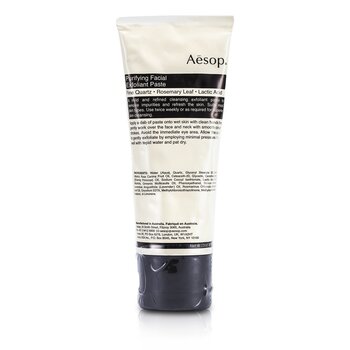


Aesop Purifying Facial Exfoliant Paste in None at Nordstrom
Summary
This facial exfoliant paste is composed of natural ingredients with minimal processing, which enhances its safety profile. The absence of harsh chemicals, synthetic fragrances, and known skin irritants contributes to its high rating. The product's clean label and use of botanicals and natural oils further support its excellent ingredient quality.
At a glance
Key ingredients 9
Water (Aqua)
Water is a universal solvent used in cosmetics to dissolve other ingredients. It helps in forming emulsions and acts as a carrier for active substances. It is essential for hydration and maintaining the product's consistency.
Risks
There are no significant risks associated with water in cosmetics.
Benefits
Water hydrates the skin and helps in the absorption of other beneficial ingredients.
Quartz
Quartz is used as a physical exfoliant in skincare products. It helps in removing dead skin cells and promoting skin renewal. Its fine particles provide gentle exfoliation without causing micro-tears.
Risks
Over-exfoliation can lead to skin irritation and sensitivity.
Benefits
Quartz can improve skin texture and enhance the absorption of other skincare ingredients.
Glyceryl Stearate SE
Glyceryl Stearate SE is an emulsifier that helps blend water and oil components in formulations. It provides a smooth texture and enhances the stability of the product. It also acts as a lubricant on the skin's surface.
Risks
There are minimal risks, but it may cause mild irritation in sensitive individuals.
Benefits
It helps in maintaining skin hydration and improves the product's application.
Rosa Canina Fruit Oil
Rosa Canina Fruit Oil, also known as rosehip oil, is rich in essential fatty acids and antioxidants. It is known for its skin-regenerating properties and ability to improve skin elasticity. It is often used for its anti-aging benefits.
Risks
There are minimal risks, but it may cause allergic reactions in sensitive individuals.
Benefits
It helps in reducing the appearance of scars and fine lines, and provides deep hydration.
Oenothera Biennis (Evening Primrose) Oil
Evening Primrose Oil is high in gamma-linolenic acid, which is beneficial for maintaining healthy skin. It is known for its anti-inflammatory properties and ability to soothe irritated skin. It is often used to improve skin texture and elasticity.
Risks
There are minimal risks, but it may cause allergic reactions in sensitive individuals.
Benefits
It helps in reducing redness and improving skin hydration and elasticity.
Glycerin
Glycerin is a humectant that attracts moisture to the skin, keeping it hydrated. It is commonly used in skincare products for its moisturizing properties. It helps in maintaining the skin's water balance on an intercellular level.
Risks
There are minimal risks, but excessive use can lead to a sticky feeling on the skin.
Benefits
It helps in improving skin barrier function and provides long-lasting hydration.
C12-16 Alcohols
C12-16 Alcohols are fatty alcohols used as emollients and thickening agents in cosmetics. They help in improving the texture and spreadability of products. They are derived from natural sources and are considered safe for use.
Risks
There are minimal risks, but they may cause mild irritation in sensitive individuals.
Benefits
They help in softening the skin and enhancing the product's texture.
Lactic Acid
Lactic Acid is an alpha hydroxy acid (AHA) used for its exfoliating properties. It helps in removing dead skin cells and promoting cell turnover. It is also known for its ability to improve skin texture and hydration.
Risks
Overuse can lead to skin irritation and increased sensitivity to sunlight.
Benefits
It helps in brightening the skin and improving its overall texture and tone.
Sodium
Sodium is often used in cosmetics as a stabilizer or pH adjuster. It helps in maintaining the product's stability and effectiveness. It is generally considered safe in the concentrations used in cosmetics.
Risks
There are minimal risks, but excessive use can lead to dryness or irritation.
Benefits
It helps in maintaining the product's consistency and effectiveness.
Processing
Unprocessed or Minimally Processed Foods
Get the full breakdown in the Scout app
Scan any product to see lab results, healthy alternatives, and your personalized analysis.
Download on theApp Store