
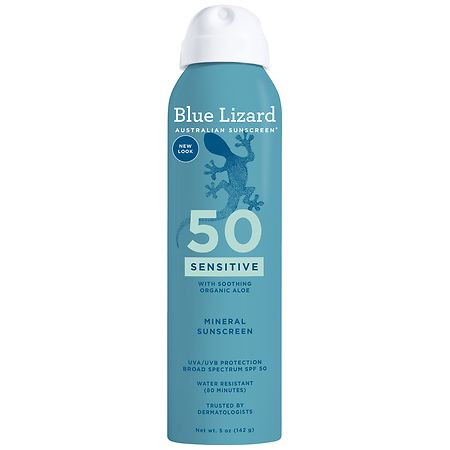

Blue Lizard Sensitive Mineral Sunscreen Spray - SPF 50+ - 5 oz: Whole Body, No Fragrance Added, Hypoallergenic
Summary
This sunscreen contains beneficial ingredients like Aloe Barbadensis Leaf Juice and Glycerin, which are known for their soothing and moisturizing properties. However, the presence of synthetic compounds and the product's high level of processing limit its score. The absence of harmful substances like parabens or synthetic fragrances is positive, but the overall formulation is not as clean as top-tier products in this category.
At a glance
Key ingredients 21
Aloe Barbadensis Leaf JuiceVery Good
Aloe Barbadensis Leaf Juice is known for its soothing and moisturizing properties, making it beneficial for sensitive skin. It helps to calm irritation and provides hydration. This ingredient is often used in skincare for its ability to support skin healing.
Risks
There are minimal risks associated with Aloe Barbadensis Leaf Juice, though some individuals may experience allergic reactions.
Benefits
It provides soothing relief and hydration, making it ideal for sensitive skin types.
Butyloctyl SalicylateNeutral
Butyloctyl Salicylate is used as a sunscreen enhancer, helping to improve the efficacy of UV filters. It acts as an emollient, providing a smooth application. This ingredient is generally considered safe for use in cosmetics.
Risks
There are no significant risks associated with Butyloctyl Salicylate, though it may cause irritation in sensitive individuals.
Benefits
It enhances the performance of sunscreen agents and provides a smooth texture.
C12-15 Alkyl BenzoateNeutral
C12-15 Alkyl Benzoate is an emollient that helps to improve the texture and feel of skincare products. It is often used to enhance the spreadability of formulations. This ingredient is generally well-tolerated by most skin types.
Risks
There are minimal risks, though it may cause mild irritation in very sensitive skin.
Benefits
It provides a silky feel and improves the spreadability of products.
Caprylyl GlycolNeutral
Caprylyl Glycol is a skin-conditioning agent that also acts as a preservative booster. It helps to improve the moisture content of the skin. This ingredient is commonly used in cosmetics for its multifunctional properties.
Risks
It may cause mild irritation in sensitive individuals.
Benefits
It enhances skin hydration and boosts the effectiveness of preservatives.
Cetyl Diglyceryl Tris (Trimethylsiloxy)silylethyl DimethiconeNeutral
This ingredient is a silicone-based compound that provides a smooth, silky feel to formulations. It helps to improve the spreadability and texture of products. It is widely used in cosmetics for its ability to enhance product aesthetics.
Risks
There are minimal risks, though silicones can sometimes cause build-up on the skin.
Benefits
It improves the texture and application of skincare products.
DimethiconeNeutral
Dimethicone is a silicone-based polymer used to provide a smooth application and form a protective barrier on the skin. It helps to lock in moisture and improve the texture of products. This ingredient is commonly used in skincare for its emollient properties.
Risks
It may cause build-up on the skin, potentially leading to clogged pores.
Benefits
It provides a protective barrier and enhances the texture of formulations.
EthylhexylglycerinNeutral
Ethylhexylglycerin is used as a skin-conditioning agent and preservative enhancer. It helps to improve the efficacy of preservatives in formulations. This ingredient is generally considered safe for use in cosmetics.
Risks
It may cause mild irritation in sensitive skin.
Benefits
It enhances the effectiveness of preservatives and conditions the skin.
GlycerinVery Good
Glycerin is a humectant that attracts moisture to the skin, helping to maintain hydration levels. It is widely used in skincare for its ability to improve skin barrier function. This ingredient is well-tolerated by most skin types and is considered safe.
Risks
There are minimal risks associated with glycerin, though overuse can lead to a sticky feel.
Benefits
It provides excellent hydration and supports the skin's natural barrier.
Hydrogen DimethiconeNeutral
Hydrogen Dimethicone is a silicone-based compound that provides a smooth, non-greasy feel to formulations. It helps to improve the spreadability and texture of products. This ingredient is commonly used in cosmetics for its ability to enhance product aesthetics.
Risks
There are minimal risks, though silicones can sometimes cause build-up on the skin.
Benefits
It improves the texture and application of skincare products.
Hydrogenated PolydeceneNeutral
Hydrogenated Polydecene is an emollient that provides a silky, smooth feel to formulations. It helps to improve the spreadability and texture of products. This ingredient is generally well-tolerated by most skin types.
Risks
There are minimal risks, though it may cause mild irritation in sensitive skin.
Benefits
It provides a silky feel and improves the spreadability of products.
Isopropyl MyristateNeutral
Isopropyl Myristate is an emollient that helps to improve the texture and absorption of skincare products. It is often used to enhance the spreadability of formulations. This ingredient is generally considered safe for use in cosmetics.
Risks
It may cause irritation or acne in sensitive or acne-prone skin.
Benefits
It enhances the texture and absorption of skincare products.
Pentylene GlycolNeutral
Pentylene Glycol is a humectant and solvent that helps to improve the moisture content of the skin. It also acts as a preservative booster in formulations. This ingredient is commonly used in cosmetics for its multifunctional properties.
Risks
It may cause mild irritation in sensitive individuals.
Benefits
It enhances skin hydration and boosts the effectiveness of preservatives.
Polyhydroxystearic AcidNeutral
Polyhydroxystearic Acid is used as a thickening agent and emulsifier in cosmetic formulations. It helps to stabilize products and improve their texture. This ingredient is generally considered safe for use in cosmetics.
Risks
There are minimal risks associated with Polyhydroxystearic Acid.
Benefits
It stabilizes formulations and improves texture.
PropanediolNeutral
Propanediol is a solvent and humectant that helps to improve the moisture content of the skin. It is often used to enhance the texture and absorption of formulations. This ingredient is generally well-tolerated by most skin types.
Risks
It may cause mild irritation in sensitive individuals.
Benefits
It enhances skin hydration and improves product absorption.
SilicaNeutral
Silica is used as an absorbent and anti-caking agent in cosmetic formulations. It helps to improve the texture and mattify the skin. This ingredient is generally considered safe for use in cosmetics.
Risks
There are minimal risks, though inhalation of silica particles should be avoided.
Benefits
It provides a mattifying effect and improves product texture.
Sodium ChlorideNeutral
Sodium Chloride is used as a thickening agent and stabilizer in cosmetic formulations. It helps to improve the texture and consistency of products. This ingredient is generally considered safe for use in cosmetics.
Risks
There are minimal risks, though it may cause irritation in very sensitive skin.
Benefits
It stabilizes formulations and improves texture.
Sodium PhytateNeutral
Sodium Phytate is used as a chelating agent in cosmetic formulations. It helps to stabilize products by binding metal ions. This ingredient is generally considered safe for use in cosmetics.
Risks
There are minimal risks associated with Sodium Phytate.
Benefits
It stabilizes formulations by binding metal ions.
Sorbitan OlivateNeutral
Sorbitan Olivate is an emulsifier derived from olive oil, used to stabilize formulations. It helps to improve the texture and spreadability of products. This ingredient is generally well-tolerated by most skin types.
Risks
There are minimal risks, though it may cause mild irritation in sensitive skin.
Benefits
It stabilizes formulations and improves texture.
Synthetic BeeswaxNeutral
Synthetic Beeswax is used as an emollient and thickening agent in cosmetic formulations. It helps to improve the texture and consistency of products. This ingredient is generally considered safe for use in cosmetics.
Risks
There are minimal risks associated with Synthetic Beeswax.
Benefits
It provides a smooth texture and stabilizes formulations.
IsododecaneNeutral
Isododecane is a solvent used to improve the spreadability and texture of cosmetic formulations. It provides a lightweight, non-greasy feel. This ingredient is commonly used in cosmetics for its ability to enhance product aesthetics.
Risks
There are minimal risks, though it may cause mild irritation in sensitive skin.
Benefits
It provides a lightweight feel and improves product spreadability.
WaterNeutral
Water is used as a solvent in cosmetic formulations, helping to dissolve other ingredients. It is a fundamental component in many skincare products. This ingredient is generally considered safe and essential in cosmetics.
Risks
There are no significant risks associated with water.
Benefits
It acts as a solvent and is essential for product formulation.
Processing
Ultra-Processed Foods
Get the full breakdown in the Scout app
Scan any product to see lab results, healthy alternatives, and your personalized analysis.
Download on theApp Store