
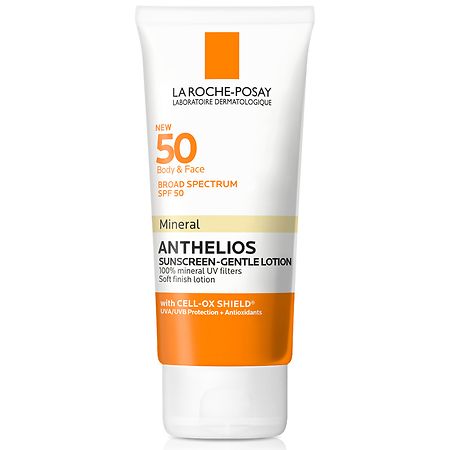

La Roche Posay Anthelios Body & Face Soft Finish Mineral Sunscreen Lotion: Moisturizing Day Skin Care, SPF 50, 3.04 fl oz
Summary
This sunscreen contains beneficial ingredients like zinc oxide, which is effective for sun protection, but also includes some synthetic components that are common in processed skincare products. While it does not contain highly harmful substances like parabens or oxybenzone, the presence of synthetic emulsifiers and preservatives slightly lowers its score. The product is moderately processed, which impacts its overall rating despite having some safe and effective ingredients.
At a glance
Key ingredients 12
Titanium Dioxide
Titanium Dioxide is a mineral sunscreen agent that provides broad-spectrum UV protection. It is often used in sunscreens due to its ability to reflect and scatter UV radiation. It is considered safe and effective for protecting the skin from sun damage.
Risks
Inhalation of nanoparticles can be a concern, but this is not typically an issue in lotion form.
Benefits
Provides effective protection against both UVA and UVB rays.
Zinc Oxide
Zinc Oxide is a mineral sunscreen agent known for its broad-spectrum UV protection. It is often used in sunscreens for its ability to block both UVA and UVB rays. It is considered safe and effective, especially in cream or lotion form.
Risks
There are minimal risks when used in non-nano form in lotions.
Benefits
Offers excellent protection against sunburn and photoaging.
Water
Water is used as a solvent in cosmetic formulations to dissolve other ingredients. It helps to create a smooth and spreadable texture. It is a neutral ingredient with no direct benefits or risks.
Benefits
Helps to hydrate the skin by providing moisture.
C12-15 Alkyl Benzoate
C12-15 Alkyl Benzoate is an emollient that helps to improve the texture and spreadability of products. It is commonly used in sunscreens to enhance the feel on the skin. It is generally considered safe for use in cosmetics.
Risks
Rarely, it may cause skin irritation in sensitive individuals.
Benefits
Improves the application and feel of the product on the skin.
Dicaprylyl Carbonate
Dicaprylyl Carbonate is an emollient that provides a silky feel to the skin. It is used to enhance the spreadability of formulations. It is considered safe for use in cosmetics.
Risks
May cause mild irritation if used in high concentrations.
Benefits
Contributes to a smooth and non-greasy finish on the skin.
Glycerin
Glycerin is a humectant that attracts moisture to the skin, helping to keep it hydrated. It is widely used in skincare products for its moisturizing properties. It is considered safe and beneficial for most skin types.
Risks
Generally safe, but overuse can lead to a sticky feeling on the skin.
Benefits
Helps to maintain skin hydration and improve skin barrier function.
Dimethicone
Dimethicone is a silicone-based polymer used to provide a smooth application and protect the skin barrier. It is commonly used in skincare products to improve texture and prevent moisture loss. It is considered safe for use in cosmetics.
Risks
May cause breakouts in acne-prone skin if not properly cleansed.
Benefits
Creates a protective barrier on the skin, reducing water loss.
Aluminum Hydroxide
Aluminum Hydroxide is used as a thickening agent and to improve the opacity of formulations. It is often included in sunscreens to enhance the stability of active ingredients. It is generally considered safe for use in cosmetics.
Risks
There are minimal risks associated with its use in topical products.
Benefits
Helps to stabilize and thicken the product formulation.
Aluminum Stearates
Aluminum Stearates are used as thickening agents and to improve the texture of cosmetic products. They help to stabilize emulsions and provide a smooth feel. They are considered safe for use in cosmetics.
Risks
May cause mild irritation in sensitive skin types.
Benefits
Contributes to the stability and texture of the product.
PEG-30 Dipolyhydroxystearate
PEG-30 Dipolyhydroxystearate is an emulsifier that helps to blend oil and water components in formulations. It is commonly used in sunscreens to ensure even distribution of active ingredients. It is generally considered safe for use in cosmetics.
Risks
May cause irritation in individuals with sensitive skin.
Benefits
Ensures a stable and uniform product formulation.
Ethylene/Acrylic Acid Copolymer
Ethylene/Acrylic Acid Copolymer is used as a film-forming agent to provide water resistance in sunscreens. It helps to enhance the durability of the product on the skin. It is considered safe for use in cosmetics.
Benefits
Improves the water resistance and longevity of the sunscreen.
Poly C10-30 Alkyl
Poly C10-30 Alkyl is used as a thickening agent and to improve the texture of formulations. It helps to stabilize emulsions and provide a smooth application. It is generally considered safe for use in cosmetics.
Risks
May cause mild irritation in sensitive individuals.
Benefits
Contributes to the stability and texture of the product.
Processing
Processed Foods
Get the full breakdown in the Scout app
Scan any product to see lab results, healthy alternatives, and your personalized analysis.
Download on theApp Store