
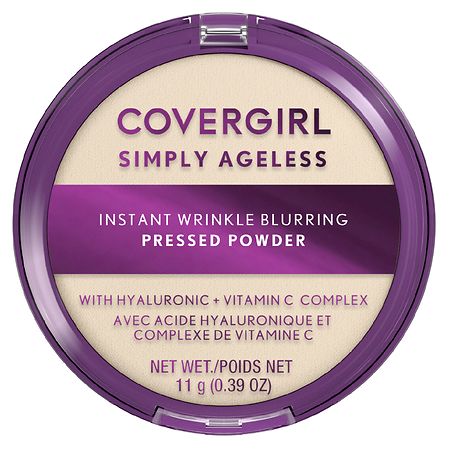
COVERGIRL Simply Ageless Instant Wrinkle Blurring Pressed Powder: Contains Vitamin C & Hyaluronic Acid, 0.39oz
Analysis updated September 2026 · How Scout scores
At a glance
Summary
This product contains beneficial ingredients like Sodium Hyaluronate and Ascorbyl Glucoside, which provide hydration and antioxidant benefits. However, the presence of talc, which carries contamination risks, and phenoxyethanol, a potential irritant, lowers its safety profile. The formulation includes both beneficial and concerning components, resulting in a mixed assessment of ingredient safety.
Key ingredients 16
Ascorbyl GlucosideVery Good
Ascorbyl Glucoside is a stable form of Vitamin C used for its antioxidant properties. It helps to brighten the skin and reduce signs of aging. It is well-tolerated and effective in improving skin tone.
Risks
Generally considered safe with minimal risk of irritation.
Benefits
Brightens skin and reduces signs of aging with antioxidant properties.
MicaGood
Beneficial ingredient — whole-food or functional value in this product class.
Risks
Inhalation of mica particles can cause respiratory irritation.
Benefits
Adds a shimmering effect to cosmetics, enhancing visual appeal.
Sodium HyaluronateGood
Sodium Hyaluronate is a form of hyaluronic acid used for its excellent hydrating properties. It is highly effective in retaining moisture and improving skin elasticity. It is well-tolerated and beneficial for all skin types.
Risks
Generally considered safe with minimal risk of irritation.
Benefits
Provides excellent hydration and improves skin elasticity.
Iron OxidesGood
Beneficial ingredient — whole-food or functional value in this product class.
Risks
Rarely, may cause skin irritation in sensitive individuals.
Benefits
Provides pigmentation and color stability in cosmetic products.
Zinc StearateNeutral
Zinc Stearate is used as a lubricant and thickening agent in cosmetics. It is generally considered safe for topical use. However, inhalation of its powder form can be irritating to the lungs.
Risks
Inhalation of powder form can cause respiratory irritation.
Benefits
Acts as a lubricant and thickening agent, improving product texture.
Octyldodecyl Stearoyl StearateNeutral
This ingredient is used as an emollient and skin conditioning agent. It is generally considered safe and non-irritating. It helps to improve the texture and feel of cosmetic products.
Risks
Rarely, it may cause skin irritation in sensitive individuals.
Benefits
Provides emollient properties, enhancing skin feel and product texture.
Isopropyl PalmitateNeutral
Isopropyl Palmitate is used as an emollient and thickening agent in cosmetics. It is generally safe but can cause acne in some individuals with sensitive skin. It helps to improve the spreadability of products.
Risks
May cause acne or skin irritation in sensitive individuals.
Benefits
Improves spreadability and provides a smooth texture to products.
1,2-HexanediolNeutral
1,2-Hexanediol is used as a preservative and humectant in cosmetics. It is generally considered safe and effective in low concentrations. It helps to maintain product stability and moisture.
Risks
High concentrations may cause skin irritation.
Benefits
Acts as a preservative and humectant, maintaining product stability and moisture.
Caprylyl GlycolNeutral
Caprylyl Glycol is used as a skin conditioning agent and preservative. It is generally considered safe and effective in cosmetics. It helps to improve skin hydration and product longevity.
Risks
Rarely, it may cause skin irritation in sensitive individuals.
Benefits
Enhances skin hydration and acts as a preservative, extending product shelf life.
Sorbitan SesquioleateNeutral
Sorbitan Sesquioleate is used as an emulsifier in cosmetics. It is generally considered safe and helps to stabilize formulations. It aids in the even distribution of ingredients in a product.
Risks
May cause skin irritation in sensitive individuals.
Benefits
Stabilizes formulations and aids in even ingredient distribution.
MethiconeNeutral
Methicone is a silicone-based compound used for its smoothing properties in cosmetics. It is generally considered safe but can cause build-up on the skin. It provides a silky texture and enhances product spreadability.
Risks
May cause build-up on the skin, leading to clogged pores.
Benefits
Provides a silky texture and enhances product spreadability.
AluminaNeutral
Alumina is used as an abrasive and thickening agent in cosmetics. It is generally considered safe for topical use. It helps to improve the texture and opacity of products.
Risks
Inhalation of powder form can cause respiratory irritation.
Benefits
Improves texture and opacity of cosmetic products.
Hydrogenated LecithinNeutral
Hydrogenated Lecithin is used as an emulsifier and skin conditioning agent. It is generally considered safe and helps to improve skin hydration. It enhances the stability and texture of cosmetic formulations.
Risks
Rarely, it may cause skin irritation in sensitive individuals.
Benefits
Enhances skin hydration and improves formulation stability and texture.
Titanium DioxideNeutral
Titanium Dioxide is used as a pigment and UV filter in cosmetics. It is generally considered safe for topical use but can be irritating if inhaled. It provides opacity and sun protection in formulations.
Risks
Inhalation of powder form can cause respiratory irritation.
Benefits
Provides opacity and sun protection in cosmetic formulations.
PhenoxyethanolBad
Phenoxyethanol is a preservative used in cosmetics to prevent microbial growth. It is considered a potential irritant and allergen, especially in high concentrations. Concerns exist regarding its potential neurotoxicity.
Risks
Potential skin irritant and allergen; concerns about neurotoxicity.
Benefits
Effective preservative that prevents microbial growth in products.
TalcVery Bad
Talc is a mineral used for its absorbent properties in cosmetics. However, it has been associated with contamination risks from asbestos, a known carcinogen. Its use in cosmetics is controversial due to potential health risks.
Risks
Potential contamination with asbestos, which is a carcinogen.
Benefits
Provides a smooth texture and absorbent properties in cosmetic formulations.
Get the full breakdown in the Scout appTake Scout shopping
Scan any product to see lab results, healthy alternatives, and your personalized analysis.
Download on theApp Store GET IT ONGoogle Play