
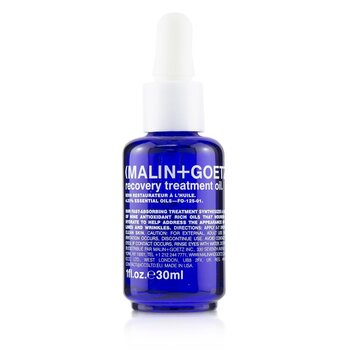
Malin+Goetz Recovery Treatment Oil 1 oz
Analysis updated July 2026 · How Scout scores
At a glance
Summary
This product contains a variety of beneficial natural oils such as squalane, argan oil, and rosehip oil, which are known for their moisturizing and skin-soothing properties. However, the presence of fragrance compounds like citral, citronellol, and geraniol, which can be skin sensitizers, slightly detracts from its overall safety profile. Despite these minor concerns, the product remains largely composed of high-quality, natural ingredients.
Key ingredients 12
squalaneVery Good
Squalane is a highly effective emollient and natural antioxidant. It mimics the skin's natural oils, making it an excellent moisturizer. It is non-comedogenic and suitable for all skin types.
Risks
There are minimal risks associated with squalane, making it safe for most users.
Benefits
It provides excellent hydration and helps to protect the skin from environmental damage.
argania spinosa kernel oilVery Good
Argania spinosa kernel oil, commonly known as argan oil, is rich in essential fatty acids and vitamin E. It is known for its moisturizing and nourishing properties. It helps to improve skin elasticity and reduce inflammation.
Risks
There are minimal risks associated with argan oil, though it may cause mild irritation in very sensitive individuals.
Benefits
It is beneficial for its anti-inflammatory and moisturizing properties.
borago officinalis seed oilVery Good
Borago officinalis seed oil, or borage oil, is high in gamma-linolenic acid (GLA), an omega-6 fatty acid. It is known for its anti-inflammatory and skin-soothing properties. It helps to maintain skin barrier function.
Risks
There are minimal risks associated with borage oil, though it may cause mild irritation in very sensitive individuals.
Benefits
It is beneficial for its anti-inflammatory properties and ability to support skin health.
camellia oleifera seed oilVery Good
Camellia oleifera seed oil is rich in antioxidants and essential fatty acids. It is known for its moisturizing and skin-soothing properties. It helps to protect the skin from environmental damage.
Risks
There are minimal risks associated with camellia oil, though it may cause mild irritation in very sensitive individuals.
Benefits
It is beneficial for its antioxidant properties and ability to hydrate the skin.
evening primroseVery Good
Evening primrose oil is high in gamma-linolenic acid (GLA), an omega-6 fatty acid. It is known for its anti-inflammatory and skin-soothing properties. It helps to improve skin elasticity and moisture retention.
Risks
There are minimal risks associated with evening primrose oil, though it may cause mild irritation in very sensitive individuals.
Benefits
It is beneficial for its anti-inflammatory properties and ability to support skin health.
grapeseed oilVery Good
Grapeseed oil is rich in antioxidants and essential fatty acids. It is known for its moisturizing and skin-soothing properties. It helps to protect the skin from environmental damage and improve skin texture.
Risks
There are minimal risks associated with grapeseed oil, though it may cause mild irritation in very sensitive individuals.
Benefits
It is beneficial for its antioxidant properties and ability to hydrate the skin.
rosehip oilVery Good
Rosehip oil is rich in essential fatty acids and vitamins A and C. It is known for its regenerative and anti-aging properties. It helps to improve skin texture and reduce the appearance of scars and fine lines.
Risks
There are minimal risks associated with rosehip oil, though it may cause mild irritation in very sensitive individuals.
Benefits
It is beneficial for its regenerative properties and ability to improve skin appearance.
caprylic/capric triglycerideNeutral
Caprylic/capric triglyceride is a mixed triester derived from coconut oil and glycerin. It is used as an emollient and helps to improve the spreadability of products. It is generally considered safe and non-irritating.
Risks
There are minimal risks associated with this ingredient, though it may cause mild irritation in very sensitive individuals.
Benefits
It is beneficial for its moisturizing properties and ability to enhance the texture of formulations.
isononyl isononanoateNeutral
Isononyl isononanoate is an ester used as an emollient and texture enhancer in cosmetic formulations. It provides a silky feel and helps to improve the spreadability of products. It is considered safe for use in cosmetics.
Risks
There are minimal risks associated with this ingredient, though it may cause mild irritation in very sensitive individuals.
Benefits
It is beneficial for its emollient properties and ability to improve product texture.
citralBad
Citral is a fragrance compound that provides a lemon scent. It is commonly used in cosmetics for its aromatic properties. However, it can be a skin sensitizer and may cause allergic reactions.
Risks
Citral can cause skin irritation and allergic reactions, especially in sensitive individuals.
Benefits
It provides a pleasant lemon scent to cosmetic products.
citronellolBad
Citronellol is a fragrance compound that provides a floral scent. It is commonly used in cosmetics for its aromatic properties. However, it can be a skin sensitizer and may cause allergic reactions.
Risks
Citronellol can cause skin irritation and allergic reactions, especially in sensitive individuals.
Benefits
It provides a pleasant floral scent to cosmetic products.
geraniolBad
Geraniol is a fragrance compound that provides a rose-like scent. It is commonly used in cosmetics for its aromatic properties. However, it can be a skin sensitizer and may cause allergic reactions.
Risks
Geraniol can cause skin irritation and allergic reactions, especially in sensitive individuals.
Benefits
It provides a pleasant rose-like scent to cosmetic products.
Get the full breakdown in the Scout appTake Scout shopping
Scan any product to see lab results, healthy alternatives, and your personalized analysis.
Download on theApp Store GET IT ONGoogle PlayAmazon pricing & content
Amazon price as of . Product prices and availability are accurate as of the date/time indicated and are subject to change. Any price and availability information displayed on Amazon.com at the time of purchase will apply to the purchase of this product.
CERTAIN CONTENT THAT APPEARS ON THIS SITE COMES FROM AMAZON. THIS CONTENT IS PROVIDED “AS IS” AND IS SUBJECT TO CHANGE OR REMOVAL AT ANY TIME.