
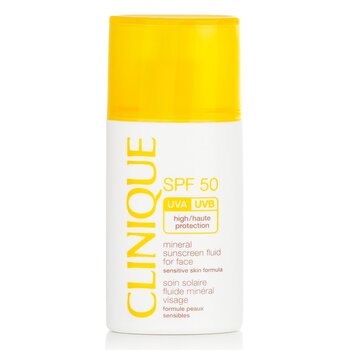

Broad Spectrum SPF 50 Mineral Sunscreen Fluid for Face by Clinique for Women - 1 oz Sunscreen
Analysis updated August 2026 · How Scout scores
At a glance
Summary
This sunscreen features mineral UV filters, titanium dioxide and zinc oxide, which are known for their safety and effectiveness in providing broad-spectrum protection. The formulation avoids chemical UV filters and other high-risk ingredients, contributing to a cleaner label. However, the presence of synthetic polymers and PEG compounds slightly reduces its overall score, despite the absence of major harmful substances.
Key ingredients 30
Zinc OxideGood
Zinc Oxide is a mineral sunscreen agent known for its broad-spectrum UV protection. It is considered safe and effective for sensitive skin.
Risks
There are minimal risks associated with Zinc Oxide when used in topical formulations.
Benefits
Zinc Oxide provides excellent protection against both UVA and UVB rays.
Iron Oxides (CI 77492)Good
Beneficial ingredient — whole-food or functional value in this product class.
Risks
There are minimal risks associated with this ingredient in topical applications.
Benefits
They provide natural-looking pigmentation and enhance the appearance of the product.
Iron Oxides (CI 77491)Good
Beneficial ingredient — whole-food or functional value in this product class.
Risks
There are minimal risks associated with this ingredient in topical applications.
Benefits
They provide natural-looking pigmentation and enhance the appearance of the product.
WaterNeutral
Water is commonly used as a solvent in cosmetic formulations. It helps dissolve other ingredients and provides a base for the product.
Risks
There are no significant risks associated with water in cosmetics.
Benefits
Water helps in the even distribution of other ingredients in the formulation.
Titanium DioxideNeutral
Standard formulation ingredient — neither beneficial nor harmful at typical use.
Risks
Inhalation of nanoparticles can be a concern, but this is less relevant in cream formulations.
Benefits
Titanium Dioxide is effective in protecting the skin from harmful UV rays.
PolydiethylsiloxaneNeutral
Polydiethylsiloxane is a silicone-based compound used for its emollient and conditioning properties. It helps improve the texture and feel of the product.
Risks
Silicones can sometimes cause skin irritation or acne in sensitive individuals.
Benefits
It provides a smooth application and helps to form a protective barrier on the skin.
C12-15 Alkyl BenzoateNeutral
C12-15 Alkyl Benzoate is an emollient that helps to improve the texture and spreadability of cosmetic products. It is commonly used in sunscreens and moisturizers.
Risks
There are minimal risks associated with this ingredient in topical applications.
Benefits
It enhances the feel of the product and helps to lock in moisture.
Isononyl IsononanoateNeutral
Isononyl Isononanoate is an emollient that provides a silky feel and improves the spreadability of formulations. It is often used in sunscreens and lotions.
Risks
There are no significant risks associated with this ingredient in cosmetic formulations.
Benefits
It helps to improve the texture and application of the product.
Diethylhexyl SuccinateNeutral
Diethylhexyl Succinate is used as an emollient and skin conditioning agent. It helps to improve the texture and feel of the product.
Risks
There are minimal risks associated with this ingredient in cosmetic formulations.
Benefits
It provides a smooth application and enhances the overall feel of the product.
Neopentyl Glycol DiheptanoateNeutral
Neopentyl Glycol Diheptanoate is an emollient that helps to improve the texture and spreadability of cosmetic products. It is commonly used in sunscreens and moisturizers.
Risks
There are minimal risks associated with this ingredient in topical applications.
Benefits
It enhances the feel of the product and helps to lock in moisture.
Methyl TrimethiconeNeutral
Methyl Trimethicone is a volatile silicone used to improve the spreadability and feel of cosmetic products. It evaporates quickly, leaving a smooth finish.
Risks
Silicones can sometimes cause skin irritation or acne in sensitive individuals.
Benefits
It provides a lightweight feel and enhances the application of the product.
Butylene GlycolNeutral
Butylene Glycol is a humectant that helps to retain moisture in the skin. It is commonly used in skincare products for its hydrating properties.
Risks
Some individuals may experience irritation or allergic reactions.
Benefits
It helps to keep the skin hydrated and improves the texture of the product.
Ethylhexyl MethoxycryleneNeutral
Ethylhexyl Methoxycrylene is used to stabilize sunscreen formulations and enhance UV protection. It helps to improve the efficacy of other sunscreen agents.
Risks
There are minimal risks associated with this ingredient in sunscreen formulations.
Benefits
It enhances the stability and effectiveness of sunscreen products.
Lauryl PEG-9 Polydimethylsiloxyethyl DimethiconeNeutral
This ingredient is a silicone-based surfactant used to improve the spreadability and texture of cosmetic products. It helps to create a smooth application.
Risks
Silicones can sometimes cause skin irritation or acne in sensitive individuals.
Benefits
It provides a smooth application and enhances the overall feel of the product.
SilicaNeutral
Silica is used as a thickening agent and absorbent in cosmetic formulations. It helps to improve the texture and mattify the skin.
Risks
Inhalation of fine silica particles can be a concern, but this is less relevant in cream formulations.
Benefits
It helps to control shine and improve the texture of the product.
Dipentaerythrityl Tri-PolyhydroxystearateNeutral
This ingredient is used as an emulsifier and thickening agent in cosmetic formulations. It helps to stabilize the product and improve its texture.
Risks
There are minimal risks associated with this ingredient in topical applications.
Benefits
It enhances the stability and texture of the product.
Laureth-4Neutral
Laureth-4 is a surfactant used to improve the spreadability and texture of cosmetic products. It helps to create a smooth application.
Risks
There is a potential risk of skin irritation, especially in sensitive individuals.
Benefits
It provides a smooth application and enhances the overall feel of the product.
Cetyl PEG/PPG-10/1 DimethiconeNeutral
This ingredient is a silicone-based surfactant used to improve the spreadability and texture of cosmetic products. It helps to create a smooth application.
Risks
Silicones can sometimes cause skin irritation or acne in sensitive individuals.
Benefits
It provides a smooth application and enhances the overall feel of the product.
Dimethicone SilylateNeutral
Dimethicone Silylate is a silicone-based compound used for its emollient and conditioning properties. It helps improve the texture and feel of the product.
Risks
Silicones can sometimes cause skin irritation or acne in sensitive individuals.
Benefits
It provides a smooth application and helps to form a protective barrier on the skin.
Hydrolyzed Wheat Protein/PVP CrosspolymerNeutral
This ingredient is used as a film-forming agent and conditioner in cosmetic formulations. It helps to improve the texture and feel of the product.
Risks
There is a potential risk of allergic reactions in individuals with wheat allergies.
Benefits
It provides conditioning benefits and enhances the texture of the product.
TriethoxycaprylylsilaneNeutral
Triethoxycaprylylsilane is used as a surface treatment for pigments and fillers in cosmetic formulations. It helps to improve the dispersion and stability of the product.
Risks
There are minimal risks associated with this ingredient in topical applications.
Benefits
It enhances the stability and application of the product.
Dimethicone Crosspolymer-3Neutral
This ingredient is a silicone-based polymer used to improve the texture and spreadability of cosmetic products. It helps to create a smooth application.
Risks
Silicones can sometimes cause skin irritation or acne in sensitive individuals.
Benefits
It provides a smooth application and enhances the overall feel of the product.
Isostearic AcidNeutral
Isostearic Acid is used as an emulsifier and thickening agent in cosmetic formulations. It helps to stabilize the product and improve its texture.
Risks
There are minimal risks associated with this ingredient in topical applications.
Benefits
It enhances the stability and texture of the product.
Caprylyl GlycolNeutral
Caprylyl Glycol is used as a skin conditioning agent and preservative booster in cosmetic formulations. It helps to improve the texture and feel of the product.
Risks
There are minimal risks associated with this ingredient in topical applications.
Benefits
It provides conditioning benefits and enhances the texture of the product.
Polyhydroxystearic AcidNeutral
Polyhydroxystearic Acid is used as an emulsifier and thickening agent in cosmetic formulations. It helps to stabilize the product and improve its texture.
Risks
There are minimal risks associated with this ingredient in topical applications.
Benefits
It enhances the stability and texture of the product.
Dipropylene GlycolNeutral
Dipropylene Glycol is used as a solvent and humectant in cosmetic formulations. It helps to improve the texture and feel of the product.
Risks
There are minimal risks associated with this ingredient in topical applications.
Benefits
It provides hydration and enhances the texture of the product.
DimethiconeBad
Occlusive silicone film-former — flagged under clean-beauty doctrine.
Risks
Some individuals may experience skin irritation or breakouts from silicones.
Benefits
Dimethicone helps to lock in moisture and improve the texture of the skin.
Butyloctyl SalicylateBad
Processed additive flagged under Scout's ingredient doctrine.
Risks
There are no significant risks associated with this ingredient in sunscreen formulations.
Benefits
It aids in the even application of sunscreen, enhancing its protective effects.
Dimethicone/PEG-10/15 CrosspolymerBad
Processed additive flagged under Scout's ingredient doctrine.
Risks
Silicones can sometimes cause skin irritation or acne in sensitive individuals.
Benefits
It provides a smooth application and enhances the overall feel of the product.
PhenoxyethanolBad
Processed additive flagged under Scout's ingredient doctrine.
Risks
There is a potential risk of skin irritation, especially in sensitive individuals.
Benefits
It helps to maintain the safety and efficacy of the product.
Get the full breakdown in the Scout appTake Scout shopping
Scan any product to see lab results, healthy alternatives, and your personalized analysis.
Download on theApp Store GET IT ONGoogle PlayAmazon pricing & content
Amazon price as of . Product prices and availability are accurate as of the date/time indicated and are subject to change. Any price and availability information displayed on Amazon.com at the time of purchase will apply to the purchase of this product.
CERTAIN CONTENT THAT APPEARS ON THIS SITE COMES FROM AMAZON. THIS CONTENT IS PROVIDED “AS IS” AND IS SUBJECT TO CHANGE OR REMOVAL AT ANY TIME.