
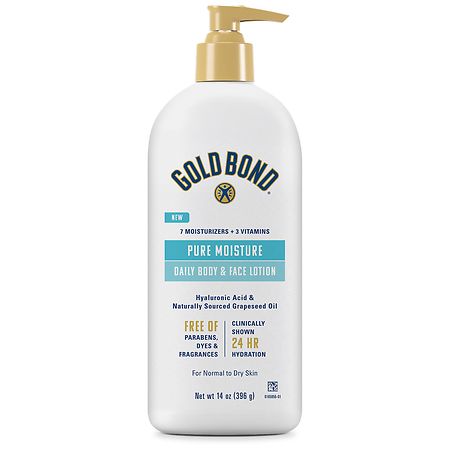


Gold Bond Pure Moisture Lotion 14 oz. Ultra-lightweight Daily Body & Face Lotion for Dry Skin
Analysis updated August 2026 · How Scout scores
At a glance
Summary
This lotion contains a variety of beneficial ingredients such as grape seed oil, sodium hyaluronate, and niacinamide, which are known for their moisturizing and skin-repairing properties. The presence of ceramides and panthenol further supports skin barrier function and hydration. However, the inclusion of synthetic ingredients like dimethicone and polysorbate 60, while generally safe, slightly reduces the overall score due to their processed nature.
Key ingredients 33
Vitis Vinifera Seed OilVery Good
Vitis Vinifera Seed Oil, or grape seed oil, is rich in antioxidants and fatty acids. It is known for its moisturizing and anti-inflammatory properties. It is suitable for all skin types and helps to improve skin elasticity.
Risks
There are minimal risks, though it may cause mild irritation in sensitive individuals.
Benefits
It provides nourishment and helps to protect the skin from oxidative stress.
Ceramide NSVery Good
Ceramide NS is a type of ceramide that helps to restore the skin's natural barrier. It is crucial for maintaining skin hydration and protecting against environmental damage. It is well-tolerated by most skin types.
Risks
There are minimal risks, though it may cause mild irritation in sensitive individuals.
Benefits
It strengthens the skin barrier and improves moisture retention.
PanthenolVery Good
Panthenol, also known as provitamin B5, is a moisturizing and soothing agent. It helps to improve skin hydration and reduce inflammation. It is suitable for all skin types and is well-tolerated.
Risks
There are minimal risks, though it may cause mild irritation in very sensitive skin.
Benefits
It provides hydration and soothes irritated skin.
Ceramide EOPVery Good
Ceramide EOP is a type of ceramide that helps to restore the skin's natural barrier. It is essential for maintaining skin hydration and protecting against environmental damage. It is well-tolerated by most skin types.
Risks
There are minimal risks, though it may cause mild irritation in sensitive individuals.
Benefits
It strengthens the skin barrier and improves moisture retention.
Ceramide EOSVery Good
Ceramide EOS is a type of ceramide that helps to restore the skin's natural barrier. It is crucial for maintaining skin hydration and protecting against environmental damage. It is well-tolerated by most skin types.
Risks
There are minimal risks, though it may cause mild irritation in sensitive individuals.
Benefits
It strengthens the skin barrier and improves moisture retention.
Ceramide APVery Good
Ceramide AP is a type of ceramide that helps to restore the skin's natural barrier. It is essential for maintaining skin hydration and protecting against environmental damage. It is well-tolerated by most skin types.
Risks
There are minimal risks, though it may cause mild irritation in sensitive individuals.
Benefits
It strengthens the skin barrier and improves moisture retention.
TocopherolVery Good
Tocopherol, also known as Vitamin E, is a powerful antioxidant. It helps to protect the skin from oxidative stress and improve skin hydration. It is suitable for all skin types and is well-tolerated.
Risks
There are minimal risks, though it may cause mild irritation in very sensitive skin.
Benefits
It provides antioxidant protection and enhances skin hydration.
3-O-Ethyl Ascorbic AcidVery Good
3-O-Ethyl Ascorbic Acid is a stable form of Vitamin C. It helps to brighten the skin and reduce the appearance of dark spots. It is suitable for all skin types and is well-tolerated.
Risks
There are minimal risks, though it may cause mild irritation in very sensitive skin.
Benefits
It provides brightening effects and reduces hyperpigmentation.
Hydroxyethyl UreaGood
Hydroxyethyl Urea is a humectant that helps to retain moisture in the skin. It is known for its ability to improve skin hydration without a sticky feel. It is generally well-tolerated by most skin types.
Risks
There are minimal risks associated with Hydroxyethyl Urea, though some individuals may experience mild irritation.
Benefits
It enhances skin moisture levels and improves skin texture.
Caprylic/Capric TriglycerideGood
Caprylic/Capric Triglyceride is an emollient derived from coconut oil and glycerin. It helps to smooth and soften the skin. It is lightweight and non-greasy, making it suitable for various skin types.
Risks
There are minimal risks, though it may cause mild irritation in sensitive individuals.
Benefits
It provides a silky feel and helps to lock in moisture.
GlycerinGood
Glycerin is a well-known humectant that attracts moisture to the skin. It is effective in improving skin hydration and maintaining the skin's moisture balance. It is generally safe and non-irritating.
Risks
There are minimal risks associated with glycerin, though overuse can lead to a sticky feel.
Benefits
It helps to keep the skin hydrated and soft.
Sodium HyaluronateGood
Sodium Hyaluronate is a form of hyaluronic acid that is highly effective in retaining moisture. It can hold up to 1000 times its weight in water, making it an excellent hydrating agent. It is suitable for all skin types and helps to plump the skin.
Risks
There are minimal risks, though it may cause mild irritation in very sensitive skin.
Benefits
It provides intense hydration and helps to reduce the appearance of fine lines.
Ceramide NPGood
Ceramide NP is a lipid that helps to restore the skin's natural barrier. It is essential for maintaining skin hydration and protecting against environmental damage. It is well-tolerated by most skin types.
Risks
There are minimal risks, though it may cause mild irritation in sensitive individuals.
Benefits
It strengthens the skin barrier and improves moisture retention.
GluconolactoneGood
Gluconolactone is a polyhydroxy acid (PHA) that provides gentle exfoliation. It helps to improve skin texture and tone without causing irritation. It is suitable for sensitive skin types.
Risks
There are minimal risks, though it may cause mild irritation in very sensitive skin.
Benefits
It provides gentle exfoliation and enhances skin radiance.
NiacinamideGood
Niacinamide is a form of Vitamin B3 that offers multiple skin benefits. It helps to improve skin elasticity, enhance barrier function, and even out skin tone. It is suitable for all skin types and is well-tolerated.
Risks
There are minimal risks, though it may cause mild irritation in very sensitive skin.
Benefits
It improves skin texture and reduces the appearance of pores.
CholesterolGood
Cholesterol is a lipid that helps to maintain the skin's natural barrier. It is essential for skin hydration and protection. It is well-tolerated by most skin types.
Risks
There are minimal risks, though it may cause mild irritation in sensitive individuals.
Benefits
It strengthens the skin barrier and improves moisture retention.
Caprooyl PhytosphingosineGood
Caprooyl Phytosphingosine is a lipid that helps to improve skin barrier function. It is known for its anti-inflammatory and antimicrobial properties. It is suitable for sensitive skin types.
Risks
There are minimal risks, though it may cause mild irritation in very sensitive skin.
Benefits
It enhances skin barrier function and reduces inflammation.
Caprooyl SphingosineGood
Caprooyl Sphingosine is a lipid that helps to improve skin barrier function. It is known for its anti-inflammatory and antimicrobial properties. It is suitable for sensitive skin types.
Risks
There are minimal risks, though it may cause mild irritation in very sensitive skin.
Benefits
It enhances skin barrier function and reduces inflammation.
WaterNeutral
Water is a common solvent used in cosmetic formulations. It helps dissolve other ingredients and provides a base for the lotion. It is generally considered safe and non-irritating.
Risks
There are no significant risks associated with water in cosmetic products.
Benefits
Water helps to hydrate the skin by providing moisture.
Stearyl AlcoholNeutral
Stearyl Alcohol is a fatty alcohol used as an emollient and thickener in cosmetics. It helps to stabilize formulations and improve texture. It is generally considered safe and non-irritating.
Risks
There are minimal risks, though it may cause irritation in very sensitive skin.
Benefits
It provides a creamy texture and helps to soften the skin.
Glyceryl StearateNeutral
Glyceryl Stearate is an emulsifier that helps to blend water and oil components in formulations. It also acts as a lubricant on the skin's surface. It is generally considered safe and non-irritating.
Risks
There are minimal risks, though it may cause mild irritation in sensitive skin.
Benefits
It helps to stabilize formulations and improve texture.
Steareth-21Neutral
Steareth-21 is an emulsifier used to stabilize formulations. It helps to blend oil and water components effectively. It is generally considered safe and non-irritating.
Risks
There are minimal risks, though it may cause mild irritation in sensitive skin.
Benefits
It helps to stabilize formulations and improve texture.
Guar Hydroxypropyltrimonium ChlorideNeutral
Guar Hydroxypropyltrimonium Chloride is a conditioning agent derived from guar gum. It helps to improve the texture and feel of the product. It is generally considered safe and non-irritating.
Risks
There are minimal risks, though it may cause mild irritation in sensitive skin.
Benefits
It enhances the texture and feel of the product.
EthylhexylglycerinNeutral
Ethylhexylglycerin is a preservative and skin-conditioning agent. It helps to enhance the efficacy of other preservatives and improve skin feel. It is generally considered safe and non-irritating.
Risks
There are minimal risks, though it may cause mild irritation in sensitive skin.
Benefits
It enhances preservative efficacy and improves skin feel.
Polyacrylate Crosspolymer-6Neutral
Polyacrylate Crosspolymer-6 is a thickening agent used to improve product texture. It helps to stabilize formulations and provide a smooth application. It is generally considered safe and non-irritating.
Risks
There are minimal risks, though it may cause mild irritation in sensitive skin.
Benefits
It improves product texture and application.
HydroxyacetophenoneNeutral
Hydroxyacetophenone is an antioxidant and preservative booster. It helps to protect the product from oxidation and enhance preservative efficacy. It is generally considered safe and non-irritating.
Risks
There are minimal risks, though it may cause mild irritation in sensitive skin.
Benefits
It protects the product from oxidation and enhances preservative efficacy.
Cetyl AlcoholNeutral
Cetyl Alcohol is a fatty alcohol used as an emollient and thickener. It helps to stabilize formulations and improve texture. It is generally considered safe and non-irritating.
Risks
There are minimal risks, though it may cause mild irritation in sensitive skin.
Benefits
It provides a creamy texture and helps to soften the skin.
Cetearyl AlcoholNeutral
Cetearyl Alcohol is a fatty alcohol used as an emollient and thickener. It helps to stabilize formulations and improve texture. It is generally considered safe and non-irritating.
Risks
There are minimal risks, though it may cause mild irritation in sensitive skin.
Benefits
It provides a creamy texture and helps to soften the skin.
Ceteareth-25Neutral
Ceteareth-25 is an emulsifier used to stabilize formulations. It helps to blend oil and water components effectively. It is generally considered safe and non-irritating.
Risks
There are minimal risks, though it may cause mild irritation in sensitive skin.
Benefits
It helps to stabilize formulations and improve texture.
Behenic AcidNeutral
Behenic Acid is a fatty acid used as an emollient and thickener. It helps to improve product texture and provide a smooth application. It is generally considered safe and non-irritating.
Risks
There are minimal risks, though it may cause mild irritation in sensitive skin.
Benefits
It improves product texture and provides a smooth application.
DimethiconeBad
Occlusive silicone film-former — flagged under clean-beauty doctrine.
Risks
Some individuals may experience clogged pores or irritation.
Benefits
It provides a smooth application and helps to protect the skin from environmental damage.
Polysorbate 60Bad
Processed additive flagged under Scout's ingredient doctrine.
Risks
There are minimal risks, though it may cause mild irritation in sensitive skin.
Benefits
It helps to stabilize formulations and improve texture.
Disodium EDTABad
Processed additive flagged under Scout's ingredient doctrine.
Risks
There are minimal risks, though it may cause mild irritation in sensitive skin.
Benefits
It enhances product stability and prevents degradation.
Get the full breakdown in the Scout appTake Scout shopping
Scan any product to see lab results, healthy alternatives, and your personalized analysis.
Download on theApp Store GET IT ONGoogle PlayAmazon pricing & content
Amazon price as of . Product prices and availability are accurate as of the date/time indicated and are subject to change. Any price and availability information displayed on Amazon.com at the time of purchase will apply to the purchase of this product.
CERTAIN CONTENT THAT APPEARS ON THIS SITE COMES FROM AMAZON. THIS CONTENT IS PROVIDED “AS IS” AND IS SUBJECT TO CHANGE OR REMOVAL AT ANY TIME.