
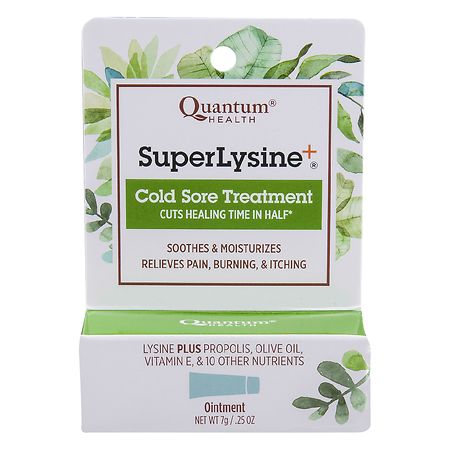

Quantum Health Super Lysine+ Cold Sore Treatment 0.25 oz Ointment
Analysis updated August 2026 · How Scout scores
At a glance
Summary
This product contains a blend of beneficial ingredients such as menthol, olive oil, beeswax, lysine, and tea tree oil, which are known for their soothing, moisturizing, and antimicrobial properties. These ingredients support oral health and help reduce cold sore symptoms. The formula is clean and free from harmful chemicals commonly found in oral care products, contributing to its high rating despite being processed.
Key ingredients 16
Olea europaea (olive) fruit oilGood
Olive oil is rich in antioxidants and has moisturizing properties. It can help soothe and protect the skin. In oral care, it may help maintain moisture and support overall oral health.
Risks
There are minimal risks associated with olive oil, though it can cause allergic reactions in rare cases.
Benefits
It is moisturizing and rich in antioxidants, which can support skin and oral health.
BeeswaxGood
Beeswax acts as a natural barrier and moisturizer. It helps to protect and soothe the skin. In oral care, it can help maintain moisture and provide a protective layer.
Risks
Beeswax is generally safe but can cause allergic reactions in some individuals.
Benefits
It provides a protective barrier and helps retain moisture.
LysineGood
Lysine is an essential amino acid that can help reduce the frequency and severity of cold sores. It is believed to inhibit the replication of the herpes simplex virus. In oral care, it supports tissue health.
Risks
Excessive intake of lysine can lead to gastrointestinal issues.
Benefits
It may help reduce cold sore outbreaks and supports tissue health.
Tea tree (melaleuca alternifolia) leaf oilGood
Tea tree oil is known for its antimicrobial properties, which can help reduce bacteria in the mouth. It is often used in oral care products for its ability to support oral hygiene. Additionally, it can help soothe irritated tissues.
Risks
Tea tree oil can be toxic if ingested in large amounts and may cause irritation in sensitive individuals.
Benefits
It has antimicrobial properties and can help maintain oral hygiene.
HoneyGood
Traditional whole-food sweetener with trace enzymes and antioxidants.
Risks
Honey can cause allergic reactions and should be used with caution.
Benefits
It has antimicrobial properties and may support healing.
MentholNeutral
Standard formulation ingredient — neither beneficial nor harmful at typical use.
Risks
Menthol can cause irritation if used in excessive amounts.
Benefits
It provides a cooling effect and can help alleviate discomfort.
Calendula officinalis extractNeutral
Calendula extract is known for its anti-inflammatory and soothing properties. It is often used to promote healing and reduce irritation. In oral care, it may help soothe inflamed tissues.
Risks
Calendula can cause allergic reactions in some individuals.
Benefits
It has anti-inflammatory properties and can help soothe irritated tissues.
Echinacea purpurea extractNeutral
Echinacea is believed to support the immune system and may help reduce the duration of cold sores. It is used in various health products for its potential immune-boosting effects. However, its efficacy in oral care is not well-established.
Risks
Echinacea can cause allergic reactions, especially in individuals allergic to ragweed.
Benefits
It may support the immune system and help reduce cold sore duration.
Zinc oxideNeutral
Zinc oxide is commonly used as a skin protectant and has mild antimicrobial properties. It can help protect the skin and promote healing. In oral care, it may help reduce irritation and support tissue health.
Risks
Zinc oxide is generally safe but can cause irritation if used excessively.
Benefits
It acts as a skin protectant and has mild antimicrobial properties.
Propolis extractNeutral
Propolis is a resinous substance with antimicrobial and anti-inflammatory properties. It is used in various health products for its potential to support healing. In oral care, it may help reduce bacteria and soothe tissues.
Risks
Propolis can cause allergic reactions, particularly in individuals allergic to bee products.
Benefits
It has antimicrobial properties and may support healing.
Gum benzoinNeutral
Gum benzoin is used for its soothing and protective properties. It can help form a protective barrier on the skin. In oral care, it may help soothe irritated tissues.
Risks
Gum benzoin can cause allergic reactions in some individuals.
Benefits
It provides a protective barrier and has soothing properties.
TocopherolNeutral
Tocopherol, or vitamin E, is an antioxidant that helps protect cells from damage. It is used in various health products for its skin-protective properties. In oral care, it may help support tissue health.
Risks
Tocopherol is generally safe but can cause irritation in sensitive individuals.
Benefits
It is an antioxidant that helps protect cells and supports tissue health.
Hydrastis canadensis (goldenseal) leafNeutral
Goldenseal is known for its antimicrobial properties and is used in various health products. It may help reduce bacteria and support healing. However, its efficacy in oral care is not well-established.
Risks
Goldenseal can cause allergic reactions and should be used with caution.
Benefits
It has antimicrobial properties and may support healing.
Melaleuca cajuputi oilNeutral
Cajuput oil is known for its antiseptic and anti-inflammatory properties. It is used in various health products for its potential to reduce irritation. In oral care, it may help soothe tissues and reduce bacteria.
Risks
Cajuput oil can cause irritation and should be used with caution.
Benefits
It has antiseptic properties and may help soothe irritated tissues.
Retinyl palmitateNeutral
Retinyl palmitate is a form of vitamin A used for its skin-protective properties. It is used in various health products for its potential to support skin health. In oral care, its benefits are not well-established.
Risks
Retinyl palmitate can cause irritation and should be used with caution.
Benefits
It is a form of vitamin A that supports skin health.
CholecalciferolNeutral
Cholecalciferol, or vitamin D3, is important for bone health and immune function. It is used in various health products for its potential to support overall health. In oral care, its benefits are not well-established.
Risks
Cholecalciferol is generally safe but can cause toxicity in excessive amounts.
Benefits
It supports bone health and immune function.
Get the full breakdown in the Scout appTake Scout shopping
Scan any product to see lab results, healthy alternatives, and your personalized analysis.
Download on theApp Store GET IT ONGoogle Play