
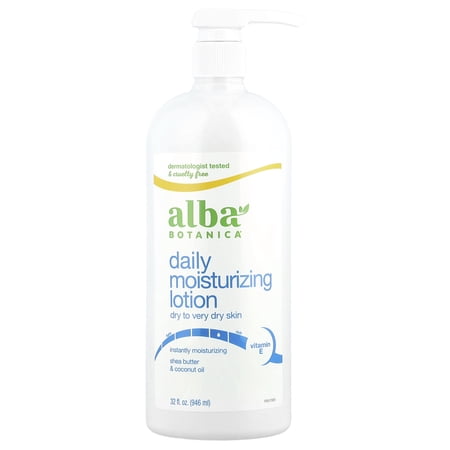
Alba Botanica Daily Moisturizing Lotion Dry to Very Dry Skin with Shea Butter and Coconut Oil 32 Oz (Packaging May Vary)
Summary
This body lotion contains a mix of natural and synthetic ingredients. It includes beneficial components like shea butter, avocado oil, and jojoba oil, which are known for their moisturizing properties. However, the presence of dimethicone and phenoxyethanol, which are synthetic, along with a processed formulation, slightly lowers its overall rating. The product avoids harsh chemicals and synthetic fragrances, which is a positive aspect.
At a glance
Key ingredients 28
Water (Aqua)
Water is a universal solvent used as a base in many cosmetic formulations. It helps dissolve other ingredients and provides hydration to the skin. It is essential for the consistency and application of the lotion.
Risks
There are no significant risks associated with water in cosmetic formulations.
Benefits
Water hydrates the skin and helps in the absorption of other beneficial ingredients.
Glycerin
Glycerin is a humectant that attracts moisture to the skin, helping to keep it hydrated. It is commonly used in skincare products for its moisturizing properties. It also helps to improve the skin barrier function.
Risks
Glycerin is generally safe, but in very high concentrations, it may cause irritation in sensitive individuals.
Benefits
Glycerin helps maintain skin hydration and improves skin smoothness.
Glyceryl Stearate SE
Glyceryl Stearate SE is an emulsifier that helps blend water and oils in formulations. It provides a smooth texture and enhances the stability of the product. It also has moisturizing properties.
Risks
There are minimal risks associated with Glyceryl Stearate SE, though it may cause mild irritation in sensitive skin.
Benefits
It helps in maintaining the consistency of the lotion and provides a moisturizing effect.
Carthamus Tinctorius (Safflower) Seed Oil
Safflower Seed Oil is a natural oil rich in linoleic acid, which helps to maintain the integrity of the skin barrier. It is known for its moisturizing and anti-inflammatory properties. It is beneficial for dry and sensitive skin.
Risks
There are minimal risks, though some individuals may experience allergic reactions.
Benefits
It provides deep hydration and helps soothe irritated skin.
Sesamum Indicum (Sesame) Seed Oil
Sesame Seed Oil is a natural oil with antioxidant and anti-inflammatory properties. It is rich in vitamins and minerals that nourish the skin. It also helps to improve skin elasticity.
Risks
Allergic reactions are possible in individuals sensitive to sesame.
Benefits
It nourishes the skin and provides antioxidant protection.
Cetyl Alcohol
Cetyl Alcohol is a fatty alcohol used as an emollient and thickener in cosmetic formulations. It helps to soften and smooth the skin. It also stabilizes emulsions and improves the texture of the product.
Risks
Generally considered safe, but may cause mild irritation in sensitive skin.
Benefits
It enhances the texture of the lotion and provides a softening effect on the skin.
Dimethicone
Dimethicone is a silicone-based polymer used as a skin protectant and conditioning agent. It forms a barrier on the skin that helps to retain moisture. It also provides a smooth, silky feel to the product.
Risks
While generally safe, it may cause breakouts in acne-prone skin due to its occlusive nature.
Benefits
It helps to lock in moisture and provides a smooth application.
Butyrospermum Parkii (Shea) Butter
Shea Butter is a natural fat extracted from the nuts of the shea tree. It is known for its rich moisturizing properties and ability to soothe dry skin. It also contains vitamins A and E, which provide antioxidant benefits.
Risks
Rarely, it may cause allergic reactions in individuals with nut allergies.
Benefits
It deeply moisturizes and nourishes the skin, improving its texture and elasticity.
Persea Gratissima (Avocado) Oil
Avocado Oil is a nutrient-rich oil that provides deep hydration and nourishment to the skin. It is high in oleic acid and vitamins, which help to repair and protect the skin barrier. It is particularly beneficial for dry and mature skin.
Risks
There are minimal risks, though it may cause allergic reactions in sensitive individuals.
Benefits
It provides intense moisture and helps to improve skin elasticity and resilience.
Simmondsia Chinensis (Jojoba) Seed Oil
Jojoba Oil is a natural oil that closely resembles the skin's natural sebum. It is easily absorbed and provides long-lasting moisture without clogging pores. It also has anti-inflammatory properties that help soothe the skin.
Risks
Generally safe, but may cause allergic reactions in rare cases.
Benefits
It moisturizes and balances the skin, making it suitable for all skin types.
Vitis Vinifera (Grape) Seed Oil
Grape Seed Oil is a lightweight oil rich in antioxidants and essential fatty acids. It helps to moisturize and protect the skin from environmental damage. It is also known for its anti-inflammatory and antimicrobial properties.
Risks
Minimal risks, though allergic reactions are possible.
Benefits
It provides antioxidant protection and helps to maintain skin hydration.
Aloe Barbadensis Leaf Juice
Aloe Vera is a well-known soothing and hydrating ingredient. It helps to calm irritated skin and provides moisture without leaving a greasy residue. It is also rich in vitamins and minerals that support skin health.
Risks
Generally safe, but may cause allergic reactions in sensitive individuals.
Benefits
It soothes and hydrates the skin, making it ideal for sensitive and dry skin types.
Camellia Sinensis Leaf Extract
Green Tea Extract is rich in antioxidants, particularly catechins, which help to protect the skin from environmental damage. It also has anti-inflammatory properties that can reduce redness and irritation. It is beneficial for maintaining healthy, youthful skin.
Risks
Minimal risks, though allergic reactions are possible.
Benefits
It provides antioxidant protection and helps to soothe and calm the skin.
Chamomilla Recutita (Matricaria) Flower Extract
Chamomile Extract is known for its calming and anti-inflammatory properties. It helps to soothe irritated skin and reduce redness. It is often used in products for sensitive skin due to its gentle nature.
Risks
Generally safe, but may cause allergic reactions in individuals sensitive to ragweed.
Benefits
It calms and soothes the skin, reducing irritation and redness.
Cucumis Sativus (Cucumber) Fruit Extract
Cucumber Extract is known for its hydrating and soothing properties. It helps to refresh and cool the skin, making it ideal for calming irritation. It also contains antioxidants that help protect the skin.
Risks
Minimal risks, though allergic reactions are possible.
Benefits
It hydrates and soothes the skin, providing a refreshing effect.
Echinacea Angustifolia Extract
Echinacea Extract is known for its immune-boosting and anti-inflammatory properties. It helps to soothe and protect the skin from environmental stressors. It is often used in skincare for its calming effects.
Risks
Minimal risks, though allergic reactions are possible.
Benefits
It soothes and protects the skin, reducing inflammation and irritation.
Lavandula Angustifolia (Lavender) Flower/Leaf/Stem Extract
Lavender Extract is known for its calming and soothing properties. It helps to reduce redness and irritation while providing a pleasant scent. It also has antimicrobial properties that can benefit the skin.
Risks
May cause allergic reactions or irritation in sensitive individuals.
Benefits
It calms and soothes the skin, providing a relaxing effect.
Panthenol
Panthenol, also known as provitamin B5, is a moisturizing and soothing agent. It helps to improve skin hydration and reduce inflammation. It is often used in skincare for its ability to enhance skin barrier function.
Risks
Generally considered safe, but may cause mild irritation in sensitive skin.
Benefits
It hydrates and soothes the skin, improving its overall appearance.
Tocopheryl Acetate
Tocopheryl Acetate is a form of Vitamin E, a powerful antioxidant that helps protect the skin from free radical damage. It also has moisturizing properties that improve skin texture. It is commonly used in skincare for its protective benefits.
Risks
Generally safe, but may cause allergic reactions in sensitive individuals.
Benefits
It provides antioxidant protection and helps to moisturize the skin.
Allantoin
Allantoin is a soothing and moisturizing agent that helps to calm irritated skin. It promotes skin healing and improves skin smoothness. It is often used in products for sensitive and dry skin.
Risks
Generally considered safe, but may cause mild irritation in rare cases.
Benefits
It soothes and moisturizes the skin, promoting healing and smoothness.
Lecithin
Lecithin is a natural emulsifier that helps to blend ingredients in formulations. It also has moisturizing properties that improve skin hydration. It is beneficial for maintaining the stability and texture of the product.
Risks
Generally safe, but may cause allergic reactions in sensitive individuals.
Benefits
It helps to stabilize the product and provides moisturizing benefits.
Polysorbate 60
Polysorbate 60 is an emulsifier that helps to blend oil and water-based ingredients. It improves the texture and consistency of the product. It is commonly used in cosmetics for its stabilizing properties.
Risks
Generally considered safe, but may cause mild irritation in sensitive skin.
Benefits
It stabilizes the formulation and enhances product texture.
Potassium Hydroxide
Potassium Hydroxide is used as a pH adjuster in cosmetic formulations. It helps to maintain the stability and effectiveness of the product. It is used in small amounts to ensure the product is safe for use.
Risks
In high concentrations, it can be irritating, but it is used in safe amounts in cosmetics.
Benefits
It helps to maintain the product's pH balance, ensuring stability and safety.
Xanthan Gum
Xanthan Gum is a natural thickening agent used to improve the texture and consistency of cosmetic products. It helps to stabilize emulsions and prevent separation. It is derived from natural sources and is safe for use in cosmetics.
Risks
Generally considered safe, but may cause mild irritation in sensitive skin.
Benefits
It stabilizes the product and improves its texture.
Alcohol
Alcohol is used as a solvent and preservative in cosmetic formulations. It helps to dissolve other ingredients and improve product penetration. However, it can be drying to the skin if used in high concentrations.
Risks
Alcohol can be drying and irritating to the skin, especially in high concentrations.
Benefits
It helps to dissolve ingredients and improve product absorption.
Benzoic Acid
Benzoic Acid is used as a preservative in cosmetic formulations. It helps to prevent the growth of bacteria and mold, extending the shelf life of the product. It is considered safe for use in cosmetics at low concentrations.
Risks
Generally safe, but may cause irritation in sensitive skin.
Benefits
It acts as a preservative, ensuring product safety and longevity.
Dehydroacetic Acid
Dehydroacetic Acid is a preservative used to prevent microbial growth in cosmetic products. It helps to maintain the safety and stability of the formulation. It is considered safe for use in cosmetics at low concentrations.
Risks
Generally safe, but may cause irritation in sensitive skin.
Benefits
It preserves the product, preventing microbial contamination.
Phenoxyethanol
Phenoxyethanol is a preservative used to prevent the growth of bacteria and mold in cosmetic products. It is effective in low concentrations and helps to extend the shelf life of the product. However, it can be irritating to the skin and eyes in some individuals.
Risks
Phenoxyethanol can cause irritation and allergic reactions in sensitive individuals.
Benefits
It acts as a preservative, ensuring product safety and longevity.
Processing
Processed Foods
Get the full breakdown in the Scout app
Scan any product to see lab results, healthy alternatives, and your personalized analysis.
Download on theApp Store