
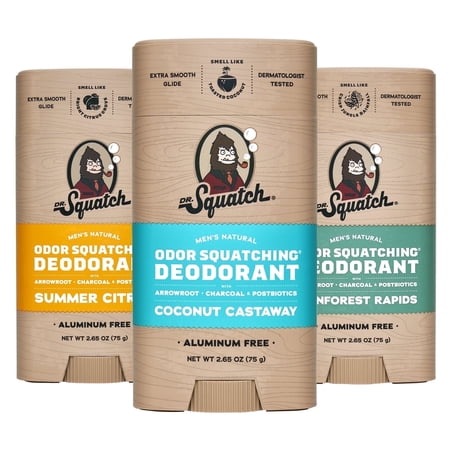
Dr. Squatch Natural Deodorant for Men - Odor-Squatching Aluminum Free - Summer Citrus Coconut Castaway & Rainforest Rapids (2.65 oz 3-Pack)
Summary
This deodorant is aluminum-free and primarily composed of natural ingredients, which are safer for skin health. It avoids synthetic chemicals such as parabens, phthalates, and synthetic fragrances, making it a clean choice for personal care. The use of naturally derived components like coconut oil and essential oils contributes to its high rating.
At a glance
Key ingredients 11
Caprylic/Capric Triglyceride
Caprylic/Capric Triglyceride is a mixed triester derived from coconut oil and glycerin. It is used for its emollient properties, helping to moisturize and soften the skin. This ingredient is generally considered safe and non-irritating.
Risks
There are minimal risks associated with this ingredient, primarily limited to rare allergic reactions.
Benefits
It provides a lightweight, non-greasy moisturizing effect, enhancing skin smoothness.
Manihot Esculenta (Arrowroot) Powder
Arrowroot powder is a natural starch used for its moisture-absorbing properties. It helps keep the skin dry by absorbing excess sweat. This ingredient is considered safe and beneficial in natural deodorants.
Risks
There are no significant risks associated with arrowroot powder.
Benefits
It effectively absorbs moisture, helping to keep the skin dry and comfortable.
Stearyl Alcohol
Stearyl Alcohol is a fatty alcohol used as an emollient and thickener in cosmetic formulations. It helps to stabilize and thicken products while providing a smooth application. It is generally considered safe and non-irritating.
Risks
Rarely, it may cause skin irritation in sensitive individuals.
Benefits
It contributes to the creamy texture of the product and helps to soften the skin.
Magnesium Hydroxide
Magnesium Hydroxide is used as a gentle odor neutralizer in natural deodorants. It works by balancing the pH of the skin and reducing odor-causing bacteria. This ingredient is highly regarded for its effectiveness and safety.
Risks
There are minimal risks, with rare cases of skin irritation reported.
Benefits
It effectively neutralizes odor without blocking pores, making it a preferred alternative to aluminum compounds.
Beeswax
Beeswax is a natural wax produced by honeybees, used for its emollient and thickening properties. It helps to form a protective barrier on the skin, locking in moisture. Beeswax is considered safe and beneficial in skincare products.
Risks
Allergic reactions are rare but possible, especially in individuals with bee allergies.
Benefits
It provides a protective, moisturizing layer on the skin, enhancing product stability.
Butyrospermum Parkii (Shea) Butter
Shea Butter is a fat extracted from the nuts of the shea tree, known for its moisturizing and anti-inflammatory properties. It is widely used in skincare for its ability to nourish and protect the skin. Shea Butter is considered safe and beneficial.
Risks
There are minimal risks, with rare cases of allergic reactions.
Benefits
It deeply moisturizes and soothes the skin, providing essential fatty acids and vitamins.
Coconut Oil
Coconut Oil is a natural oil extracted from the meat of coconuts, used for its moisturizing and antimicrobial properties. It helps to nourish the skin and reduce odor-causing bacteria. Coconut Oil is widely regarded as safe and beneficial.
Risks
Potential risks include rare allergic reactions and comedogenicity in acne-prone skin.
Benefits
It provides deep hydration and has natural antibacterial properties, supporting skin health.
Jojoba Oil
Jojoba Oil is a liquid wax ester extracted from the seeds of the jojoba plant, used for its moisturizing and skin-soothing properties. It closely resembles the skin's natural sebum, making it an excellent emollient. Jojoba Oil is considered safe and beneficial.
Risks
There are minimal risks, with rare cases of allergic reactions.
Benefits
It helps to balance oil production and provides long-lasting moisture without clogging pores.
Charcoal
Charcoal is used in deodorants for its ability to absorb impurities and toxins. It helps to detoxify the skin and reduce odor. Charcoal is considered safe and effective in personal care products.
Risks
There are minimal risks, with rare cases of skin irritation.
Benefits
It effectively absorbs moisture and odor, contributing to a fresher feel.
Probiotics
Probiotics are beneficial bacteria used in deodorants to support the skin's natural microbiome. They help to balance bacteria on the skin, reducing odor. Probiotics are considered safe and beneficial in skincare.
Risks
There are minimal risks, with rare cases of skin irritation.
Benefits
They promote a healthy skin microbiome, reducing odor naturally.
Natural Scents
Natural scents are derived from essential oils and plant extracts, used to provide fragrance without synthetic chemicals. They offer a pleasant aroma while being less likely to cause irritation. Natural scents are generally considered safe and preferable to synthetic fragrances.
Risks
Potential risks include allergic reactions in sensitive individuals.
Benefits
They provide a natural fragrance, enhancing the product's appeal without synthetic additives.
Processing
Processed Foods
Get the full breakdown in the Scout app
Scan any product to see lab results, healthy alternatives, and your personalized analysis.
Download on theApp Store