
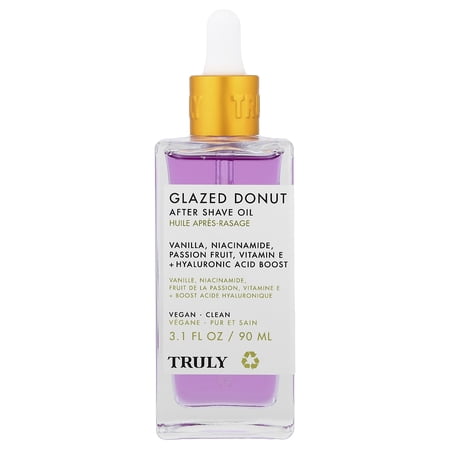


Truly Beauty Glazed Donut After Shave Oil 3.1 fl oz (90 ml)
Analysis updated August 2026 · How Scout scores
At a glance
Summary
This after shave oil contains several beneficial natural oils and extracts, such as baobab oil, jojoba seed oil, and vitamin E, which are known for their moisturizing and antioxidant properties. However, the presence of synthetic fragrance and artificial dyes like Red 33 and Violet 2 introduces potential irritants and allergens, which detract from the overall ingredient safety. The product's processing level and inclusion of these synthetic components prevent it from achieving a higher score.
Key ingredients 16
Adansonia Digitata (Baobab) OilVery Good
Baobab Oil is rich in vitamins and antioxidants, making it beneficial for skin health. It is known for its moisturizing and skin-repairing properties. It is a natural oil that is well-tolerated by most skin types.
Risks
There are no significant risks associated with Baobab Oil, though allergic reactions are possible in sensitive individuals.
Benefits
It deeply moisturizes the skin and helps to improve skin elasticity and smoothness.
Simmondsia Chinensis (Jojoba) Seed OilVery Good
Jojoba Oil is a natural oil that closely resembles the skin's own sebum. It is highly moisturizing and helps to balance oil production. It is non-comedogenic and suitable for all skin types.
Risks
Jojoba Oil is generally safe, with minimal risk of irritation or allergic reaction.
Benefits
It provides excellent moisturizing properties and helps to soothe and protect the skin.
Vitamin EVery Good
Vitamin E is a powerful antioxidant that helps to protect the skin from free radical damage. It is commonly used in skincare for its moisturizing and healing properties. It is well-tolerated by most skin types.
Risks
Vitamin E is generally safe, though it can cause irritation in very sensitive skin.
Benefits
It helps to improve skin texture and reduce signs of aging.
Caprylic/Capric TriglycerideGood
Caprylic/Capric Triglyceride is a mixed triester derived from coconut oil and glycerin. It is used as an emollient and helps to improve the spreadability of products. It is generally considered safe and non-irritating.
Risks
There are minimal risks associated with this ingredient, primarily limited to rare cases of skin irritation.
Benefits
It provides a lightweight, non-greasy moisturizing effect and enhances the texture of skincare products.
GlycerinGood
Glycerin is a humectant that attracts moisture to the skin. It is widely used in skincare for its hydrating properties. It is generally safe and non-irritating.
Risks
Glycerin is safe for most people, though it can cause irritation in very sensitive skin.
Benefits
It helps to maintain skin hydration and improve skin barrier function.
Passiflora Edulis Peel ExtractGood
Passiflora Edulis Peel Extract is derived from passion fruit and is rich in antioxidants. It is used for its skin-soothing and protective properties. It is generally considered safe for topical use.
Risks
There is a low risk of allergic reaction, particularly in individuals with fruit allergies.
Benefits
It provides antioxidant benefits and helps to protect the skin from environmental stressors.
Coconut OilGood
Coconut Oil is a natural emollient that helps to moisturize and soften the skin. It is rich in fatty acids and has antibacterial properties. It is widely used in skincare for its nourishing benefits.
Risks
Coconut Oil can be comedogenic and may cause breakouts in acne-prone skin.
Benefits
It provides deep hydration and helps to protect the skin barrier.
Grape Seed ExtractGood
Grape Seed Extract is rich in antioxidants and is used for its skin-protective properties. It helps to improve skin elasticity and reduce the appearance of fine lines. It is generally safe for topical use.
Risks
There is a low risk of allergic reaction, particularly in individuals with grape allergies.
Benefits
It provides antioxidant protection and helps to improve skin texture.
NiacinamideGood
Niacinamide is a form of Vitamin B3 that is known for its skin-soothing and anti-inflammatory properties. It helps to improve skin texture and reduce the appearance of pores. It is well-tolerated by most skin types.
Risks
Niacinamide is generally safe, though it can cause mild irritation in very sensitive skin.
Benefits
It helps to improve skin tone, reduce redness, and enhance skin barrier function.
Passiflora Incarnata Seed OilGood
Passiflora Incarnata Seed Oil is derived from passionflower seeds and is rich in essential fatty acids. It is used for its moisturizing and skin-soothing properties. It is generally considered safe for topical use.
Risks
There is a low risk of allergic reaction, particularly in individuals with plant allergies.
Benefits
It helps to moisturize and soothe the skin, improving its overall appearance.
Sodium HyaluronateGood
Sodium Hyaluronate is a form of hyaluronic acid that is used for its excellent hydrating properties. It helps to retain moisture in the skin, making it appear plump and smooth. It is well-tolerated by most skin types.
Risks
Sodium Hyaluronate is generally safe, with minimal risk of irritation or allergic reaction.
Benefits
It provides deep hydration and helps to improve skin elasticity and texture.
Lavandula Angustifolia (Lavender) OilNeutral
Lavender Oil is known for its calming scent and potential skin-soothing properties. It is used in skincare for its fragrance and potential anti-inflammatory effects. However, it can be irritating to sensitive skin.
Risks
Lavender Oil can cause skin irritation or allergic reactions in some individuals.
Benefits
It may provide calming and soothing effects on the skin.
Red 33Neutral
Red 33 is a synthetic dye used to impart color to cosmetic products. It is approved for use in cosmetics but can cause irritation in sensitive individuals. It is generally considered safe when used within regulatory limits.
Risks
There is a potential risk of skin irritation or allergic reaction, particularly in sensitive individuals.
Benefits
It provides vibrant color to the product, enhancing its visual appeal.
Violet 2Neutral
Violet 2 is a synthetic dye used to add color to cosmetic products. It is approved for use in cosmetics but can cause irritation in sensitive individuals. It is generally considered safe when used within regulatory limits.
Risks
There is a potential risk of skin irritation or allergic reaction, particularly in sensitive individuals.
Benefits
It provides vibrant color to the product, enhancing its visual appeal.
Vanilla Planifolia Fruit OilNeutral
Vanilla Planifolia Fruit Oil is used for its fragrance and potential antioxidant properties. It is generally considered safe for use in cosmetics. However, it can cause irritation in sensitive individuals.
Risks
There is a potential risk of skin irritation or allergic reaction, particularly in sensitive individuals.
Benefits
It provides a pleasant vanilla scent and may offer antioxidant benefits.
FragranceVery Bad
Fragrance is often used to enhance the scent of cosmetic products. However, it can be a common irritant and allergen, especially for sensitive skin. It is associated with potential skin irritation and allergic reactions.
Risks
Fragrance can cause skin irritation, allergic reactions, and may trigger asthma in sensitive individuals.
Benefits
It provides a pleasant scent to the product, enhancing the user experience.
Processing
Processed Foods
Get the full breakdown in the Scout appTake Scout shopping
Scan any product to see lab results, healthy alternatives, and your personalized analysis.
Download on theApp Store GET IT ONGoogle PlayAmazon pricing & content
Amazon price as of . Product prices and availability are accurate as of the date/time indicated and are subject to change. Any price and availability information displayed on Amazon.com at the time of purchase will apply to the purchase of this product.
CERTAIN CONTENT THAT APPEARS ON THIS SITE COMES FROM AMAZON. THIS CONTENT IS PROVIDED “AS IS” AND IS SUBJECT TO CHANGE OR REMOVAL AT ANY TIME.