
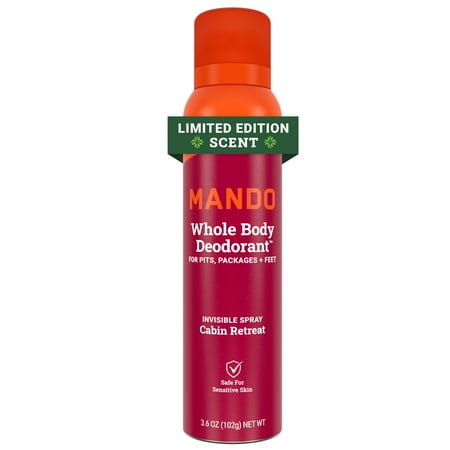

Mando Whole Body Deodorant for Men - Invisible Spray Deodorant - Aluminum Free - Limited Edition Holiday Scent - Cabin Retreat - 3.6oz
Summary
This deodorant is aluminum-free, which is a positive aspect for ingredient safety. However, it contains synthetic fragrance, which can be a concern for some users due to potential allergens and irritants. The presence of natural ingredients like mandelic acid and the absence of parabens and phthalates contribute positively to its overall safety profile.
At a glance
Key ingredients 18
DI WaterNeutral
DI Water is deionized water, commonly used as a solvent in cosmetic formulations. It is purified to remove ions and impurities, making it a neutral base for other ingredients. It does not contribute to the deodorant's efficacy or risks.
Risks
There are no known risks associated with DI Water.
Benefits
It serves as a neutral carrier for other active ingredients.
SD Alcohol 40BNeutral
SD Alcohol 40B is a denatured alcohol used as a solvent and to help dry the product quickly. It can be drying to the skin if used in high concentrations. It is effective in reducing the drying time of the product.
Risks
Potential skin dryness or irritation with frequent use.
Benefits
Helps the product dry quickly and acts as a solvent for other ingredients.
Caprylic/Capric TriglycerideNeutral
Caprylic/Capric Triglyceride is derived from coconut oil and glycerin, used as an emollient and skin-conditioning agent. It is generally considered safe and non-irritating. It helps to improve the spreadability of the product.
Risks
Minimal risk of skin irritation.
Benefits
Provides a smooth application and helps moisturize the skin.
Oleyl AlcoholNeutral
Oleyl Alcohol is a fatty alcohol used as an emollient and thickener. It is generally considered safe for use in cosmetics. It helps to stabilize the formulation and improve texture.
Risks
May cause mild irritation in sensitive individuals.
Benefits
Improves the texture and stability of the product.
Coco-CaprylateNeutral
Coco-Caprylate is an ester of coconut alcohol and caprylic acid, used as an emollient. It is known for its skin-conditioning properties. It provides a silky feel to the skin.
Risks
Generally considered safe with low risk of irritation.
Benefits
Enhances skin feel and provides a moisturizing effect.
Mandelic AcidNeutral
Mandelic Acid is an alpha hydroxy acid (AHA) used for its exfoliating properties. It is milder compared to other AHAs, making it suitable for sensitive skin. It helps to gently exfoliate the skin surface.
Risks
May cause mild irritation or sensitivity, especially with sun exposure.
Benefits
Promotes gentle exfoliation and can improve skin texture.
UndecaneNeutral
Undecane is a hydrocarbon used as an emollient and solvent. It is considered safe for use in cosmetics. It helps to improve the spreadability of the product.
Risks
Minimal risk of irritation.
Benefits
Contributes to a smooth application and enhances product texture.
CaffeineNeutral
Caffeine is used in cosmetics for its antioxidant properties and potential to improve skin appearance. It is generally well-tolerated in topical applications. It may help to reduce puffiness and improve skin tone.
Risks
Low risk of irritation or sensitivity.
Benefits
Provides antioxidant benefits and may improve skin appearance.
TridecaneNeutral
Tridecane is a hydrocarbon used as an emollient and solvent. It is considered safe for use in cosmetics. It helps to improve the spreadability and texture of the product.
Risks
Minimal risk of irritation.
Benefits
Enhances product texture and application.
NitrogenNeutral
Nitrogen is used as a propellant in aerosol products. It is inert and does not react with other ingredients. It helps to dispense the product evenly.
Risks
No known risks when used as a propellant.
Benefits
Ensures even distribution of the product.
FragranceBad
Fragrance is a mixture of aromatic compounds used to impart scent. It can contain phthalates and other allergens. It is often associated with skin irritation and allergic reactions.
Risks
Potential for skin irritation and allergic reactions.
Benefits
Provides a pleasant scent to the product.
Citronellyl MethylcrotonateNeutral
Citronellyl Methylcrotonate is used as a fragrance ingredient. It is generally considered safe for use in cosmetics. It contributes to the overall scent profile of the product.
Risks
Potential for mild irritation or sensitivity.
Benefits
Enhances the fragrance of the product.
Benzyl AlcoholBad
Benzyl Alcohol is used as a preservative and solvent. It can cause skin irritation and allergic reactions in some individuals. It is effective in preserving the product by preventing microbial growth.
Risks
Potential for skin irritation and allergic reactions.
Benefits
Acts as a preservative to extend product shelf life.
Benzoic AcidNeutral
Benzoic Acid is used as a preservative in cosmetics. It is generally recognized as safe when used within recommended concentrations. It helps to prevent microbial growth in the product.
Risks
May cause mild irritation in sensitive individuals.
Benefits
Prevents microbial contamination and extends shelf life.
Sorbic AcidNeutral
Sorbic Acid is a preservative used to inhibit the growth of mold and yeast. It is considered safe for use in cosmetics. It helps to maintain product integrity by preventing spoilage.
Risks
Low risk of irritation or sensitivity.
Benefits
Effective in preventing microbial growth and spoilage.
Citric AcidNeutral
Citric Acid is used to adjust the pH of cosmetic formulations. It is generally considered safe and non-irritating. It helps to maintain the stability and efficacy of the product.
Risks
May cause mild irritation if used in high concentrations.
Benefits
Stabilizes pH and enhances product stability.
Sodium HydroxideNeutral
Sodium Hydroxide is used to adjust the pH of cosmetic products. It is a strong base and must be used in controlled amounts. It helps to balance the pH of the formulation.
Risks
Can cause irritation if used inappropriately.
Benefits
Ensures the product has the correct pH for stability and efficacy.
D-LimoneneNeutral
D-Limonene is a naturally occurring compound used for its fragrance and solvent properties. It is generally considered safe but can be an allergen for some individuals. It provides a citrus scent and helps dissolve other ingredients.
Risks
Potential allergen and skin sensitizer.
Benefits
Contributes a fresh citrus scent and acts as a solvent.
Processing
Processed Foods
Get the full breakdown in the Scout app
Scan any product to see lab results, healthy alternatives, and your personalized analysis.
Download on theApp Store