
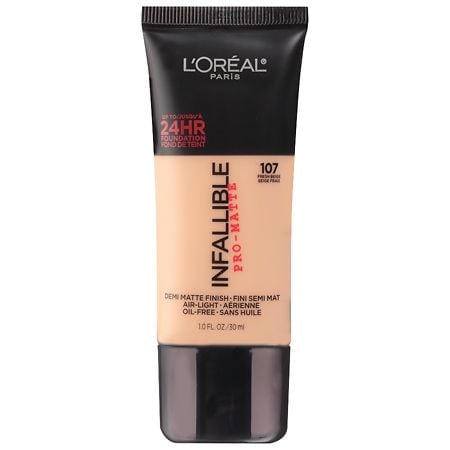


L Oreal Paris Infallible Pro-Matte Liquid Foundation Makeup 107 Fresh Beige 1 fl oz
Analysis updated August 2026 · How Scout scores
At a glance
Summary
This foundation contains a mix of synthetic ingredients, including dimethicone and PEG compounds, which are common in cosmetics but can be concerning for some due to their synthetic nature. The presence of phenoxyethanol, a preservative that can cause irritation, further impacts the score. However, the inclusion of tocopherol, a beneficial antioxidant, provides some redeeming qualities.
Key ingredients 27
TocopherolVery Good
Tocopherol, also known as Vitamin E, is an antioxidant used to protect the skin from free radical damage. It helps in maintaining skin health and improving the shelf life of the product. It is generally considered beneficial for skin health.
Risks
There are minimal risks associated with tocopherol in cosmetics.
Benefits
Protects skin from free radical damage and maintains skin health.
CI 77491, CI 77492, CI 77499 / Iron OxidesGood
Beneficial ingredient — whole-food or functional value in this product class.
Risks
There are minimal risks associated with iron oxides in cosmetics.
Benefits
Provide stable and non-toxic color to cosmetics.
Aqua / Water / EauNeutral
Water is a common solvent used in cosmetics to dissolve other ingredients. It helps in the application and spreadability of the product. It does not have any direct benefits or risks in this context.
Risks
There are no significant risks associated with water in cosmetics.
Benefits
Water helps in the even distribution of other ingredients in the formulation.
IsododecaneNeutral
Isododecane is a hydrocarbon used to enhance the spreadability of the product and provide a lightweight feel. It evaporates quickly, leaving a non-greasy finish. It is generally considered safe for use in cosmetics.
Risks
There are minimal risks associated with isododecane in cosmetics.
Benefits
Provides a lightweight, non-greasy finish and enhances spreadability.
Nylon-12Neutral
Nylon-12 is a synthetic polymer used to improve the texture and feel of the product. It helps in absorbing excess oil and provides a matte finish. It is generally considered safe for use in cosmetics.
Risks
There are minimal risks associated with Nylon-12 in cosmetics.
Benefits
Improves texture, absorbs excess oil, and provides a matte finish.
Acrylates/Polytrimethylsiloxymethacrylate CopolymerNeutral
This copolymer is used as a film-forming agent to provide long-lasting wear and water resistance. It helps in maintaining the integrity of the product on the skin. It is generally considered safe for use in cosmetics.
Risks
There are minimal risks associated with this copolymer in cosmetics.
Benefits
Provides long-lasting wear and water resistance.
SilicaNeutral
Silica is used as an absorbent and anti-caking agent in cosmetics. It helps in controlling shine and provides a smooth finish. It is generally considered safe for use in cosmetics.
Risks
Inhalation of silica dust can be harmful, but this is not a concern in liquid formulations.
Benefits
Controls shine and provides a smooth finish.
Butylene GlycolNeutral
Butylene Glycol is a common solvent and conditioning agent in cosmetics. It helps in improving the texture and spreadability of the product. It is generally considered safe for use in cosmetics.
Risks
May cause irritation in very sensitive skin.
Benefits
Improves texture and spreadability of the product.
PEG-10 DimethiconeNeutral
PEG-10 Dimethicone is a silicone-based polymer used as an emulsifier and conditioning agent. It helps in providing a smooth application and enhances the texture of the product. It is generally considered safe for use in cosmetics.
Risks
May cause irritation in sensitive skin.
Benefits
Provides smooth application and enhances texture.
IsohexadecaneNeutral
Isohexadecane is a hydrocarbon used as an emollient and solvent in cosmetics. It provides a lightweight, non-greasy feel and enhances the spreadability of the product. It is generally considered safe for use in cosmetics.
Risks
There are minimal risks associated with isohexadecane in cosmetics.
Benefits
Provides a lightweight, non-greasy feel and enhances spreadability.
Isononyl IsononanoateNeutral
Isononyl Isononanoate is an ester used as an emollient and conditioning agent in cosmetics. It provides a silky feel and enhances the texture of the product. It is generally considered safe for use in cosmetics.
Risks
There are minimal risks associated with isononyl isononanoate in cosmetics.
Benefits
Provides a silky feel and enhances texture.
Pentylene GlycolNeutral
Pentylene Glycol is a humectant and solvent used in cosmetics to improve texture and moisture retention. It helps in enhancing the spreadability of the product. It is generally considered safe for use in cosmetics.
Risks
May cause irritation in very sensitive skin.
Benefits
Improves texture and moisture retention.
Synthetic FluorphlogopiteNeutral
Synthetic Fluorphlogopite is a synthetic mica used to add shimmer and improve the texture of cosmetics. It provides a smooth, luminous finish. It is generally considered safe for use in cosmetics.
Risks
There are minimal risks associated with synthetic fluorphlogopite in cosmetics.
Benefits
Adds shimmer and provides a smooth, luminous finish.
BIS-PEG/PPG-14/14 DimethiconeNeutral
BIS-PEG/PPG-14/14 Dimethicone is a silicone-based polymer used as an emulsifier and conditioning agent. It helps in providing a smooth application and enhances the texture of the product. It is generally considered safe for use in cosmetics.
Risks
May cause irritation in sensitive skin.
Benefits
Provides smooth application and enhances texture.
Magnesium SulfateNeutral
Magnesium Sulfate is used as a thickening agent and absorbent in cosmetics. It helps in improving the texture and stability of the product. It is generally considered safe for use in cosmetics.
Risks
There are minimal risks associated with magnesium sulfate in cosmetics.
Benefits
Improves texture and stability of the product.
Caprylyl GlycolNeutral
Caprylyl Glycol is a humectant and conditioning agent used in cosmetics to improve moisture retention. It also has antimicrobial properties that enhance the preservation of the product. It is generally considered safe for use in cosmetics.
Risks
There are minimal risks associated with caprylyl glycol in cosmetics.
Benefits
Improves moisture retention and enhances preservation.
Acrylonitrile/Methyl Methacrylate/Vinylidene Chloride CopolymerNeutral
This copolymer is used as a film-forming agent to provide long-lasting wear and water resistance. It helps in maintaining the integrity of the product on the skin. It is generally considered safe for use in cosmetics.
Risks
There are minimal risks associated with this copolymer in cosmetics.
Benefits
Provides long-lasting wear and water resistance.
Disodium Stearoyl GlutamateNeutral
Disodium Stearoyl Glutamate is an emulsifier used to stabilize formulations and improve texture. It is derived from amino acids and fatty acids, making it a mild and effective ingredient. It is generally considered safe for use in cosmetics.
Risks
There are minimal risks associated with disodium stearoyl glutamate in cosmetics.
Benefits
Stabilizes formulations and improves texture.
Disteardimonium HectoriteNeutral
Disteardimonium Hectorite is a thickening agent used to improve the texture and stability of cosmetics. It helps in suspending pigments and other particles in the formulation. It is generally considered safe for use in cosmetics.
Risks
There are minimal risks associated with disteardimonium hectorite in cosmetics.
Benefits
Improves texture and stability of the product.
Calcium GluconateNeutral
Calcium Gluconate is used as a conditioning agent in cosmetics. It helps in maintaining skin health and improving the texture of the product. It is generally considered safe for use in cosmetics.
Risks
There are minimal risks associated with calcium gluconate in cosmetics.
Benefits
Maintains skin health and improves texture.
PerliteNeutral
Perlite is a natural mineral used as an absorbent and exfoliant in cosmetics. It helps in controlling shine and providing a matte finish. It is generally considered safe for use in cosmetics.
Risks
There are minimal risks associated with perlite in cosmetics.
Benefits
Controls shine and provides a matte finish.
Magnesium GluconateNeutral
Magnesium Gluconate is used as a conditioning agent in cosmetics. It helps in maintaining skin health and improving the texture of the product. It is generally considered safe for use in cosmetics.
Risks
There are minimal risks associated with magnesium gluconate in cosmetics.
Benefits
Maintains skin health and improves texture.
Aluminum HydroxideNeutral
Aluminum Hydroxide is used as a thickening agent and opacifier in cosmetics. It helps in improving the texture and opacity of the product. It is generally considered safe for use in cosmetics.
Risks
There are minimal risks associated with aluminum hydroxide in cosmetics.
Benefits
Improves texture and opacity of the product.
IsobutaneNeutral
Isobutane is used as a propellant in aerosol cosmetics. It helps in dispensing the product evenly. It is generally considered safe for use in cosmetics when used in appropriate concentrations.
Risks
There are minimal risks associated with isobutane in cosmetics.
Benefits
Helps in even dispensing of aerosol products.
CI 77891 / Titanium DioxideNeutral
Titanium Dioxide is used as a pigment and UV filter in cosmetics. It provides opacity and sun protection. It is generally considered safe for use in cosmetics.
Risks
Inhalation of titanium dioxide dust can be harmful, but this is not a concern in liquid formulations.
Benefits
Provides opacity and sun protection.
DimethiconeBad
Occlusive silicone film-former — flagged under clean-beauty doctrine.
Risks
May cause skin irritation or breakouts in sensitive individuals.
Benefits
Provides a smooth application and helps retain moisture on the skin.
PhenoxyethanolBad
Phenoxyethanol is a preservative used to prevent microbial growth in cosmetics. It is effective in low concentrations but can cause irritation in sensitive individuals. It is generally considered safe but has been associated with allergic reactions.
Risks
May cause irritation or allergic reactions in sensitive individuals.
Benefits
Prevents microbial growth and extends the shelf life of the product.
Get the full breakdown in the Scout appTake Scout shopping
Scan any product to see lab results, healthy alternatives, and your personalized analysis.
Download on theApp Store GET IT ONGoogle PlayAmazon pricing & content
Amazon price as of . Product prices and availability are accurate as of the date/time indicated and are subject to change. Any price and availability information displayed on Amazon.com at the time of purchase will apply to the purchase of this product.
CERTAIN CONTENT THAT APPEARS ON THIS SITE COMES FROM AMAZON. THIS CONTENT IS PROVIDED “AS IS” AND IS SUBJECT TO CHANGE OR REMOVAL AT ANY TIME.