
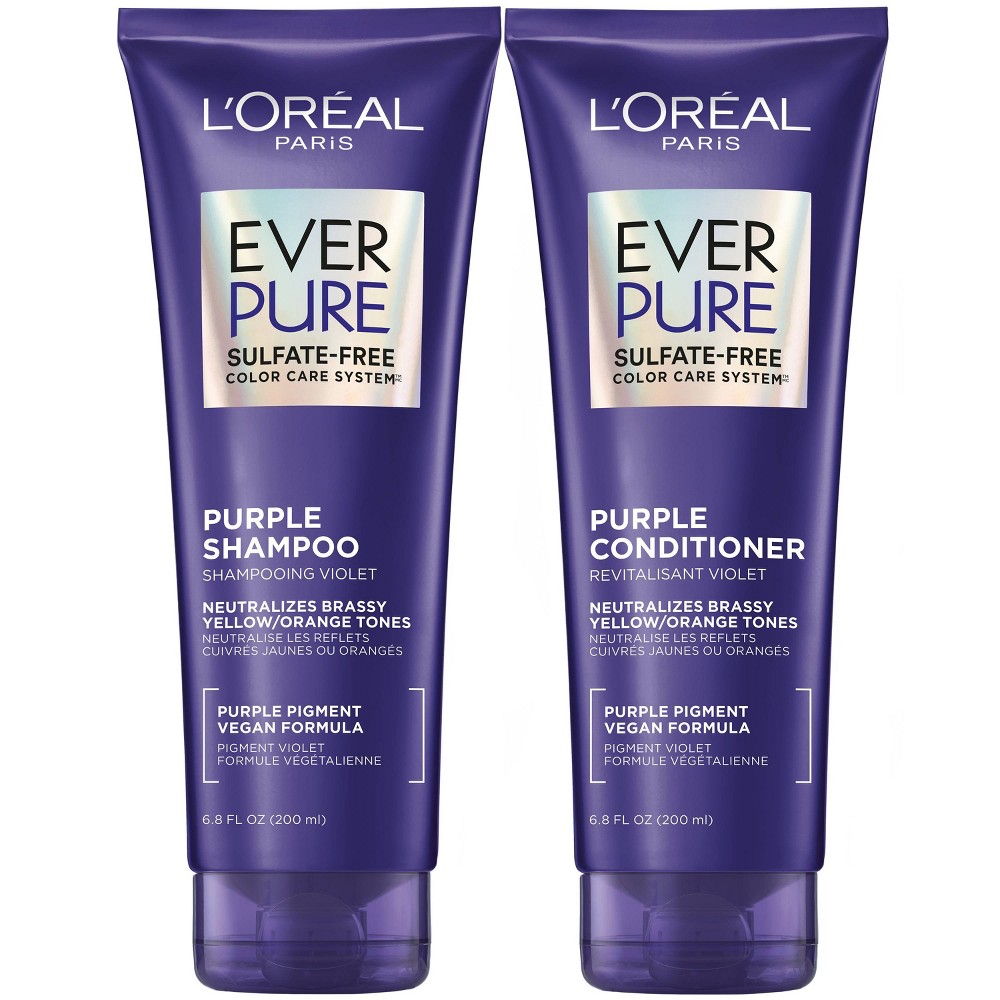
L'Oreal Paris EverPure Purple Shampoo & Conditioner Kit - 6.8 fl oz: For Colored Hair, Paraben-Free, Vegan
Analysis updated July 2026 · How Scout scores
At a glance
Summary
This shampoo and conditioner kit contains some beneficial ingredients like coco-betaine and sodium cocoyl isethionate, which are gentle surfactants derived from coconut oil. However, it also includes potentially harmful components such as synthetic fragrance, sodium chloride, and non-water-soluble silicone (amodimethicone), which can cause scalp irritation and hair buildup. The presence of preservatives like methylchloroisothiazolinone and methylisothiazolinone, known for causing allergic reactions, further impacts its overall ingredient safety and processing level.
Key ingredients 36
Sodium Cocoyl IsethionateVery Good
Sodium Cocoyl Isethionate is a gentle surfactant derived from coconut oil. It is known for its mildness and ability to cleanse without stripping natural oils. It is suitable for sensitive skin and hair.
Risks
Generally considered safe with minimal risk of irritation.
Benefits
Provides gentle cleansing and helps maintain moisture in the hair.
Coco-BetaineGood
Coco-Betaine is a mild surfactant derived from coconut oil. It helps to cleanse the hair without stripping natural oils. It is considered gentle and suitable for sensitive skin.
Risks
In rare cases, it may cause irritation in individuals with very sensitive skin.
Benefits
It provides gentle cleansing and helps maintain the hair's natural moisture balance.
Decyl GlucosideGood
Beneficial ingredient — whole-food or functional value in this product class.
Risks
Generally considered safe with minimal risk of irritation.
Benefits
Provides gentle cleansing and is environmentally friendly.
Hibiscus Sabdariffa Flower ExtractGood
Hibiscus Sabdariffa Flower Extract is used for its antioxidant and conditioning properties. It helps to nourish and strengthen the hair. It is derived from natural sources and is generally considered safe.
Risks
There are no significant risks associated with this ingredient.
Benefits
Provides nourishment and strengthens the hair.
Aqua/WaterNeutral
Water is a common solvent used in cosmetic formulations. It helps to dissolve other ingredients and provides a base for the product. It is generally considered safe and non-reactive.
Risks
There are no significant risks associated with water in cosmetic products.
Benefits
Water helps to hydrate and distribute other ingredients evenly across the hair.
Disodium Laureth SulfosuccinateNeutral
This is a mild surfactant used to cleanse the hair and scalp. It is less irritating than traditional sulfates. It is often used in formulations for sensitive skin.
Risks
May cause mild irritation if used in high concentrations.
Benefits
Provides effective cleansing with reduced risk of irritation compared to harsher sulfates.
Sodium Lauryl SulfoacetateNeutral
This is a mild surfactant used for its foaming and cleansing properties. It is considered less irritating than traditional sulfates. It is often used in formulations for sensitive skin.
Risks
May cause mild irritation in sensitive individuals.
Benefits
Provides effective cleansing with a rich lather.
Glycol DistearateNeutral
Glycol Distearate is used as an opacifying agent and to add pearlescence to products. It helps improve the texture and appearance of the product. It is generally considered safe for use in cosmetics.
Risks
There are no significant risks associated with this ingredient.
Benefits
Enhances the visual appeal and texture of the product.
Sodium ChlorideNeutral
Standard formulation ingredient — neither beneficial nor harmful at typical use.
Risks
May cause dryness and irritation, especially in sensitive individuals.
Benefits
Helps to thicken the product and improve its texture.
PPG-5-Ceteth-20Neutral
PPG-5-Ceteth-20 is used as an emulsifier and surfactant in cosmetic formulations. It helps to stabilize and blend ingredients. It is generally considered safe for use in cosmetics.
Risks
There are no significant risks associated with this ingredient.
Benefits
Improves the stability and consistency of the product.
Polyquaternium-10Neutral
Polyquaternium-10 is used as a conditioning agent in hair care products. It helps to improve the texture and manageability of hair. It is generally considered safe for use in cosmetics.
Risks
There are no significant risks associated with this ingredient.
Benefits
Improves hair texture and reduces static.
Sodium HydroxideNeutral
Sodium Hydroxide is used to adjust the pH of cosmetic formulations. It is a strong alkali that can be irritating in high concentrations. It is used in small amounts to ensure product stability.
Risks
Can cause irritation if used in high concentrations.
Benefits
Helps to maintain the stability and effectiveness of the product.
Citrus AcidNeutral
Citric Acid is used to adjust the pH of cosmetic products. It helps to maintain the stability and effectiveness of the formulation. It is generally considered safe for use in cosmetics.
Risks
May cause mild irritation in sensitive individuals.
Benefits
Helps to maintain the stability and pH balance of the product.
PEG-55 Propylene Glycol OleateNeutral
This ingredient is used as an emulsifier and surfactant in cosmetic formulations. It helps to blend and stabilize ingredients. It is generally considered safe for use in cosmetics.
Risks
There are no significant risks associated with this ingredient.
Benefits
Improves the stability and consistency of the product.
CarbomerNeutral
Carbomer is used as a thickening agent in cosmetic formulations. It helps to stabilize and improve the texture of the product. It is generally considered safe for use in cosmetics.
Risks
There are no significant risks associated with this ingredient.
Benefits
Improves the texture and stability of the product.
Acrylates/Beheneth-25 Methacrylate CopolymerNeutral
This ingredient is used as a film-forming agent in cosmetic formulations. It helps to provide hold and improve the texture of the product. It is generally considered safe for use in cosmetics.
Risks
There are no significant risks associated with this ingredient.
Benefits
Provides hold and improves the texture of the product.
CI 60730/Ext. Violet 2Neutral
CI 60730, also known as Ext. Violet 2, is a colorant used in cosmetic formulations. It helps to provide color to the product. It is generally considered safe for use in cosmetics.
Risks
There are no significant risks associated with this ingredient.
Benefits
Provides color to the product.
Butylene GlycolNeutral
Butylene Glycol is used as a humectant and solvent in cosmetic formulations. It helps to retain moisture and improve product texture. It is generally considered safe for use in cosmetics.
Risks
May cause irritation in sensitive individuals.
Benefits
Helps to retain moisture and improve product texture.
Benzoic AcidNeutral
Benzoic Acid is used as a preservative in cosmetic formulations. It helps to prevent the growth of microorganisms and extend product shelf life. It is generally considered safe for use in cosmetics.
Risks
May cause irritation in sensitive individuals.
Benefits
Helps to preserve the product and extend its shelf life.
Trideceth-6Neutral
Trideceth-6 is used as an emulsifier and surfactant in cosmetic formulations. It helps to blend and stabilize ingredients. It is generally considered safe for use in cosmetics.
Risks
There are no significant risks associated with this ingredient.
Benefits
Improves the stability and consistency of the product.
Salicylic AcidNeutral
Salicylic Acid is used for its exfoliating and anti-inflammatory properties. It helps to remove dead skin cells and reduce scalp irritation. It is generally considered safe for use in cosmetics.
Risks
May cause irritation in sensitive individuals.
Benefits
Helps to exfoliate the scalp and reduce irritation.
Magnesium NitrateNeutral
Magnesium Nitrate is used as a stabilizer in cosmetic formulations. It helps to maintain the stability and effectiveness of the product. It is generally considered safe for use in cosmetics.
Risks
There are no significant risks associated with this ingredient.
Benefits
Helps to maintain the stability and effectiveness of the product.
Hexyl CinnamalNeutral
Hexyl Cinnamal is a fragrance compound used to add scent to cosmetic products. It is derived from chamomile oil and is generally considered safe for use in cosmetics. It is used in small concentrations to provide a pleasant aroma.
Risks
May cause allergic reactions in sensitive individuals.
Benefits
Provides a pleasant scent to the product.
HydroxycitronellalNeutral
Hydroxycitronellal is a fragrance compound used to add scent to cosmetic products. It is generally considered safe for use in cosmetics. It is used in small concentrations to provide a pleasant aroma.
Risks
May cause allergic reactions in sensitive individuals.
Benefits
Provides a pleasant scent to the product.
Tetrasodium EDTANeutral
Tetrasodium EDTA is used as a chelating agent in cosmetic formulations. It helps to stabilize and improve the effectiveness of the product. It is generally considered safe for use in cosmetics.
Risks
There are no significant risks associated with this ingredient.
Benefits
Improves the stability and effectiveness of the product.
SorbitolNeutral
Sorbitol is used as a humectant and thickening agent in cosmetic formulations. It helps to retain moisture and improve product texture. It is generally considered safe for use in cosmetics.
Risks
There are no significant risks associated with this ingredient.
Benefits
Helps to retain moisture and improve product texture.
Magnesium ChlorideNeutral
Magnesium Chloride is used as a stabilizer in cosmetic formulations. It helps to maintain the stability and effectiveness of the product. It is generally considered safe for use in cosmetics.
Risks
There are no significant risks associated with this ingredient.
Benefits
Helps to maintain the stability and effectiveness of the product.
Sodium Lauroyl SarcosinateBad
Processed additive flagged under Scout's ingredient doctrine.
Risks
May cause mild irritation if used in high concentrations.
Benefits
Provides gentle cleansing and is suitable for sensitive skin.
AmodimethiconeBad
Amodimethicone is a silicone used for its conditioning properties. It can cause buildup on the hair, leading to dryness and brittleness. It is not water-soluble and may require clarifying shampoos to remove.
Risks
Can cause buildup and dryness, making hair brittle over time.
Benefits
Provides temporary smoothness and shine to the hair.
Propylene GlycolBad
Processed additive flagged under Scout's ingredient doctrine.
Risks
May cause irritation in sensitive individuals.
Benefits
Helps to retain moisture and improve product texture.
LinaloolBad
Processed additive flagged under Scout's ingredient doctrine.
Risks
May cause allergic reactions in sensitive individuals.
Benefits
Provides a pleasant scent to the product.
Sodium BenzoateBad
Synthetic preservative that can form benzene in the presence of vitamin C.
Risks
May cause irritation in sensitive individuals.
Benefits
Helps to preserve the product and extend its shelf life.
Cetrimonium ChlorideBad
Processed additive flagged under Scout's ingredient doctrine.
Risks
May cause irritation in sensitive individuals.
Benefits
Improves hair texture and reduces static.
MethylchloroisothiazolinoneBad
Methylchloroisothiazolinone is a preservative used to prevent microbial growth. It is known to cause allergic reactions and skin irritation in some individuals. It is often used in combination with other preservatives.
Risks
May cause allergic reactions and skin irritation.
Benefits
Helps to preserve the product and prevent microbial growth.
Parfum/FragranceVery Bad
Synthetic fragrances can cause allergic reactions and skin irritation. They often contain undisclosed chemicals that may be harmful. It is recommended to avoid synthetic fragrances if possible.
Risks
May cause skin irritation and allergic reactions.
Benefits
Provides a pleasant scent to the product.
MethylisothiazolinoneVery Bad
Methylisothiazolinone is a preservative used to prevent microbial growth. It is known to cause allergic reactions and skin irritation in some individuals. It is often used in combination with other preservatives.
Risks
May cause allergic reactions and skin irritation.
Benefits
Helps to preserve the product and prevent microbial growth.
Get the full breakdown in the Scout appTake Scout shopping
Scan any product to see lab results, healthy alternatives, and your personalized analysis.
Download on theApp Store GET IT ONGoogle PlayAmazon pricing & content
Amazon price as of . Product prices and availability are accurate as of the date/time indicated and are subject to change. Any price and availability information displayed on Amazon.com at the time of purchase will apply to the purchase of this product.
CERTAIN CONTENT THAT APPEARS ON THIS SITE COMES FROM AMAZON. THIS CONTENT IS PROVIDED “AS IS” AND IS SUBJECT TO CHANGE OR REMOVAL AT ANY TIME.