
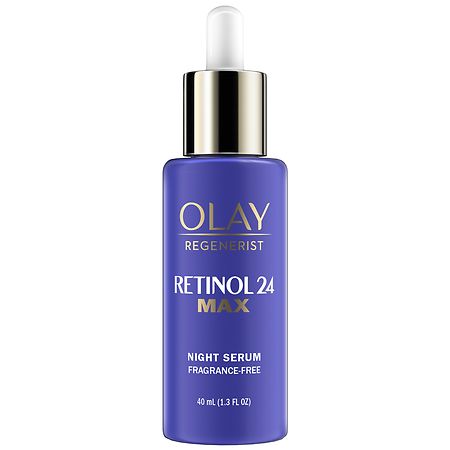

Olay Regenerist Retinol 24 MAX Night Face Serum 1.3 oz
Summary
This serum contains beneficial skin actives like retinol and niacinamide, which are known for their anti-aging properties. However, the presence of synthetic fragrance and other synthetic ingredients slightly lowers its safety profile. The product is moderately processed, which affects its overall rating, but it still offers some skin benefits due to its active ingredients.
At a glance
Key ingredients 19
Water
Water is a universal solvent used in cosmetics to dissolve other ingredients. It helps in the application and absorption of the product. It is generally considered safe and non-irritating.
Risks
There are no significant risks associated with water in cosmetics.
Benefits
Water hydrates the skin and helps in the delivery of active ingredients.
Dimethicone
Dimethicone is a silicone-based polymer used to provide a smooth application and form a protective barrier on the skin. It helps to lock in moisture and improve the texture of the product. It is generally considered safe for most skin types.
Risks
Some individuals may experience skin irritation or breakouts from silicone-based products.
Benefits
Dimethicone can help to reduce water loss and improve skin hydration.
Glycerin
Glycerin is a humectant that attracts moisture to the skin, helping to maintain hydration. It is widely used in skincare for its moisturizing properties. It is considered safe and beneficial for most skin types.
Risks
Glycerin is generally safe, but in rare cases, it may cause irritation in sensitive individuals.
Benefits
Glycerin helps to keep the skin soft and supple by drawing moisture from the environment.
Retinol
Retinol is a form of Vitamin A that promotes cell turnover and improves skin texture. It is known for its anti-aging benefits, reducing the appearance of fine lines and wrinkles. It is a potent ingredient that requires careful formulation to minimize irritation.
Risks
Retinol can cause irritation, redness, and peeling, especially in sensitive skin or when used excessively.
Benefits
Retinol is effective in improving skin tone, texture, and reducing signs of aging.
Retinyl Propionate
Retinyl Propionate is a derivative of Vitamin A that is used for its anti-aging properties. It is milder than retinol, making it suitable for sensitive skin. It helps to improve skin elasticity and reduce wrinkles.
Risks
Potential for irritation exists, especially if used in conjunction with other retinoids.
Benefits
Retinyl Propionate offers anti-aging benefits with a lower risk of irritation compared to retinol.
Niacinamide
Niacinamide is a form of Vitamin B3 that is known for its anti-inflammatory and brightening properties. It helps to improve skin barrier function and reduce redness. It is well-tolerated by most skin types.
Risks
Niacinamide is generally safe, but high concentrations may cause mild irritation.
Benefits
Niacinamide improves skin texture, reduces pore size, and enhances skin radiance.
Palmitoyl Pentapeptide-4
Palmitoyl Pentapeptide-4 is a peptide that stimulates collagen production and improves skin elasticity. It is used for its anti-aging benefits, helping to reduce the appearance of fine lines. It is considered safe and effective for most skin types.
Risks
There are minimal risks associated with peptides, though some individuals may experience mild irritation.
Benefits
Peptides like Palmitoyl Pentapeptide-4 help to firm the skin and reduce signs of aging.
Dimethicone Crosspolymer
Dimethicone Crosspolymer is a silicone derivative used to enhance the texture and spreadability of products. It provides a silky feel and helps to fill in fine lines. It is generally considered safe for topical use.
Risks
May cause breakouts or irritation in individuals sensitive to silicones.
Benefits
Improves product texture and provides a smooth application.
Polyacrylamide
Polyacrylamide is a thickening agent used to stabilize formulations and improve texture. It is effective in creating a smooth, gel-like consistency. However, it is a synthetic polymer that can be concerning due to potential impurities.
Risks
Polyacrylamide may contain acrylamide, a potential carcinogen, as an impurity.
Benefits
Provides a desirable texture and consistency to cosmetic products.
Titanium Dioxide
Titanium Dioxide is a mineral used as a pigment and UV filter in cosmetics. It provides opacity and sun protection. It is considered safe and effective when used in non-nano form.
Risks
Inhalation of nano-sized particles can be a concern, though topical use is generally safe.
Benefits
Offers sun protection and improves product opacity.
C13-14 Isoparaffin
C13-14 Isoparaffin is a hydrocarbon used as an emollient and thickening agent. It helps to improve the texture and spreadability of products. It is generally considered safe for use in cosmetics.
Risks
May cause irritation in sensitive individuals or those with compromised skin barriers.
Benefits
Enhances product texture and provides a smooth application.
DMDM Hydantoin
DMDM Hydantoin is a formaldehyde-releasing preservative used to prevent microbial growth. It is effective in extending the shelf life of products. However, it is a controversial ingredient due to its potential to release formaldehyde.
Risks
Formaldehyde release can cause skin irritation and allergic reactions.
Benefits
Prevents microbial contamination and extends product shelf life.
Mica
Mica is a mineral used to add shimmer and improve the appearance of cosmetics. It provides a natural glow and enhances the visual appeal of products. It is generally considered safe for use in cosmetics.
Risks
Inhalation of mica particles can be a concern, though topical use is safe.
Benefits
Adds a luminous finish and enhances product aesthetics.
Polysorbate 20
Polysorbate 20 is an emulsifier used to stabilize formulations and improve texture. It helps to blend oil and water-based ingredients. It is generally considered safe for use in cosmetics.
Risks
May cause irritation in sensitive individuals.
Benefits
Improves product stability and texture.
Laureth-4
Laureth-4 is an emulsifier and surfactant used to improve the texture and spreadability of products. It helps to blend ingredients and create a uniform consistency. It is generally considered safe for use in cosmetics.
Risks
May cause irritation or allergic reactions in sensitive individuals.
Benefits
Enhances product texture and consistency.
Dimethiconol
Dimethiconol is a silicone-based polymer used to provide a smooth application and improve product texture. It forms a protective barrier on the skin, helping to lock in moisture. It is generally considered safe for use in cosmetics.
Risks
May cause breakouts or irritation in individuals sensitive to silicones.
Benefits
Improves skin hydration and provides a smooth application.
Laureth-7
Laureth-7 is an emulsifier and surfactant used to improve the texture and spreadability of products. It helps to blend ingredients and create a uniform consistency. It is generally considered safe for use in cosmetics.
Risks
May cause irritation or allergic reactions in sensitive individuals.
Benefits
Enhances product texture and consistency.
Disodium EDTA
Disodium EDTA is a chelating agent used to improve the stability and efficacy of cosmetic formulations. It binds to metal ions, preventing them from affecting the product. It is generally considered safe for use in cosmetics.
Risks
May cause irritation in sensitive individuals.
Benefits
Improves product stability and prevents degradation.
Iodopropynyl Butylcarbamate
Iodopropynyl Butylcarbamate is a preservative used to prevent microbial growth in cosmetics. It is effective in low concentrations and helps to extend product shelf life. It is generally considered safe for use in cosmetics.
Risks
May cause irritation or allergic reactions in sensitive individuals.
Benefits
Prevents microbial contamination and extends product shelf life.
Processing
Processed Foods
Get the full breakdown in the Scout app
Scan any product to see lab results, healthy alternatives, and your personalized analysis.
Download on theApp Store