
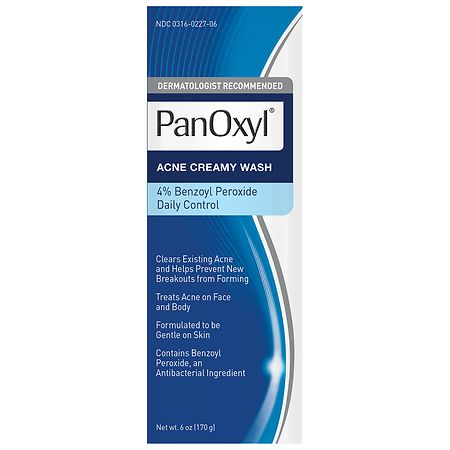

PanOxyl 4% Benzoyl Peroxide Acne Creamy Wash for Face & Body - Unscented - 6oz: Whole Body, Paraben-Free, Acne-Prone
Summary
This face wash contains benzoyl peroxide, a common and effective acne treatment, but also includes several synthetic ingredients such as polyacrylate crosspolymer-6 and dimethicone, which are not naturally derived. The presence of carbomers and other synthetic emulsifiers indicates a moderate level of processing. While it is paraben-free and unscented, the inclusion of some synthetic components prevents it from achieving a higher score.
At a glance
Key ingredients 22
Benzoyl Peroxide 4%Good
Benzoyl Peroxide is a well-known acne treatment that helps to reduce bacteria and clear pores. It is effective in reducing acne lesions and preventing future breakouts. However, it can be drying and irritating to sensitive skin.
Risks
Potential for skin irritation and dryness, especially in sensitive skin types.
Benefits
Effective in treating acne by reducing bacteria and clearing pores.
Carbomer Homopolymer Type CNeutral
Carbomer is a thickening agent used to stabilize emulsions. It is generally considered safe and non-irritating. It does not provide direct skin benefits but helps in product formulation.
Risks
Minimal risk, generally considered safe.
Benefits
Helps stabilize and thicken formulations.
Carbomer Interpolymer Type ANeutral
Similar to other carbomers, it acts as a thickening and stabilizing agent in cosmetic formulations. It is non-reactive and safe for use. It does not offer direct skin benefits.
Risks
Minimal risk, generally considered safe.
Benefits
Contributes to the stability and texture of the product.
Decyl GlucosideGood
Decyl Glucoside is a mild, non-ionic surfactant derived from glucose. It is gentle on the skin and suitable for sensitive skin types. It effectively cleanses without stripping natural oils.
Risks
Low risk of irritation, generally well-tolerated.
Benefits
Provides gentle cleansing suitable for sensitive skin.
DimethiconeNeutral
Dimethicone is a silicone-based polymer used for its smoothing and moisturizing properties. It forms a barrier on the skin, preventing moisture loss. It is non-comedogenic and widely used in skincare.
Risks
Minimal risk, can cause build-up if not properly cleansed.
Benefits
Provides a smooth application and helps retain moisture.
Dioctyl Sodium SulfosuccinateNeutral
This ingredient is used as a surfactant and emulsifier in cosmetic formulations. It helps to mix oil and water components. It is generally considered safe for use in cosmetics.
Risks
Low risk of irritation, generally considered safe.
Benefits
Helps in emulsifying and stabilizing formulations.
GlycerinVery Good
Glycerin is a humectant that attracts moisture to the skin, keeping it hydrated. It is a common ingredient in skincare due to its moisturizing properties. It is safe and effective for all skin types.
Risks
Minimal risk, generally considered safe.
Benefits
Excellent moisturizer that helps maintain skin hydration.
Palmitic AcidNeutral
Palmitic Acid is a fatty acid used as an emollient and surfactant. It helps to soften the skin and improve texture. It is generally safe and non-irritating.
Risks
Minimal risk, generally considered safe.
Benefits
Contributes to skin softness and product texture.
Polyacrylate Crosspolymer-6Neutral
This ingredient is used as a thickening agent and stabilizer in cosmetic formulations. It helps to improve the texture and consistency of products. It is considered safe for use in cosmetics.
Risks
Minimal risk, generally considered safe.
Benefits
Enhances product texture and stability.
Polyoxyl 40 StearateNeutral
Polyoxyl 40 Stearate is an emulsifier that helps to blend oil and water components. It is commonly used in skincare products for its stabilizing properties. It is generally considered safe for use.
Risks
Minimal risk, generally considered safe.
Benefits
Helps stabilize emulsions and improve product consistency.
PropanediolNeutral
Propanediol is a glycol used as a solvent and humectant in cosmetics. It helps to improve skin hydration and product texture. It is considered safe and non-irritating.
Risks
Minimal risk, generally considered safe.
Benefits
Improves skin hydration and product texture.
Purified WaterNeutral
Purified Water is used as a solvent in cosmetic formulations. It helps to dissolve other ingredients and provides a base for the product. It is safe and essential in many formulations.
Risks
No risks associated with its use.
Benefits
Acts as a solvent and base for formulations.
SilicaNeutral
Silica is used as an absorbent and anti-caking agent in cosmetics. It helps to improve the texture and feel of products. It is generally considered safe for use.
Risks
Minimal risk, generally considered safe.
Benefits
Improves product texture and prevents caking.
Sodium ChlorideNeutral
Sodium Chloride, or table salt, is used as a thickening agent in cosmetics. It helps to improve the viscosity of products. It is safe and non-irritating in cosmetic formulations.
Risks
Minimal risk, generally considered safe.
Benefits
Enhances product viscosity and texture.
Sodium CitrateNeutral
Sodium Citrate is used as a buffering agent in cosmetics to maintain pH balance. It helps to stabilize formulations and is generally considered safe. It does not provide direct skin benefits.
Risks
Minimal risk, generally considered safe.
Benefits
Helps maintain pH balance and stabilize formulations.
Sodium HydroxideNeutral
Sodium Hydroxide is used to adjust the pH of cosmetic formulations. It is effective in small amounts but can be irritating in higher concentrations. It is generally safe when used appropriately.
Risks
Potential for irritation if used in high concentrations.
Benefits
Helps adjust and maintain the pH of formulations.
Sodium Laurylglucosides HydroxypropylsulfonateNeutral
This ingredient is a mild surfactant used for its cleansing properties. It is derived from natural sources and is gentle on the skin. It is considered safe and effective for cleansing.
Risks
Low risk of irritation, generally well-tolerated.
Benefits
Provides gentle cleansing suitable for sensitive skin.
Sorbitan StearateNeutral
Sorbitan Stearate is an emulsifier used to stabilize cosmetic formulations. It helps to blend oil and water components effectively. It is generally considered safe for use.
Risks
Minimal risk, generally considered safe.
Benefits
Helps stabilize emulsions and improve product consistency.
SorbitolNeutral
Sorbitol is a sugar alcohol used as a humectant in cosmetics. It helps to retain moisture in the skin and improve product texture. It is safe and non-irritating.
Risks
Minimal risk, generally considered safe.
Benefits
Helps retain moisture and improve product texture.
Stearic AcidNeutral
Stearic Acid is a fatty acid used as an emulsifier and thickener in cosmetics. It helps to stabilize formulations and improve texture. It is generally considered safe for use.
Risks
Minimal risk, generally considered safe.
Benefits
Contributes to product stability and texture.
T-Butyl AlcoholNeutral
T-Butyl Alcohol is used as a solvent and denaturant in cosmetics. It helps to dissolve other ingredients and improve product formulation. It is generally considered safe in small amounts.
Risks
Potential for irritation if used in high concentrations.
Benefits
Acts as a solvent to improve product formulation.
Xanthan GumNeutral
Xanthan Gum is a natural thickening agent used in cosmetics. It helps to stabilize and thicken formulations. It is safe and non-irritating for use in skincare products.
Risks
Minimal risk, generally considered safe.
Benefits
Enhances product stability and texture.
Processing
Processed Foods
Get the full breakdown in the Scout app
Scan any product to see lab results, healthy alternatives, and your personalized analysis.
Download on theApp Store