
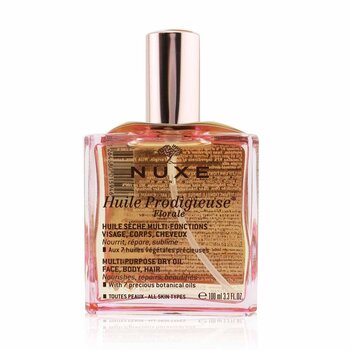


NUXE Huile Prodigieuse Florale Multi-Purpose Dry Oil Unisex Oil 3.3 oz 100ml
Analysis updated September 2026 · How Scout scores
At a glance
Summary
This product contains a variety of beneficial natural oils such as macadamia, sweet almond, and argan oil, which are known for their moisturizing and nourishing properties. However, it also includes several fragrance components like limonene and linalool, which are common allergens and can cause skin irritation. The presence of these fragrance allergens slightly lowers the overall safety profile of the product.
Key ingredients 24
MACADAMIA INTEGRIFOLIA SEED OILVery Good
Macadamia Integrifolia Seed Oil is a natural oil rich in fatty acids, particularly palmitoleic acid, which is similar to human sebum. It is highly moisturizing and helps to restore the skin's barrier function.
Risks
There are minimal risks, though individuals with nut allergies should exercise caution.
Benefits
It is excellent for moisturizing and nourishing the skin, making it soft and supple.
PRUNUS AMYGDALUS DULCIS (SWEET ALMOND) OILVery Good
Sweet Almond Oil is a natural oil rich in vitamins A and E, as well as fatty acids. It is known for its moisturizing and nourishing properties.
Risks
Individuals with nut allergies should use caution.
Benefits
It helps to soothe and hydrate the skin, improving its overall appearance.
CORYLUS AVELLANA (HAZELNUT) SEED OILVery Good
Hazelnut Seed Oil is a natural oil rich in fatty acids and vitamin E. It is known for its astringent and moisturizing properties.
Risks
There are minimal risks, though nut allergies should be considered.
Benefits
It helps to balance oil production and tighten the skin, making it ideal for oily or combination skin types.
CAMELLIA OLEIFERA SEED OILVery Good
Camellia Oleifera Seed Oil is a natural oil rich in antioxidants and fatty acids. It is known for its moisturizing and anti-aging properties.
Risks
There are minimal risks associated with this ingredient.
Benefits
It helps to nourish and protect the skin, reducing the appearance of fine lines and wrinkles.
CAMELLIA JAPONICA SEED OILVery Good
Camellia Japonica Seed Oil is a natural oil rich in oleic acid and antioxidants. It is highly moisturizing and helps to improve skin elasticity.
Risks
There are minimal risks, though it may cause mild irritation in very sensitive skin.
Benefits
It provides deep hydration and helps to maintain the skin's natural barrier.
TOCOPHEROLVery Good
Tocopherol, or Vitamin E, is a powerful antioxidant that helps to protect the skin from free radical damage. It is also moisturizing and soothing.
Risks
There are minimal risks, though high concentrations may cause irritation in sensitive skin.
Benefits
It helps to improve skin texture and reduce signs of aging.
ARGANIA SPINOSA KERNEL OILVery Good
Argan Oil is a natural oil rich in fatty acids and vitamin E. It is known for its moisturizing and anti-inflammatory properties.
Risks
There are minimal risks, though it may cause mild irritation in very sensitive skin.
Benefits
It helps to hydrate and nourish the skin, improving its elasticity and softness.
BORAGO OFFICINALIS SEED OILVery Good
Borage Seed Oil is rich in gamma-linolenic acid (GLA), an essential fatty acid. It is known for its anti-inflammatory and moisturizing properties.
Risks
There are minimal risks, though it may cause mild irritation in very sensitive skin.
Benefits
It helps to soothe and calm irritated skin, making it ideal for sensitive skin types.
HELIANTHUS ANNUUS (SUNFLOWER) SEED OILVery Good
Sunflower Seed Oil is a natural oil rich in linoleic acid and vitamin E. It is known for its moisturizing and barrier-repairing properties.
Risks
There are minimal risks, though it may cause mild irritation in very sensitive skin.
Benefits
It helps to hydrate and protect the skin, improving its overall health.
CAPRYLIC/CAPRIC TRIGLYCERIDEGood
Caprylic/Capric Triglyceride is derived from coconut oil and glycerin. It is used as an emollient and helps to improve the spreadability of the product.
Risks
There are minimal risks, though it may cause mild irritation in very sensitive skin.
Benefits
It is lightweight and non-greasy, providing excellent skin conditioning properties.
TOCOPHERYL ACETATEGood
Tocopheryl Acetate is a form of Vitamin E used for its antioxidant properties. It helps to protect the skin from environmental stressors.
Risks
There are minimal risks, though high concentrations may cause irritation in sensitive skin.
Benefits
It helps to improve skin texture and reduce signs of aging.
ROSMARINUS OFFICINALIS (ROSEMARY) LEAF EXTRACTGood
Rosemary Leaf Extract is a natural antioxidant and anti-inflammatory agent. It helps to protect the skin from free radical damage.
Risks
There are minimal risks, though it may cause mild irritation in very sensitive skin.
Benefits
It helps to soothe and calm the skin, reducing redness and irritation.
ASCORBIC ACIDGood
Ascorbic Acid, or Vitamin C, is a powerful antioxidant that helps to brighten the skin and reduce signs of aging. It is also known for its collagen-boosting properties.
Risks
There are minimal risks, though high concentrations may cause irritation in sensitive skin.
Benefits
It helps to improve skin tone and texture, reducing the appearance of fine lines and wrinkles.
COCO-CAPRYLATE/CAPRATENeutral
Coco-Caprylate/Caprate is an emollient derived from coconut oil and caprylic/capric fatty acids. It is used to improve skin feel and provide a silky texture. It is generally considered safe and non-irritating.
Risks
There are minimal risks associated with this ingredient, primarily related to potential allergic reactions in sensitive individuals.
Benefits
It provides a lightweight, non-greasy feel and enhances the spreadability of the product.
DICAPRYLYL ETHERNeutral
Dicaprylyl Ether is a synthetic oil used as an emollient and skin-conditioning agent. It provides a dry, silky feel to the skin.
Risks
There are minimal risks, primarily related to potential skin irritation in sensitive individuals.
Benefits
It enhances the texture of the product, making it feel smooth and non-greasy.
POLYGLYCERYL-3 DIISOSTEARATENeutral
Polyglyceryl-3 Diisostearate is an emulsifier used to stabilize formulations. It helps to blend oil and water components.
Risks
There are minimal risks, primarily related to potential skin irritation in sensitive individuals.
Benefits
It improves the texture and stability of the product.
AQUA/WATERNeutral
Water is used as a solvent in cosmetic formulations. It helps to dissolve other ingredients and provides hydration.
Risks
There are no significant risks associated with water in cosmetic formulations.
Benefits
It helps to hydrate the skin and improve the texture of the product.
LIMONENEBad
Limonene is a fragrance component that can cause skin irritation and allergic reactions. It is a common allergen in cosmetic products.
Risks
It can cause skin sensitivity and allergic reactions, especially in those with sensitive skin.
Benefits
It provides a citrus scent to the product.
LINALOOLBad
Linalool is a fragrance component that can cause skin irritation and allergic reactions. It is a common allergen in cosmetic products.
Risks
It can cause skin sensitivity and allergic reactions, especially in those with sensitive skin.
Benefits
It provides a floral scent to the product.
CITRALBad
Citral is a fragrance component that can cause skin irritation and allergic reactions. It is a common allergen in cosmetic products.
Risks
It can cause skin sensitivity and allergic reactions, especially in those with sensitive skin.
Benefits
It provides a lemon scent to the product.
CITRONELLOLBad
Citronellol is a fragrance component that can cause skin irritation and allergic reactions. It is a common allergen in cosmetic products.
Risks
It can cause skin sensitivity and allergic reactions, especially in those with sensitive skin.
Benefits
It provides a rose scent to the product.
HYDROXYCITRONELLALBad
Hydroxycitronellal is a fragrance component that can cause skin irritation and allergic reactions. It is a common allergen in cosmetic products.
Risks
It can cause skin sensitivity and allergic reactions, especially in those with sensitive skin.
Benefits
It provides a floral scent to the product.
GERANIOLBad
Geraniol is a fragrance component that can cause skin irritation and allergic reactions. It is a common allergen in cosmetic products.
Risks
It can cause skin sensitivity and allergic reactions, especially in those with sensitive skin.
Benefits
It provides a rose-like scent to the product.
PARFUM/FRAGRANCEVery Bad
Fragrance is a mixture of aromatic compounds used to impart scent. It is a common allergen and can cause skin irritation.
Risks
Fragrance can lead to allergic reactions and skin sensitivity, especially in those with sensitive skin.
Benefits
It provides a pleasant scent to the product, enhancing the user experience.
Get the full breakdown in the Scout appTake Scout shopping
Scan any product to see lab results, healthy alternatives, and your personalized analysis.
Download on theApp Store GET IT ONGoogle PlayAmazon pricing & content
Amazon price as of . Product prices and availability are accurate as of the date/time indicated and are subject to change. Any price and availability information displayed on Amazon.com at the time of purchase will apply to the purchase of this product.
CERTAIN CONTENT THAT APPEARS ON THIS SITE COMES FROM AMAZON. THIS CONTENT IS PROVIDED “AS IS” AND IS SUBJECT TO CHANGE OR REMOVAL AT ANY TIME.