
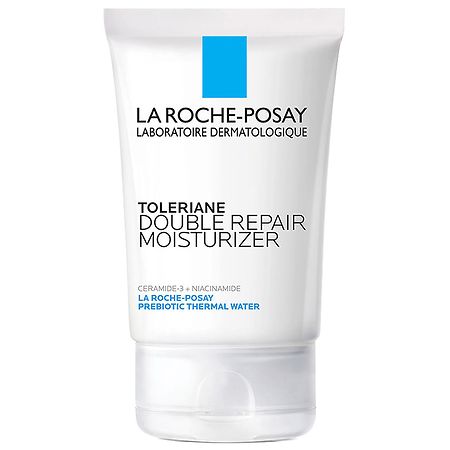
La Roche Posay Toleriane Double Repair Face Moisturizer with Ceramide and Niacinamide - 3.38 fl oz: Paraben-Free, Alcohol-Free
Summary
This moisturizer contains beneficial ingredients like niacinamide, ceramide NP, glycerin, and tocopherol, which are known for their skin-enhancing properties. However, it includes synthetic components such as dimethicone and acrylonitrile/methyl methacrylate/vinylidene chloride copolymer, which are common in processed skincare products. The absence of parabens and alcohol is positive, but the presence of synthetic polymers slightly lowers its overall ingredient safety score.
At a glance
Key ingredients 20
NiacinamideVery Good
Niacinamide is a form of Vitamin B3 that is known for its anti-inflammatory properties and ability to improve skin texture. It helps in reducing redness and blotchiness, making it suitable for sensitive skin. Additionally, it enhances the skin's barrier function, which helps retain moisture.
Risks
Niacinamide is generally well-tolerated, but in rare cases, it may cause mild irritation or redness.
Benefits
It is beneficial for improving skin elasticity, reducing fine lines, and evening out skin tone.
Ceramide NPVery Good
Ceramide NP is a lipid molecule that is naturally found in the skin and plays a crucial role in maintaining the skin's barrier function. It helps to lock in moisture and protect the skin from environmental damage. This ingredient is particularly beneficial for dry or sensitive skin types.
Risks
Ceramide NP is considered safe and is unlikely to cause any adverse effects.
Benefits
It helps in restoring the skin's natural barrier, improving hydration, and reducing signs of aging.
GlycerinGood
Glycerin is a humectant that attracts moisture to the skin, helping to keep it hydrated. It is a common ingredient in skincare products due to its ability to improve skin smoothness and suppleness. Glycerin is non-irritating and suitable for all skin types.
Risks
There are minimal risks associated with glycerin, though it may cause irritation if used in high concentrations.
Benefits
It effectively hydrates the skin and enhances the penetration of other beneficial ingredients.
DimethiconeNeutral
Dimethicone is a type of silicone that forms a barrier on the skin, providing a smooth and silky feel. It is often used in moisturizers to prevent water loss and improve the texture of the product. While it is effective in creating a protective layer, it does not provide any active skin benefits.
Risks
Dimethicone is generally safe, but it may cause breakouts in acne-prone skin due to its occlusive nature.
Benefits
It helps in smoothing the skin's surface and reducing the appearance of fine lines.
Hydrogenated PolyisobuteneNeutral
Hydrogenated Polyisobutene is a synthetic polymer used as an emollient and moisturizer in skincare products. It provides a non-greasy, lightweight feel and helps to improve the spreadability of the product. While it is effective in enhancing texture, it does not offer direct skin benefits.
Risks
There are no significant risks associated with this ingredient, though it may not be suitable for those seeking natural formulations.
Benefits
It contributes to a smooth application and helps in maintaining skin hydration.
Ammonium Polyacryloyldimethyl TaurateNeutral
Ammonium Polyacryloyldimethyl Taurate is a synthetic polymer used as a thickening agent and stabilizer in cosmetic formulations. It helps to improve the texture and consistency of the product. While it is effective in formulation stability, it does not provide direct skin benefits.
Risks
This ingredient is generally considered safe, with no significant risks reported.
Benefits
It enhances the product's texture and ensures even application.
Myristyl MyristateNeutral
Myristyl Myristate is an ester used as an emollient and thickening agent in skincare products. It provides a creamy texture and helps to soften the skin. While it improves product feel, it does not offer active skin benefits.
Risks
It may cause mild irritation in sensitive individuals, though it is generally well-tolerated.
Benefits
It contributes to a smooth, creamy texture and enhances skin softness.
Stearic AcidNeutral
Stearic Acid is a fatty acid used as an emulsifier and thickener in cosmetic formulations. It helps to stabilize products and improve their texture. While it is effective in formulation, it does not provide direct skin benefits.
Risks
Stearic Acid is generally safe, but it may cause irritation in sensitive skin types.
Benefits
It aids in product stability and provides a smooth application.
Potassium Cetyl PhosphateNeutral
Potassium Cetyl Phosphate is an emulsifying agent that helps to blend oil and water-based ingredients in formulations. It improves the texture and consistency of the product. While it is effective in formulation, it does not offer direct skin benefits.
Risks
This ingredient is considered safe with no significant risks reported.
Benefits
It enhances product stability and ensures a uniform texture.
IsobutaneNeutral
Isobutane is a propellant used in aerosol products to dispense the product evenly. It is a volatile hydrocarbon that evaporates quickly after application. While it is effective in product delivery, it does not provide skin benefits.
Risks
Inhalation of isobutane can be harmful, but it is generally safe when used as directed in cosmetic products.
Benefits
It aids in the even distribution of aerosol products.
Glyceryl Stearate SENeutral
Glyceryl Stearate SE is an emulsifier that helps to blend oil and water components in formulations. It provides a creamy texture and enhances product stability. While it is effective in formulation, it does not offer direct skin benefits.
Risks
This ingredient is generally safe, though it may cause irritation in sensitive individuals.
Benefits
It contributes to a smooth, stable formulation and enhances product feel.
Sodium HydroxideNeutral
Sodium Hydroxide is used to adjust the pH of cosmetic formulations. It is a strong alkaline compound that helps to balance the acidity of the product. While it is effective in pH adjustment, it does not provide skin benefits.
Risks
In high concentrations, it can be irritating, but it is used in safe amounts in cosmetics.
Benefits
It ensures the product has a suitable pH for skin application.
Myristic AcidNeutral
Myristic Acid is a fatty acid used as an emulsifier and surfactant in cosmetic formulations. It helps to stabilize products and improve their texture. While it is effective in formulation, it does not provide direct skin benefits.
Risks
It may cause irritation in sensitive skin types, though it is generally well-tolerated.
Benefits
It aids in product stability and provides a smooth application.
Palmitic AcidNeutral
Palmitic Acid is a fatty acid used as an emollient and thickening agent in skincare products. It helps to soften the skin and improve product texture. While it enhances product feel, it does not offer active skin benefits.
Risks
Palmitic Acid is generally safe, but it may cause irritation in sensitive individuals.
Benefits
It contributes to a smooth, creamy texture and enhances skin softness.
Capryloyl GlycineNeutral
Capryloyl Glycine is an amino acid derivative used for its antimicrobial properties in skincare products. It helps to preserve the product and maintain skin health. While it is effective in preservation, it does not provide direct skin benefits.
Risks
This ingredient is considered safe with no significant risks reported.
Benefits
It aids in product preservation and supports skin health.
Caprylyl GlycolNeutral
Caprylyl Glycol is a humectant and skin conditioning agent used in cosmetic formulations. It helps to retain moisture and improve product texture. While it enhances hydration, it does not offer active skin benefits.
Risks
Caprylyl Glycol is generally safe, though it may cause irritation in sensitive individuals.
Benefits
It contributes to skin hydration and improves product feel.
Xanthan GumNeutral
Xanthan Gum is a natural thickening agent used to stabilize and improve the texture of cosmetic formulations. It helps to create a smooth, even consistency. While it is effective in formulation, it does not provide direct skin benefits.
Risks
This ingredient is considered safe with no significant risks reported.
Benefits
It enhances product stability and ensures a uniform texture.
T-Butyl AlcoholNeutral
T-Butyl Alcohol is used as a solvent and denaturant in cosmetic formulations. It helps to dissolve other ingredients and improve product stability. While it is effective in formulation, it does not provide direct skin benefits.
Risks
In high concentrations, it can be irritating, but it is used in safe amounts in cosmetics.
Benefits
It aids in product stability and enhances ingredient solubility.
Acrylonitrile/Methyl Methacrylate/Vinylidene Chloride CopolymerNeutral
This copolymer is used as a film-forming agent in cosmetic formulations. It helps to create a protective barrier on the skin and improve product texture. While it is effective in formulation, it does not provide direct skin benefits.
Risks
This ingredient is considered safe with no significant risks reported.
Benefits
It enhances product texture and provides a protective barrier on the skin.
TocopherolGood
Tocopherol, also known as Vitamin E, is an antioxidant that helps to protect the skin from free radical damage. It is commonly used in skincare products for its moisturizing and anti-aging properties. Tocopherol is beneficial for maintaining skin health and improving its appearance.
Risks
Tocopherol is generally safe, though it may cause irritation in very sensitive individuals.
Benefits
It provides antioxidant protection and helps to maintain skin moisture and elasticity.
Processing
Processed Foods
Get the full breakdown in the Scout app
Scan any product to see lab results, healthy alternatives, and your personalized analysis.
Download on theApp Store