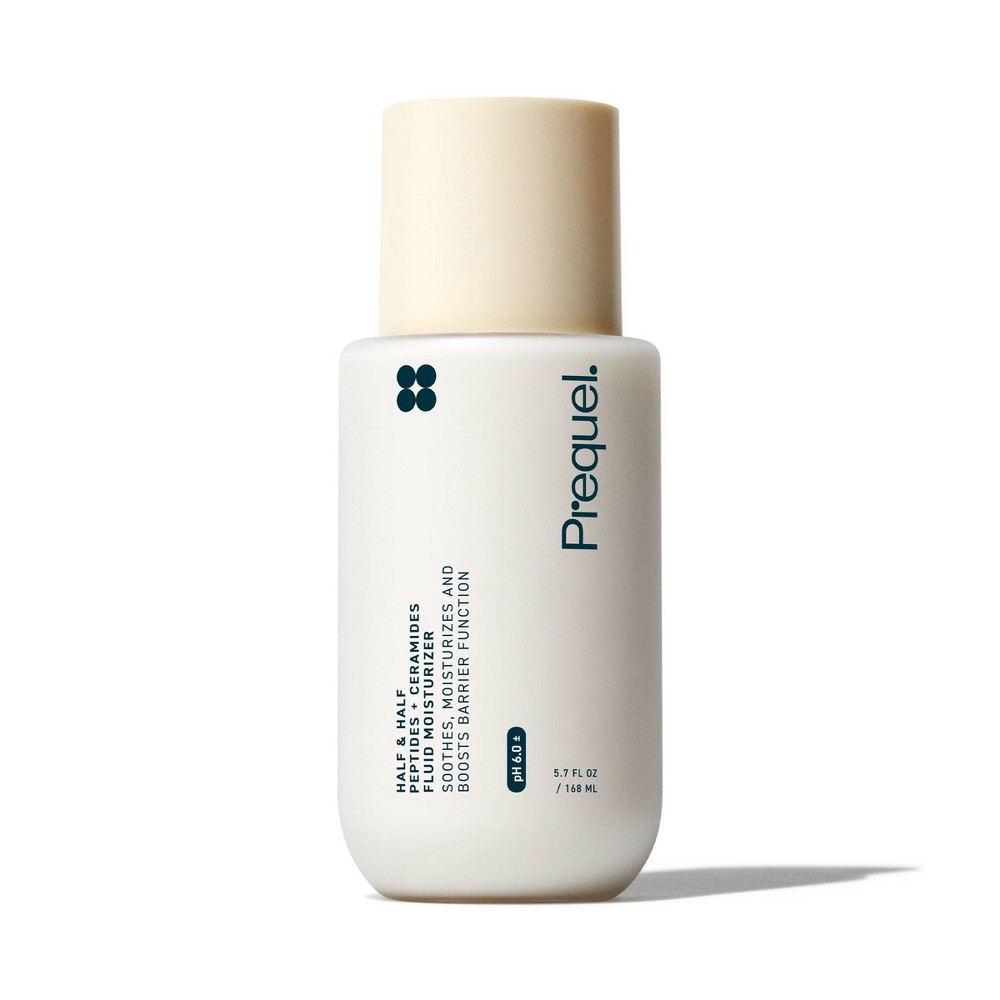
Prequel Half & Half Peptides + Ceramides Fluid Moisturizer - 5.7 fl oz: For Face, Normal to Dry Skin
At a glance
Summary
This moisturizer features a blend of beneficial ingredients like glycerin, squalane, and multiple ceramides, which are excellent for hydration and skin barrier support. The presence of peptides further enhances its skin-repairing properties. Although it contains phenoxyethanol as a preservative, which can be irritating for some, the overall formulation is clean and minimally processed, making it a high-quality skincare product. Its plastic packaging can shed microplastics into the product and lowers its score.
Key ingredients 50
SqualaneVery Good
Squalane is a highly effective emollient and natural antioxidant. It mimics the skin's natural oils, making it an excellent moisturizer. It is non-comedogenic and suitable for all skin types.
Risks
There are no significant risks associated with squalane.
Benefits
Squalane provides deep hydration and helps to improve skin elasticity.
Ceramide ASVery Good
Ceramide AS is a type of ceramide that helps to reinforce the skin's natural barrier. It aids in moisture retention and skin protection. It is considered safe and beneficial for skin health.
Risks
There are no significant risks associated with Ceramide AS.
Benefits
Ceramide AS improves skin barrier function and hydration.
Ceramide NSVery Good
Ceramide NS is a skin-identical lipid that helps to maintain the skin's barrier function. It is crucial for preventing moisture loss. It is safe and beneficial for all skin types.
Risks
There are no significant risks associated with Ceramide NS.
Benefits
Ceramide NS enhances skin hydration and barrier integrity.
Ceramide EOPVery Good
Ceramide EOP is a ceramide that supports the skin's natural barrier and hydration levels. It is essential for healthy skin function. It is well-tolerated and beneficial for all skin types.
Risks
There are no significant risks associated with Ceramide EOP.
Benefits
Ceramide EOP helps to restore and maintain skin barrier function.
Ceramide APVery Good
Ceramide AP is a lipid that plays a key role in maintaining the skin's barrier and moisture levels. It is important for skin health and hydration. It is safe and beneficial for all skin types.
Risks
There are no significant risks associated with Ceramide AP.
Benefits
Ceramide AP enhances skin barrier strength and moisture retention.
Hexapeptide-11Very Good
Hexapeptide-11 is a peptide that helps to improve skin firmness and elasticity. It is known for its anti-aging benefits. It is considered safe and effective for skincare.
Risks
There are no significant risks associated with Hexapeptide-11.
Benefits
Hexapeptide-11 promotes skin firmness and reduces signs of aging.
Palmitoyl Tripeptide-1Very Good
Palmitoyl Tripeptide-1 is a peptide that stimulates collagen production and skin repair. It is used for its anti-aging properties. It is safe and beneficial for improving skin texture.
Risks
There are no significant risks associated with Palmitoyl Tripeptide-1.
Benefits
It enhances skin firmness and reduces the appearance of wrinkles.
Palmitoyl Tetrapeptide-7Very Good
Palmitoyl Tetrapeptide-7 is a peptide that helps to reduce inflammation and improve skin elasticity. It is known for its anti-aging benefits. It is considered safe and effective for skincare.
Risks
There are no significant risks associated with Palmitoyl Tetrapeptide-7.
Benefits
It reduces skin inflammation and enhances elasticity.
GlycerinGood
Glycerin is a humectant that attracts moisture to the skin, helping to keep it hydrated. It is widely used in skincare for its moisturizing properties. It is considered safe and beneficial for most skin types.
Risks
There are minimal risks associated with glycerin; it is generally well-tolerated.
Benefits
Glycerin helps to maintain skin hydration and improve skin barrier function.
PropanediolGood
Propanediol is a glycol that acts as a solvent and humectant in skincare products. It helps to improve the texture and absorption of the product. It is considered safe for use in cosmetics.
Risks
Propanediol may cause mild irritation in sensitive individuals.
Benefits
Propanediol enhances skin hydration and improves product spreadability.
Ethylhexyl OlivateGood
Ethylhexyl Olivate is derived from olive oil and acts as an emollient and skin-conditioning agent. It helps to soften and smooth the skin. It is considered safe and beneficial for skin health.
Risks
There are minimal risks associated with Ethylhexyl Olivate.
Benefits
It provides moisturizing and skin-softening benefits.
Hydrolyzed Rice ProteinGood
Hydrolyzed Rice Protein is used for its conditioning and moisturizing properties. It helps to improve skin texture and hydration. It is considered safe and beneficial for skin health.
Risks
There are minimal risks associated with Hydrolyzed Rice Protein.
Benefits
It enhances skin moisture retention and provides a smoothing effect.
Ceramide NPGood
Ceramide NP is a lipid that helps to restore the skin barrier and retain moisture. It is essential for maintaining healthy skin. It is well-tolerated and beneficial for all skin types.
Risks
There are no significant risks associated with Ceramide NP.
Benefits
Ceramide NP strengthens the skin barrier and improves hydration.
BetaineGood
Betaine is a natural osmolyte that helps to maintain skin hydration and protect against irritation. It is used for its moisturizing and soothing properties. It is considered safe and beneficial for skin health.
Risks
There are minimal risks associated with Betaine.
Benefits
It enhances skin hydration and provides soothing effects.
Sodium PCAGood
Sodium PCA is a natural moisturizing factor that helps to maintain skin hydration. It is used for its excellent moisture-retaining properties. It is considered safe and beneficial for skin health.
Risks
There are minimal risks associated with Sodium PCA.
Benefits
It enhances skin hydration and moisture retention.
PCAGood
PCA is a natural moisturizing factor that helps to maintain skin hydration. It is used for its excellent moisture-retaining properties. It is considered safe and beneficial for skin health.
Risks
There are minimal risks associated with PCA.
Benefits
It enhances skin hydration and moisture retention.
GlycineGood
Beneficial ingredient — whole-food or functional value in this product class.
Risks
There are minimal risks associated with Glycine.
Benefits
It enhances skin hydration and texture.
TocopherolGood
Tocopherol, also known as Vitamin E, is an antioxidant that helps to protect the skin from free radical damage. It is used for its moisturizing and skin-conditioning properties. It is considered safe and beneficial for skin health.
Risks
There are minimal risks associated with Tocopherol.
Benefits
It provides antioxidant protection and enhances skin hydration.
Water (Aqua)Neutral
Water is a common solvent used in cosmetics to dissolve other ingredients. It helps in the application and absorption of the product. It does not have any direct benefits or risks.
Risks
There are no significant risks associated with water in cosmetics.
Benefits
Water helps in hydrating the skin by providing moisture.
Isopropyl MyristateNeutral
Isopropyl Myristate is an emollient that helps to improve the texture and feel of skincare products. It aids in the absorption of other ingredients. It is generally considered safe for use in cosmetics.
Risks
It may cause pore-clogging in acne-prone skin.
Benefits
Isopropyl Myristate enhances the smoothness and spreadability of products.
Polyglyceryl-10 StearateNeutral
Polyglyceryl-10 Stearate is an emulsifier that helps to blend oil and water-based ingredients. It improves the texture and stability of the product. It is generally considered safe for use in cosmetics.
Risks
There are minimal risks associated with Polyglyceryl-10 Stearate.
Benefits
It enhances product stability and texture.
TrioleinNeutral
Triolein is a triglyceride that acts as an emollient and skin-conditioning agent. It helps to soften and smooth the skin. It is generally considered safe for use in cosmetics.
Risks
There are minimal risks associated with Triolein.
Benefits
It provides skin-softening and conditioning benefits.
Ammonium Acryloyldimethyltaurate/VP CopolymerNeutral
This copolymer is used as a thickening agent and film-former in cosmetics. It helps to improve the texture and application of the product. It is generally considered safe for use in cosmetics.
Risks
There are minimal risks associated with this copolymer.
Benefits
It enhances product texture and application.
Glyceryl OleateNeutral
Glyceryl Oleate is an emulsifier and skin-conditioning agent. It helps to blend ingredients and improve skin feel. It is generally considered safe for use in cosmetics.
Risks
There are minimal risks associated with Glyceryl Oleate.
Benefits
It enhances product stability and skin feel.
UndecaneNeutral
Undecane is a hydrocarbon used as an emollient and solvent in cosmetics. It helps to improve the texture and spreadability of the product. It is generally considered safe for use in cosmetics.
Risks
There are minimal risks associated with Undecane.
Benefits
It enhances product texture and spreadability.
HydroxyacetophenoneNeutral
Hydroxyacetophenone is an antioxidant and preservative used in cosmetics. It helps to protect the product from degradation. It is generally considered safe for use in cosmetics.
Risks
There are minimal risks associated with Hydroxyacetophenone.
Benefits
It provides antioxidant protection and product stability.
Glyceryl DioleateNeutral
Glyceryl Dioleate is an emulsifier and skin-conditioning agent. It helps to blend ingredients and improve skin feel. It is generally considered safe for use in cosmetics.
Risks
There are minimal risks associated with Glyceryl Dioleate.
Benefits
It enhances product stability and skin feel.
Caprylyl GlycolNeutral
Caprylyl Glycol is a humectant and skin-conditioning agent. It helps to retain moisture and improve skin feel. It is generally considered safe for use in cosmetics.
Risks
There are minimal risks associated with Caprylyl Glycol.
Benefits
It enhances skin hydration and product texture.
Xanthan GumNeutral
Xanthan Gum is a thickening agent used to stabilize and improve the texture of cosmetics. It helps to maintain product consistency. It is generally considered safe for use in cosmetics.
Risks
There are minimal risks associated with Xanthan Gum.
Benefits
It enhances product stability and texture.
TridecaneNeutral
Tridecane is a hydrocarbon used as an emollient and solvent in cosmetics. It helps to improve the texture and spreadability of the product. It is generally considered safe for use in cosmetics.
Risks
There are minimal risks associated with Tridecane.
Benefits
It enhances product texture and spreadability.
Sodium Stearoyl GlutamateNeutral
Sodium Stearoyl Glutamate is an emulsifier that helps to blend oil and water-based ingredients. It improves the texture and stability of the product. It is generally considered safe for use in cosmetics.
Risks
There are minimal risks associated with Sodium Stearoyl Glutamate.
Benefits
It enhances product stability and texture.
Citric AcidNeutral
Citric Acid is used to adjust the pH of cosmetics and as a mild exfoliant. It helps to maintain product stability and improve skin texture. It is generally considered safe for use in cosmetics.
Risks
In high concentrations, it may cause skin irritation.
Benefits
It helps to balance pH and provides mild exfoliation.
Sodium PhytateNeutral
Sodium Phytate is a chelating agent that helps to stabilize cosmetics by binding metal ions. It improves product stability and shelf life. It is generally considered safe for use in cosmetics.
Risks
There are minimal risks associated with Sodium Phytate.
Benefits
It enhances product stability and shelf life.
Sodium HydroxideNeutral
Sodium Hydroxide is used to adjust the pH of cosmetics. It helps to maintain product stability and effectiveness. It is generally considered safe for use in cosmetics when used in low concentrations.
Risks
In high concentrations, it can be irritating to the skin.
Benefits
It helps to balance pH and stabilize formulations.
Sodium LactateNeutral
Standard formulation ingredient — neither beneficial nor harmful at typical use.
Risks
There are minimal risks associated with Sodium Lactate.
Benefits
It enhances skin hydration and moisture retention.
SerineNeutral
Serine is an amino acid used for its moisturizing and skin-conditioning properties. It helps to improve skin texture and hydration. It is generally considered safe for use in cosmetics.
Risks
There are minimal risks associated with Serine.
Benefits
It enhances skin hydration and texture.
AlanineNeutral
Alanine is an amino acid used for its moisturizing and skin-conditioning properties. It helps to improve skin texture and hydration. It is generally considered safe for use in cosmetics.
Risks
There are minimal risks associated with Alanine.
Benefits
It enhances skin hydration and texture.
Palmitic AcidNeutral
Palmitic Acid is a fatty acid used as an emollient and surfactant in cosmetics. It helps to improve skin texture and product stability. It is generally considered safe for use in cosmetics.
Risks
There are minimal risks associated with Palmitic Acid.
Benefits
It enhances skin texture and product stability.
Hydrogenated LecithinNeutral
Hydrogenated Lecithin is an emulsifier and skin-conditioning agent. It helps to blend ingredients and improve skin feel. It is generally considered safe for use in cosmetics.
Risks
There are minimal risks associated with Hydrogenated Lecithin.
Benefits
It enhances product stability and skin feel.
Ethylhexyl PalmitateNeutral
Ethylhexyl Palmitate is an emollient that helps to improve the texture and feel of skincare products. It aids in the absorption of other ingredients. It is generally considered safe for use in cosmetics.
Risks
It may cause pore-clogging in acne-prone skin.
Benefits
It enhances the smoothness and spreadability of products.
Butylene GlycolNeutral
Butylene Glycol is a solvent and humectant used to improve the texture and moisture content of cosmetics. It helps to enhance product spreadability. It is generally considered safe for use in cosmetics.
Risks
There are minimal risks associated with Butylene Glycol.
Benefits
It enhances skin hydration and product texture.
EthylhexylglycerinNeutral
Ethylhexylglycerin is a preservative and skin-conditioning agent. It helps to enhance the efficacy of other preservatives. It is generally considered safe for use in cosmetics.
Risks
There are minimal risks associated with Ethylhexylglycerin.
Benefits
It enhances product preservation and skin feel.
Glutamic AcidNeutral
Glutamic Acid is an amino acid used for its moisturizing and skin-conditioning properties. It helps to improve skin texture and hydration. It is generally considered safe for use in cosmetics.
Risks
There are minimal risks associated with Glutamic Acid.
Benefits
It enhances skin hydration and texture.
Lysine HClNeutral
Lysine HCl is an amino acid used for its moisturizing and skin-conditioning properties. It helps to improve skin texture and hydration. It is generally considered safe for use in cosmetics.
Risks
There are minimal risks associated with Lysine HCl.
Benefits
It enhances skin hydration and texture.
ThreonineNeutral
Threonine is an amino acid used for its moisturizing and skin-conditioning properties. It helps to improve skin texture and hydration. It is generally considered safe for use in cosmetics.
Risks
There are minimal risks associated with Threonine.
Benefits
It enhances skin hydration and texture.
ArginineNeutral
Arginine is an amino acid used for its moisturizing and skin-conditioning properties. It helps to improve skin texture and hydration. It is generally considered safe for use in cosmetics.
Risks
There are minimal risks associated with Arginine.
Benefits
It enhances skin hydration and texture.
ProlineNeutral
Proline is an amino acid used for its moisturizing and skin-conditioning properties. It helps to improve skin texture and hydration. It is generally considered safe for use in cosmetics.
Risks
There are minimal risks associated with Proline.
Benefits
It enhances skin hydration and texture.
CarbomerNeutral
Carbomer is a thickening agent used to stabilize and improve the texture of cosmetics. It helps to maintain product consistency. It is generally considered safe for use in cosmetics.
Risks
There are minimal risks associated with Carbomer.
Benefits
It enhances product stability and texture.
Sodium BenzoateBad
Synthetic preservative that can form benzene in the presence of vitamin C.
Risks
In high concentrations, it may cause skin irritation.
Benefits
It helps to preserve product safety and extend shelf life.
PhenoxyethanolBad
Phenoxyethanol is a preservative used to prevent microbial growth in cosmetics. It is effective but can cause irritation in some individuals. It is considered safe in low concentrations but has potential risks.
Risks
It may cause skin irritation and allergic reactions in sensitive individuals.
Benefits
It helps to preserve product safety and extend shelf life.
Processing
Processed Foods
Get the full breakdown in the Scout appTake Scout shopping
Scan any product to see lab results, healthy alternatives, and your personalized analysis.
Are you Round Lab? Fix an error Get the badge Get tested
Amazon pricing & content
Amazon price as of . Product prices and availability are accurate as of the date/time indicated and are subject to change. Any price and availability information displayed on Amazon.com at the time of purchase will apply to the purchase of this product.
CERTAIN CONTENT THAT APPEARS ON THIS SITE COMES FROM AMAZON. THIS CONTENT IS PROVIDED “AS IS” AND IS SUBJECT TO CHANGE OR REMOVAL AT ANY TIME.