
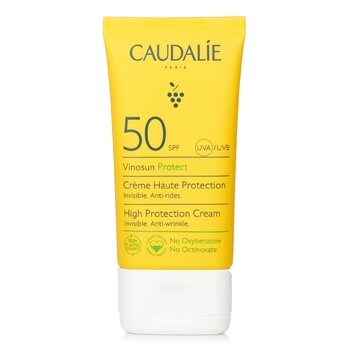

CaudalieVinosun Protect High Protection Cream SPF50 50ml/1.6oz
Analysis updated August 2026 · How Scout scores
At a glance
Summary
This sunscreen contains several chemical UV filters, which can be concerning due to potential skin irritation and environmental impact. The presence of fragrance adds a risk of irritation for sensitive skin. However, it also includes beneficial ingredients like grape seed extract and sunflower seed oil, which provide antioxidant and moisturizing benefits, balancing some of the concerns.
Key ingredients 31
ArginineGood
Arginine is an amino acid that helps in skin hydration and repair. It is known for its moisturizing properties.
Risks
Generally considered safe with low risk of irritation.
Benefits
Enhances skin hydration and supports skin repair processes.
Palmitoyl Grape Seed ExtractGood
Palmitoyl Grape Seed Extract is known for its antioxidant properties. It helps in protecting the skin from oxidative stress.
Risks
Generally considered safe with low risk of irritation.
Benefits
Provides antioxidant protection, supporting skin health.
GlycerinGood
Glycerin is a well-known humectant that attracts moisture to the skin. It is widely used for its hydrating properties.
Risks
Generally considered safe with low risk of irritation.
Benefits
Enhances skin hydration and maintains moisture balance.
Tocopheryl AcetateGood
Tocopheryl Acetate is a form of Vitamin E used for its antioxidant properties. It helps in protecting the skin from oxidative damage.
Risks
Generally considered safe with low risk of irritation.
Benefits
Provides antioxidant protection, supporting skin health.
Helianthus Annuus (Sunflower) Seed OilGood
Sunflower Seed Oil is a natural oil known for its emollient properties. It helps in moisturizing and nourishing the skin.
Risks
Generally considered safe with low risk of irritation.
Benefits
Provides skin nourishment and hydration.
TocopherolGood
Tocopherol is a form of Vitamin E used for its antioxidant properties. It helps in protecting the skin from oxidative damage.
Risks
Generally considered safe with low risk of irritation.
Benefits
Provides antioxidant protection, supporting skin health.
Aqua/Water/EauNeutral
Water is a common solvent used in cosmetics to dissolve other ingredients. It is essential for the formulation but does not provide direct benefits or risks.
Risks
There are no known risks associated with water in cosmetics.
Benefits
Water helps in the application and absorption of the product.
Dibutyl AdipateNeutral
Dibutyl Adipate is used as an emollient and plasticizer in cosmetics. It helps in improving the texture and spreadability of the product.
Risks
There are minimal risks associated with its use in cosmetics.
Benefits
It enhances the smooth application of the product.
Diethylamino Hydroxybenzoil Hexyl BenzoateNeutral
This ingredient is a UV filter used to protect the skin from UVA rays. It is commonly used in sunscreens for its photostability.
Risks
There are no significant risks associated with its use in regulated amounts.
Benefits
Provides effective UVA protection, contributing to the sunscreen's efficacy.
PropanediolNeutral
Propanediol is used as a solvent and humectant in cosmetics. It helps in improving the texture and moisture retention of the product.
Risks
Generally considered safe with low risk of irritation.
Benefits
Enhances skin hydration and product texture.
Dicaprylyl CarbonateNeutral
Dicaprylyl Carbonate is an emollient that provides a velvety feel to the skin. It is used to improve the spreadability of the product.
Risks
There are minimal risks associated with its use.
Benefits
Improves the sensory feel and application of the product.
Ethylhexyl TriazoneNeutral
Ethylhexyl Triazone is a UVB filter used in sunscreens. It is known for its high photostability and effectiveness in protecting against UVB rays.
Benefits
Provides strong UVB protection, enhancing the sunscreen's effectiveness.
MethylpropanediolNeutral
Methylpropanediol is used as a solvent and penetration enhancer in cosmetics. It helps in improving the delivery of active ingredients.
Risks
Generally considered safe with low risk of irritation.
Benefits
Enhances the absorption of active ingredients into the skin.
Bis-Ethylhexyloxyphenol Methoxyphenyl TriazineNeutral
This is a broad-spectrum UV filter used in sunscreens. It is effective in protecting against both UVA and UVB rays.
Benefits
Provides comprehensive UV protection, contributing to the sunscreen's efficacy.
Phenylbenzimidazole Sulfonic AcidNeutral
This ingredient is a UVB filter used in sunscreens. It helps in protecting the skin from sunburn.
Benefits
Provides effective UVB protection, enhancing the sunscreen's effectiveness.
C20-22 Alkyl PhosphateNeutral
C20-22 Alkyl Phosphate is used as an emulsifier in cosmetics. It helps in stabilizing the formulation.
Risks
There are minimal risks associated with its use.
Benefits
Improves the stability and consistency of the product.
C20-22 AlcoholsNeutral
C20-22 Alcohols are fatty alcohols used as emollients and thickeners in cosmetics. They help in improving the texture of the product.
Risks
Generally considered safe with low risk of irritation.
Benefits
Enhances the texture and feel of the product.
Benzotriazolyl Dodecyl P-CresolNeutral
This ingredient is used as a UV absorber in cosmetics. It helps in protecting the product from UV degradation.
Risks
There are minimal risks associated with its use.
Benefits
Protects the product from UV-induced degradation, enhancing its stability.
Caprylyl GlycolNeutral
Caprylyl Glycol is used as a skin conditioning agent and preservative booster. It helps in improving the product's shelf life.
Risks
Generally considered safe with low risk of irritation.
Benefits
Enhances skin conditioning and product preservation.
Caprylyl/Capryl GlucosideNeutral
This ingredient is a mild surfactant used in cosmetics. It helps in cleansing and foaming.
Risks
Generally considered safe with low risk of irritation.
Benefits
Provides gentle cleansing and foaming properties.
SilicaNeutral
Silica is used as an absorbent and anti-caking agent in cosmetics. It helps in improving the texture and mattifying the skin.
Risks
Generally considered safe with low risk of irritation.
Benefits
Improves product texture and provides a matte finish.
Polyacrylate Crosspolymer-6Neutral
This ingredient is used as a thickening agent in cosmetics. It helps in stabilizing and thickening the formulation.
Risks
There are minimal risks associated with its use.
Benefits
Enhances the stability and consistency of the product.
Xanthan GumNeutral
Xanthan Gum is used as a thickening and stabilizing agent in cosmetics. It helps in improving the texture and consistency of the product.
Risks
Generally considered safe with low risk of irritation.
Benefits
Improves product texture and stability.
PhenylpropanolNeutral
Phenylpropanol is used as a preservative and fragrance ingredient in cosmetics. It helps in extending the shelf life of the product.
Risks
There are minimal risks associated with its use.
Benefits
Enhances product preservation and provides a mild fragrance.
O-Cymen-5-OlNeutral
O-Cymen-5-Ol is used as a preservative in cosmetics. It helps in preventing microbial growth in the product.
Risks
There are minimal risks associated with its use.
Benefits
Enhances product preservation by preventing microbial contamination.
Picea Abies Wood ExtractNeutral
Picea Abies Wood Extract is used for its antioxidant properties in cosmetics. It helps in protecting the skin from environmental stressors.
Risks
Generally considered safe with low risk of irritation.
Benefits
Provides antioxidant protection, supporting skin health.
Hexyl CinnamalNeutral
Hexyl Cinnamal is a fragrance ingredient used in cosmetics. It provides a floral scent to the product.
Risks
May cause irritation or allergic reactions in sensitive individuals.
Benefits
Enhances the fragrance profile of the product.
GeraniolNeutral
Geraniol is a fragrance ingredient used in cosmetics. It provides a rose-like scent to the product.
Risks
May cause irritation or allergic reactions in sensitive individuals.
Benefits
Enhances the fragrance profile of the product.
CitronellolNeutral
Citronellol is a fragrance ingredient used in cosmetics. It provides a floral scent to the product.
Risks
May cause irritation or allergic reactions in sensitive individuals.
Benefits
Enhances the fragrance profile of the product.
LinaloolBad
Processed additive flagged under Scout's ingredient doctrine.
Risks
May cause irritation or allergic reactions in sensitive individuals.
Benefits
Enhances the fragrance profile of the product.
Parfum (Fragrance)Very Bad
Fragrance is used to provide a pleasant scent to cosmetics. However, it can cause irritation and allergic reactions in sensitive individuals.
Risks
Potential for skin irritation and allergic reactions.
Benefits
Enhances the sensory experience of the product.
Get the full breakdown in the Scout appTake Scout shopping
Scan any product to see lab results, healthy alternatives, and your personalized analysis.
Download on theApp Store GET IT ONGoogle Play