
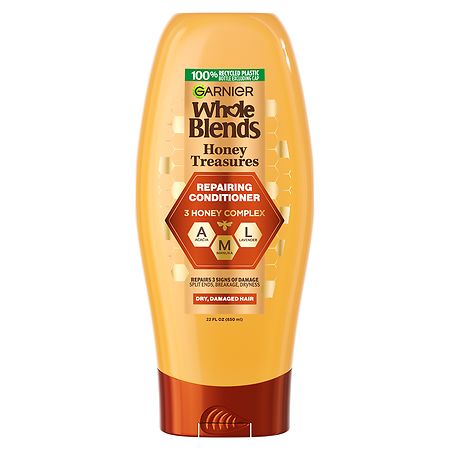
Garnier Whole Blends Honey Treasures Repairing Conditioner - 22 fl oz: For All Hair Types, Daily Use, Cream Formula
Analysis updated August 2026 · How Scout scores
At a glance
Summary
This conditioner contains beneficial ingredients like argan oil, honey, and jojoba esters, which are known for their moisturizing and nourishing properties. However, the presence of non-water-soluble silicone (amodimethicone) and drying alcohols such as isopropyl alcohol and benzyl alcohol can lead to buildup and dryness, respectively. Additionally, synthetic fragrance can cause irritation, which affects the overall safety and health impact of the product on hair and scalp.
Key ingredients 25
Argania Spinosa Kernel OilVery Good
Argan Oil is rich in essential fatty acids and vitamin E, making it an excellent moisturizer for hair. It helps to nourish and strengthen hair, reducing breakage. It is highly valued for its conditioning properties.
Risks
There are minimal risks, though it may cause allergic reactions in rare cases.
Benefits
It deeply conditions and adds shine to hair.
Jojoba EstersVery Good
Jojoba Esters are derived from jojoba oil and are used as emollients in hair care products. They help to moisturize and condition the hair, improving its texture and shine. They are considered safe and beneficial for hair health.
Risks
There are minimal risks, though it may cause allergic reactions in rare cases.
Benefits
They provide moisture and enhance hair's natural shine.
Behentrimonium ChlorideGood
Behentrimonium Chloride is a conditioning agent that helps detangle hair and reduce static. It is effective in improving hair manageability. It is generally regarded as safe for use in hair care products.
Risks
In rare cases, it may cause irritation to sensitive scalps.
Benefits
It enhances hair softness and smoothness.
Mel / Honey / MielGood
Honey is a natural humectant that attracts moisture to the hair. It helps to hydrate and soften hair, improving its overall health. It is well-regarded for its nourishing properties.
Risks
There are minimal risks, though it may cause stickiness if not rinsed properly.
Benefits
It provides hydration and enhances hair's natural shine.
Aqua / Water / EauNeutral
Water is a common solvent used in cosmetic formulations. It helps dissolve other ingredients and provides a base for the product. It is generally considered safe and non-reactive.
Risks
There are no significant risks associated with water in cosmetic products.
Benefits
Water helps in the even distribution of the product on hair.
Cetearyl AlcoholNeutral
Standard formulation ingredient — neither beneficial nor harmful at typical use.
Risks
There are minimal risks, though some individuals may experience mild irritation.
Benefits
It provides moisture and improves the texture of hair.
Acacia Decurrens Flower Cera / Acacia Decurrens Flower WaxNeutral
Acacia Decurrens Flower Wax is used as a thickening agent and emollient. It helps to provide texture and consistency to the product. It is generally considered safe for use in cosmetics.
Risks
There are no significant risks associated with this ingredient.
Benefits
It helps in maintaining the product's consistency.
Helianthus Annuus Seed Cera / Sunflower Seed WaxNeutral
Sunflower Seed Wax is used as a thickener and emollient in cosmetic formulations. It helps to stabilize the product and provide a smooth texture. It is considered safe and non-irritating.
Risks
There are no significant risks associated with this ingredient.
Benefits
It contributes to the product's texture and stability.
Cera Alba / Beeswax / Cire DabeilleNeutral
Beeswax is used as a thickening agent and emollient in hair care products. It helps to provide texture and hold to the product. It is generally considered safe for use in cosmetics.
Risks
There are no significant risks, though it may cause buildup if used excessively.
Benefits
It helps in maintaining the product's consistency and provides a slight hold.
Potassium HydroxideNeutral
Potassium Hydroxide is used to adjust the pH of cosmetic formulations. It helps to maintain the stability and effectiveness of the product. It is used in small amounts and is considered safe.
Risks
In high concentrations, it can be irritating, but it is used in safe amounts in cosmetics.
Benefits
It helps in maintaining the product's pH balance.
Trideceth-6Neutral
Trideceth-6 is a surfactant and emulsifier used in cosmetic formulations. It helps to blend oil and water components, ensuring product stability. It is generally considered safe for use in cosmetics.
Risks
There are no significant risks associated with this ingredient.
Benefits
It aids in the even distribution of the product.
Isopropyl AlcoholNeutral
Standard formulation ingredient — neither beneficial nor harmful at typical use.
Risks
Prolonged use can lead to dry, brittle hair and scalp irritation.
Benefits
It helps in quick drying of the product.
Citric AcidNeutral
Citric Acid is used to adjust the pH of cosmetic formulations. It helps to maintain the stability and effectiveness of the product. It is generally considered safe for use in cosmetics.
Risks
In high concentrations, it can be irritating, but it is used in safe amounts in cosmetics.
Benefits
It helps in maintaining the product's pH balance.
Polyglycerin-3Neutral
Polyglycerin-3 is used as an emollient and humectant in cosmetic formulations. It helps to moisturize and soften the hair. It is generally considered safe for use in cosmetics.
Risks
There are no significant risks associated with this ingredient.
Benefits
It provides moisture and improves hair texture.
Benzoic AcidNeutral
Benzoic Acid is used as a preservative in cosmetic formulations. It helps to prevent microbial growth and extend the shelf life of the product. It is generally considered safe for use in cosmetics.
Risks
In high concentrations, it can cause skin irritation, but it is used in safe amounts in cosmetics.
Benefits
It helps in preserving the product's integrity.
CI 15985 / Yellow 6Neutral
Yellow 6 is a synthetic dye used to impart color to cosmetic products. It helps to enhance the visual appeal of the product. It is generally considered safe for use in cosmetics.
Risks
There are no significant risks associated with this ingredient.
Benefits
It provides color to the product.
CoumarinNeutral
Coumarin is a fragrance ingredient used to impart a sweet scent to cosmetic products. It is used in small amounts and is generally considered safe. It is commonly found in perfumes and scented products.
Risks
In high concentrations, it can cause skin irritation, but it is used in safe amounts in cosmetics.
Benefits
It provides a sweet scent to the product.
Benzyl SalicylateNeutral
Benzyl Salicylate is a fragrance ingredient used to impart a floral scent to cosmetic products. It is used in small amounts and is generally considered safe. It is commonly found in perfumes and scented products.
Risks
In high concentrations, it can cause skin irritation, but it is used in safe amounts in cosmetics.
Benefits
It provides a floral scent to the product.
AmodimethiconeBad
Amodimethicone is a silicone used to provide shine and smoothness to hair. However, it is non-water-soluble and can lead to buildup over time. This buildup can make hair feel heavy and less manageable.
Risks
Prolonged use may result in product buildup, requiring clarifying shampoos to remove.
Benefits
It provides immediate shine and smoothness to hair.
PhenoxyethanolBad
Processed additive flagged under Scout's ingredient doctrine.
Risks
In high concentrations, it can cause skin irritation, but it is used in safe amounts in cosmetics.
Benefits
It helps in preserving the product's integrity.
Cetrimonium ChlorideBad
Processed additive flagged under Scout's ingredient doctrine.
Risks
In rare cases, it may cause irritation to sensitive scalps.
Benefits
It enhances hair softness and smoothness.
LimoneneBad
Processed additive flagged under Scout's ingredient doctrine.
Risks
In high concentrations, it can cause skin irritation, but it is used in safe amounts in cosmetics.
Benefits
It provides a citrus scent to the product.
Benzyl AlcoholBad
Benzyl Alcohol is used as a preservative and solvent in cosmetic formulations. It can be drying to the hair and scalp, leading to potential irritation. It is generally not recommended for sensitive individuals.
Risks
It can cause dryness and irritation to the scalp and hair.
Benefits
It helps in preserving the product's integrity.
CI 19140 / Yellow 5Very Bad
Heavily flagged ingredient class under Scout's doctrine.
Risks
There are no significant risks associated with this ingredient.
Benefits
It provides color to the product.
Parfum / FragranceVery Bad
Synthetic fragrance is used to impart a pleasant scent to cosmetic products. However, it can contain a mixture of chemicals that may cause irritation or allergic reactions. It is generally not recommended for sensitive individuals.
Risks
It can cause skin irritation and allergic reactions in sensitive individuals.
Benefits
It provides a pleasant scent to the product.
Get the full breakdown in the Scout appTake Scout shopping
Scan any product to see lab results, healthy alternatives, and your personalized analysis.
Download on theApp Store GET IT ONGoogle PlayAmazon pricing & content
Amazon price as of . Product prices and availability are accurate as of the date/time indicated and are subject to change. Any price and availability information displayed on Amazon.com at the time of purchase will apply to the purchase of this product.
CERTAIN CONTENT THAT APPEARS ON THIS SITE COMES FROM AMAZON. THIS CONTENT IS PROVIDED “AS IS” AND IS SUBJECT TO CHANGE OR REMOVAL AT ANY TIME.