
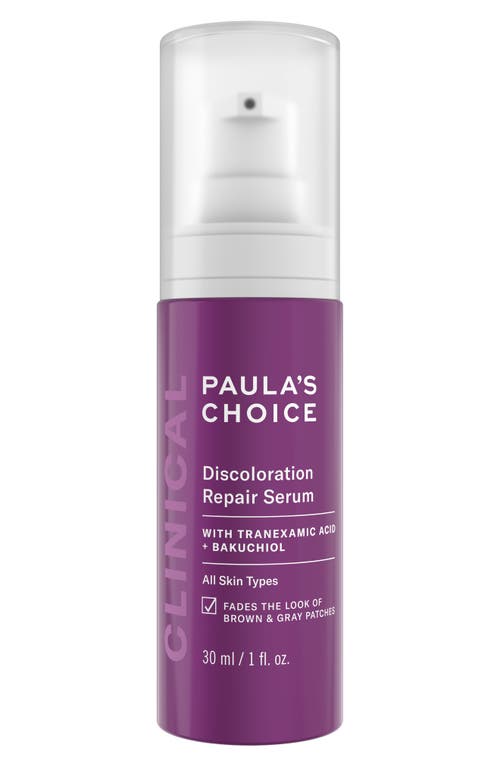
Paula's Choice Clinical Discoloration Repair Serum at Nordstrom

Paula's Choice
68 Fair
$55.00 · 1 fl oz
View on Amazon
Verified Amazon match

Summary

This serum contains beneficial skin actives such as niacinamide and tranexamic acid, which are known for their skin-brightening and discoloration-reducing properties. However, it also includes some synthetic preservatives and emulsifiers, which slightly lower its overall safety profile. The product is minimally processed, but the presence of these synthetic ingredients prevents it from achieving a higher score.

At a glance

Beneficial ingredients 0
Harmful ingredients 0
Owned by Unilever
Category Serum

Key ingredients 15

Water

Water is a universal solvent used in cosmetics to dissolve other ingredients. It helps in the application and absorption of the product. It is generally considered safe and non-irritating.

Risks

There are no significant risks associated with water in cosmetics.

Benefits

Water hydrates the skin and helps in the delivery of active ingredients.

See more about Water →
Glycerin

Glycerin is a humectant that attracts moisture to the skin. It helps maintain skin hydration and improves the skin barrier function. It is widely used in skincare for its moisturizing properties.

Risks

Glycerin is generally safe, but in rare cases, it may cause irritation if used in high concentrations.

Benefits

Glycerin helps keep the skin soft and supple by retaining moisture.

See more about Glycerin →
Butylene Glycol

Butylene Glycol is a solvent and conditioning agent that helps improve the texture of skincare products. It enhances the penetration of other ingredients into the skin. It is considered safe for use in cosmetics.

Risks

In rare cases, it may cause mild irritation or allergic reactions.

Benefits

It helps in maintaining skin moisture and improves product spreadability.

See more about Butylene Glycol →
Caprylyl Glycol

Caprylyl Glycol is a skin-conditioning agent with antimicrobial properties. It helps to stabilize formulations and extend the shelf life of products. It is considered safe and effective in cosmetics.

Risks

There are minimal risks, but it may cause irritation in sensitive individuals.

Benefits

It provides moisturizing benefits and enhances product preservation.

See more about Caprylyl Glycol →
Niacinamide

Niacinamide is a form of Vitamin B3 that offers multiple skin benefits. It improves skin elasticity, enhances the skin barrier, and reduces inflammation. It is highly regarded in skincare for its versatility and effectiveness.

Risks

Niacinamide is generally well-tolerated, but high concentrations may cause mild irritation.

Benefits

It helps in reducing fine lines, improving skin tone, and minimizing pores.

See more about Niacinamide →
Tranexamic Acid

Tranexamic Acid is used in skincare for its ability to reduce discoloration and hyperpigmentation. It works by inhibiting melanin synthesis in the skin. It is considered safe and effective for brightening the skin.

Risks

There are minimal risks, but it may cause irritation in sensitive skin.

Benefits

It helps in evening out skin tone and reducing dark spots.

Azelaic Acid

Azelaic Acid is a dicarboxylic acid that helps in treating acne and rosacea. It has anti-inflammatory and antimicrobial properties. It is effective in reducing redness and improving skin texture.

Risks

It may cause mild irritation or dryness in some individuals.

Benefits

It helps in reducing acne and improving skin clarity.

Alpha-Arbutin

Alpha-Arbutin is a skin-brightening agent that helps reduce hyperpigmentation. It works by inhibiting tyrosinase, an enzyme involved in melanin production. It is considered safe and effective for lightening dark spots.

Risks

There are minimal risks, but it may cause irritation in sensitive skin.

Benefits

It helps in achieving a more even skin tone and reducing dark spots.

Glutathione

Glutathione is an antioxidant that helps protect the skin from oxidative stress. It is used in skincare for its skin-brightening and anti-aging properties. It is considered safe and beneficial for skin health.

Risks

There are minimal risks, but it may cause irritation in sensitive individuals.

Benefits

It helps in reducing oxidative damage and improving skin radiance.

Kojic Acid

Kojic Acid is a natural skin-lightening agent derived from fungi. It inhibits melanin production, helping to reduce dark spots and hyperpigmentation. It is considered effective for brightening the skin.

Risks

It may cause irritation or sensitivity, especially in high concentrations.

Benefits

It helps in achieving a more even skin tone and reducing pigmentation.

Licorice Root Extract

Licorice Root Extract is a natural ingredient known for its soothing and brightening properties. It contains glabridin, which helps reduce pigmentation and inflammation. It is considered safe and beneficial for sensitive skin.

Risks

There are minimal risks, but it may cause irritation in rare cases.

Benefits

It helps in reducing redness and improving skin tone.

Melatonin

Melatonin is a hormone that regulates sleep, but in skincare, it acts as an antioxidant. It helps protect the skin from environmental damage and supports skin repair. It is considered safe and beneficial for skin health.

Risks

There are minimal risks, but it may cause irritation in sensitive individuals.

Benefits

It helps in reducing oxidative stress and promoting skin repair.

See more about Melatonin →
Tocopherol

Tocopherol, or Vitamin E, is a powerful antioxidant that protects the skin from free radical damage. It helps in moisturizing and improving skin texture. It is widely used in skincare for its protective properties.

Risks

There are minimal risks, but it may cause irritation in sensitive individuals.

Benefits

It helps in maintaining skin health and reducing signs of aging.

See more about Tocopherol →
Bakuchiol

Bakuchiol is a plant-based alternative to retinol with anti-aging benefits. It helps in reducing fine lines and improving skin firmness without the irritation associated with retinol. It is considered safe and effective for sensitive skin.

Risks

There are minimal risks, but it may cause irritation in rare cases.

Benefits

It helps in improving skin texture and reducing signs of aging.

Milk Thistle

Milk Thistle is a botanical extract known for its antioxidant and anti-inflammatory properties. It helps protect the skin from environmental stressors and supports skin repair. It is considered safe and beneficial for skin health.

Risks

There are minimal risks, but it may cause irritation in sensitive individuals.

Benefits

It helps in reducing inflammation and promoting skin healing.

See more about Milk Thistle →

Processing

Group 1 · Minimally processed

Unprocessed or Minimally Processed Foods

Get the full breakdown in the Scout app

Scan any product to see lab results, healthy alternatives, and your personalized analysis.

Download on theApp Store