
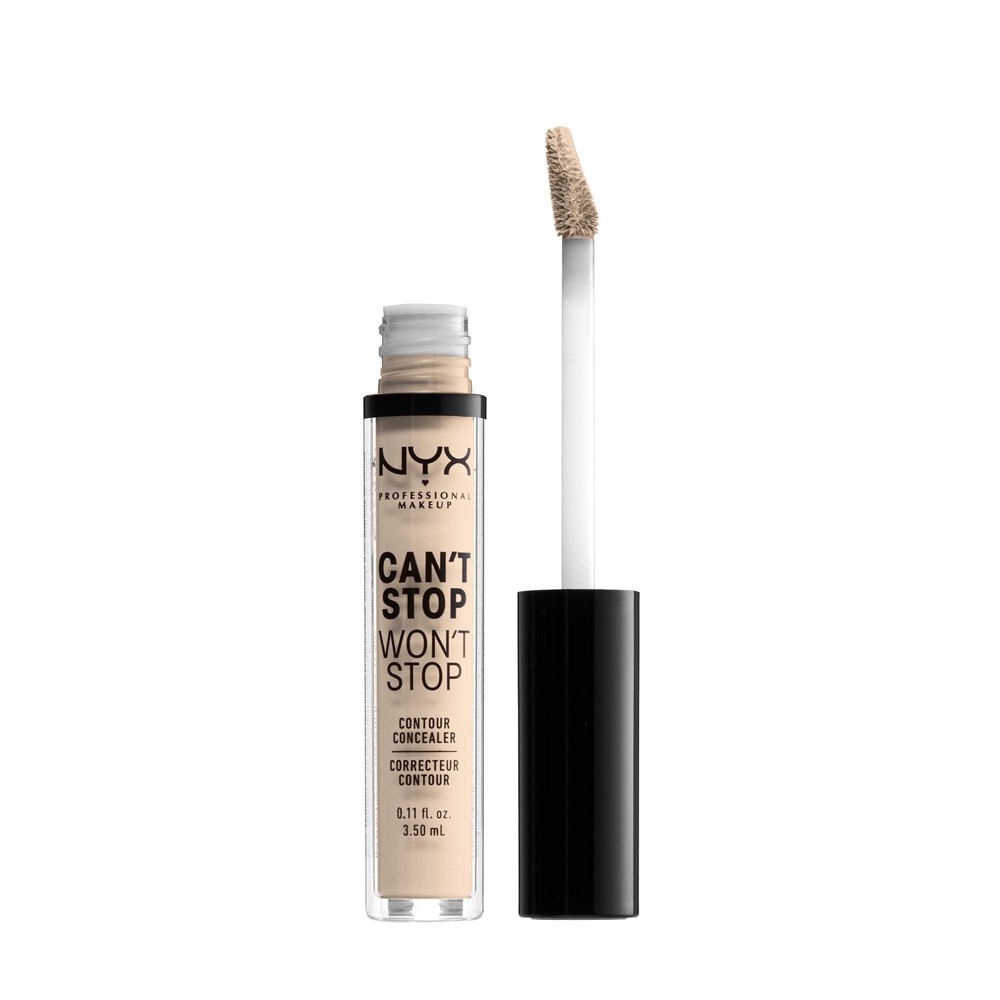

NYX Professional Makeup Can't Stop Won't Stop Contour Concealer - 02 Fair - 0.11 fl oz: Face, Buildable Coverage, Cream, Single Container
Analysis updated August 2026 · How Scout scores
At a glance
Summary
This concealer contains a mix of synthetic ingredients, including silicones and PEG compounds, which are common in cosmetics but can be concerning due to potential skin irritation and environmental impact. The presence of tocopherol is a positive aspect, providing antioxidant benefits. However, the inclusion of PEG compounds and other synthetic additives limits its score, reflecting a moderate level of processing and ingredient safety concerns.
Key ingredients 22
TocopherolVery Good
Tocopherol, also known as Vitamin E, is an antioxidant that helps to protect the skin from free radical damage. It is used to improve the stability and shelf life of the product. It is well-regarded for its skin conditioning properties.
Risks
There are no significant risks associated with Tocopherol.
Benefits
It provides antioxidant protection and helps to nourish the skin.
Water/Aqua/EauNeutral
Water is a common solvent used in cosmetics to dissolve other ingredients. It helps in the application and spreadability of the product. It is generally considered safe and non-irritating.
Risks
There are no significant risks associated with water in cosmetics.
Benefits
Water helps to hydrate the skin and improve the texture of the product.
CyclopentasiloxaneNeutral
Cyclopentasiloxane is a silicone that provides a smooth application and silky feel. It is used to improve the spreadability of the product. It evaporates quickly, leaving no residue.
Risks
There are concerns about bioaccumulation in the environment.
Benefits
It helps to temporarily fill in fine lines and wrinkles, providing a smoother appearance.
Methyl Methacrylate CrosspolymerNeutral
This ingredient is used as a film-forming agent to provide a long-lasting effect. It helps in improving the texture and wear of the product. It is generally considered safe for use in cosmetics.
Risks
There is a low risk of skin irritation for sensitive individuals.
Benefits
It enhances the durability and longevity of the makeup.
CyclohexasiloxaneNeutral
Cyclohexasiloxane is a silicone used for its emollient properties. It helps to provide a smooth and silky feel to the skin. It is lightweight and evaporates quickly.
Risks
Environmental concerns exist regarding its persistence and bioaccumulation.
Benefits
It aids in the even application of the product and improves skin feel.
Butylene GlycolNeutral
Butylene Glycol is a common humectant used to retain moisture in the skin. It also helps to improve the texture and spreadability of the product. It is generally considered safe for use in cosmetics.
Risks
There is a low risk of irritation for very sensitive skin.
Benefits
It helps to keep the skin hydrated and enhances the product's texture.
PEG-10 DimethiconeNeutral
PEG-10 Dimethicone is a silicone-based polymer used as an emulsifier and conditioning agent. It helps to improve the spreadability and feel of the product. It is generally considered safe for use in cosmetics.
Risks
There is a potential risk of contamination with ethylene oxide and 1,4-dioxane.
Benefits
It provides a smooth application and enhances the product's texture.
TrimethylsiloxysilicateNeutral
Trimethylsiloxysilicate is a silicone resin used to form a flexible, durable film on the skin. It helps to improve the wear time of the product. It is generally considered safe for use in cosmetics.
Risks
There are no significant risks associated with this ingredient.
Benefits
It enhances the longevity and water resistance of the makeup.
Polyglyceryl-3 Polydimethylsiloxyethyl DimethiconeNeutral
This ingredient is used as an emulsifier and conditioning agent in cosmetics. It helps to improve the texture and spreadability of the product. It is generally considered safe for use in cosmetics.
Risks
There are no significant risks associated with this ingredient.
Benefits
It aids in the even distribution of the product on the skin.
Silica Dimethyl Silylate [Nano]Neutral
Silica Dimethyl Silylate is used as a thickening agent and to provide a matte finish. It helps to absorb excess oil and improve the texture of the product. It is generally considered safe for use in cosmetics.
Risks
There are concerns about inhalation risks with nano-sized particles.
Benefits
It helps to control shine and provides a smooth, matte finish.
Sodium ChlorideNeutral
Sodium Chloride is used as a thickening agent in cosmetics. It helps to improve the viscosity and stability of the product. It is generally considered safe for use in cosmetics.
Risks
There are no significant risks associated with this ingredient.
Benefits
It helps to stabilize the formulation and improve texture.
TriethoxycaprylylsilaneNeutral
Triethoxycaprylylsilane is used as a surface modifier to improve pigment dispersion. It helps to enhance the spreadability and adhesion of the product. It is generally considered safe for use in cosmetics.
Risks
There are no significant risks associated with this ingredient.
Benefits
It improves the evenness and longevity of the makeup.
Aluminum HydroxideNeutral
Aluminum Hydroxide is used as a colorant and to improve the opacity of the product. It helps to enhance the coverage and finish of the makeup. It is generally considered safe for use in cosmetics.
Risks
There are no significant risks associated with this ingredient.
Benefits
It provides opacity and improves the coverage of the product.
Propylene CarbonateNeutral
Propylene Carbonate is used as a solvent and viscosity regulator. It helps to improve the texture and spreadability of the product. It is generally considered safe for use in cosmetics.
Risks
There are no significant risks associated with this ingredient.
Benefits
It aids in the even application and consistency of the makeup.
Disteardimonium HectoriteNeutral
Disteardimonium Hectorite is used as a thickening agent and to improve the texture of the product. It helps to stabilize the formulation and enhance spreadability. It is generally considered safe for use in cosmetics.
Risks
There are no significant risks associated with this ingredient.
Benefits
It improves the consistency and application of the makeup.
EthylhexylglycerinNeutral
Ethylhexylglycerin is used as a skin conditioning agent and preservative enhancer. It helps to improve the efficacy of preservatives and provide a smooth feel. It is generally considered safe for use in cosmetics.
Risks
There are no significant risks associated with this ingredient.
Benefits
It enhances the preservation and feel of the product.
Cetyl PEG/PPG-10/1 DimethiconeNeutral
This ingredient is used as an emulsifier and conditioning agent. It helps to improve the texture and spreadability of the product. It is generally considered safe for use in cosmetics.
Risks
There is a potential risk of contamination with ethylene oxide and 1,4-dioxane.
Benefits
It provides a smooth application and enhances the product's texture.
Pentaerythrityl Tetra-Di-T-Butyl HydroxyhydrocinnamateNeutral
This ingredient is used as an antioxidant to improve the stability of the product. It helps to prevent the oxidation of other ingredients. It is generally considered safe for use in cosmetics.
Risks
There are no significant risks associated with this ingredient.
Benefits
It enhances the shelf life and stability of the product.
DimethiconeBad
Occlusive silicone film-former — flagged under clean-beauty doctrine.
Risks
There are no significant risks associated with this ingredient.
Benefits
It helps to fill in fine lines and create a smooth appearance.
Dimethicone/Vinyl Dimethicone CrosspolymerBad
Processed additive flagged under Scout's ingredient doctrine.
Risks
There are no significant risks associated with this ingredient.
Benefits
It enhances the texture and application of the makeup.
Disodium EDTABad
Processed additive flagged under Scout's ingredient doctrine.
Risks
There are concerns about its environmental impact due to persistence.
Benefits
It enhances the stability and shelf life of the product.
PhenoxyethanolBad
Processed additive flagged under Scout's ingredient doctrine.
Risks
There is a low risk of skin irritation for sensitive individuals.
Benefits
It provides effective preservation and extends the product's shelf life.
Get the full breakdown in the Scout appTake Scout shopping
Scan any product to see lab results, healthy alternatives, and your personalized analysis.
Download on theApp Store GET IT ONGoogle PlayAmazon pricing & content
Amazon price as of . Product prices and availability are accurate as of the date/time indicated and are subject to change. Any price and availability information displayed on Amazon.com at the time of purchase will apply to the purchase of this product.
CERTAIN CONTENT THAT APPEARS ON THIS SITE COMES FROM AMAZON. THIS CONTENT IS PROVIDED “AS IS” AND IS SUBJECT TO CHANGE OR REMOVAL AT ANY TIME.