
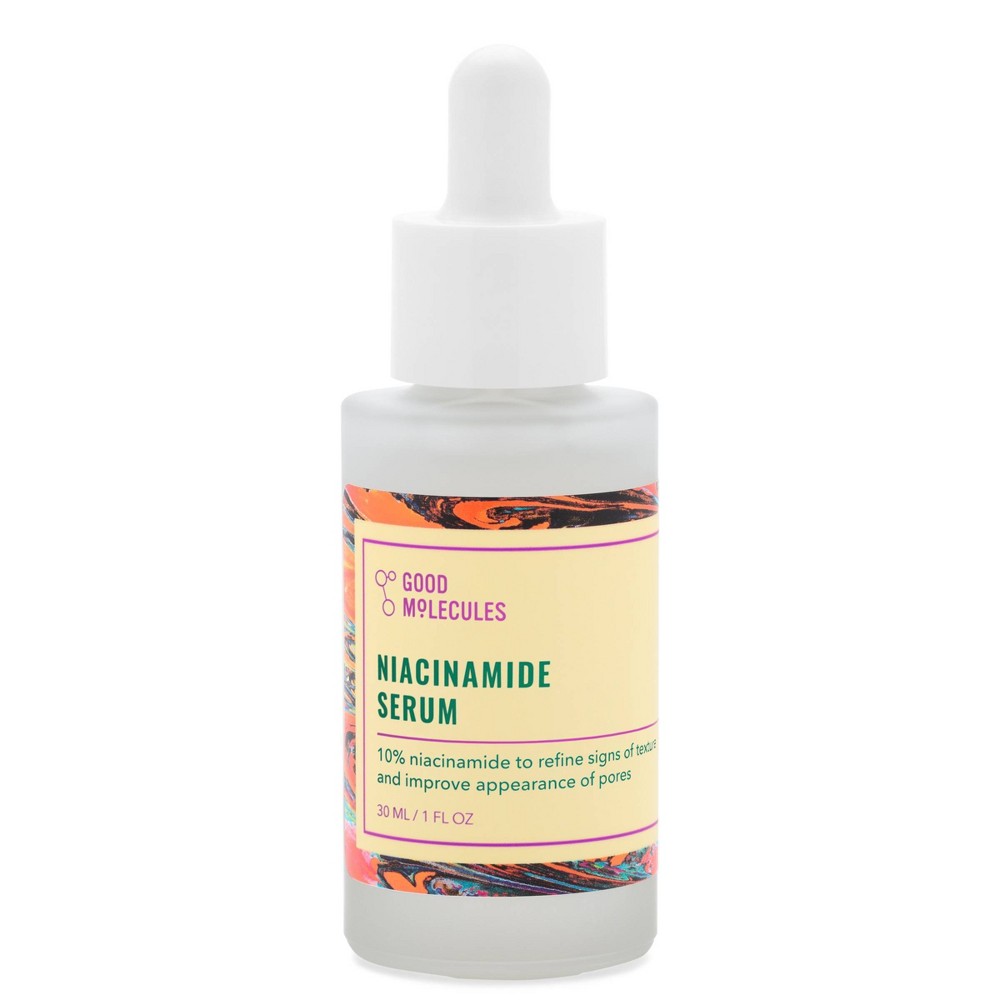

Good Molecules Niacinamide Face Serum - 1 fl oz: Smoothing, Vegan, Combination Skin
Analysis updated August 2026 · How Scout scores
At a glance
Summary
This serum contains beneficial ingredients like niacinamide, glycerin, and tocopherol, which are known for their skin-soothing and hydrating properties. The formulation avoids harsh chemicals and includes mostly safe and effective components, although it does contain some synthetic emulsifiers and stabilizers. The level of processing is moderate, but the overall ingredient quality supports a positive rating.
Key ingredients 16
NiacinamideGood
Niacinamide is a form of Vitamin B3 that is known for its anti-inflammatory properties and ability to improve skin texture. It helps in reducing redness and blotchiness. It is highly beneficial for skin health.
Risks
There are minimal risks, though some individuals may experience mild irritation.
Benefits
Niacinamide improves skin texture and reduces inflammation.
GlycerinGood
Glycerin is a humectant that attracts moisture to the skin, helping to keep it hydrated. It is widely used in skincare for its moisturizing properties. It is beneficial for maintaining skin hydration.
Risks
There are minimal risks associated with glycerin.
Benefits
Glycerin helps to keep the skin hydrated and moisturized.
TocopherolGood
Tocopherol, also known as Vitamin E, is an antioxidant that helps protect the skin from damage caused by free radicals. It is beneficial for skin health and protection. It is widely used in skincare for its protective properties.
Risks
There are minimal risks, though it may cause irritation in sensitive individuals.
Benefits
Tocopherol protects the skin from free radical damage and supports skin health.
WaterNeutral
Water is a common solvent used in cosmetics to dissolve other ingredients. It helps in the application and absorption of the product. It does not provide direct benefits or risks.
Risks
There are no significant risks associated with water in cosmetics.
Benefits
Water helps in the application and absorption of the product.
Dipropylene GlycolNeutral
Dipropylene Glycol is a solvent and viscosity-decreasing agent used in cosmetics. It helps in the even distribution of the product. It is generally considered safe for use in cosmetics.
Risks
There are minimal risks, though it may cause irritation in sensitive individuals.
Benefits
It helps in the even distribution and absorption of the product.
1,2-HexanediolNeutral
1,2-Hexanediol is a solvent and preservative used in cosmetics. It helps in stabilizing the formulation. It is generally considered safe for use in cosmetics.
Risks
There are minimal risks, though it may cause irritation in sensitive individuals.
Benefits
It helps in stabilizing the formulation and preserving the product.
BetaineNeutral
Betaine is a naturally derived ingredient that helps to maintain skin hydration. It is used for its moisturizing properties. It is generally considered safe and beneficial for skin hydration.
Risks
There are minimal risks associated with betaine.
Benefits
Betaine helps to maintain skin hydration and moisture balance.
Hydrogenated LecithinNeutral
Hydrogenated Lecithin is an emulsifier that helps to stabilize and blend ingredients in a formulation. It is used to improve the texture and consistency of the product. It is generally considered safe for use in cosmetics.
Risks
There are minimal risks associated with hydrogenated lecithin.
Benefits
It helps to stabilize and improve the texture of the product.
Xanthan GumNeutral
Xanthan Gum is a thickening agent used to improve the texture and consistency of cosmetic products. It helps in stabilizing the formulation. It is generally considered safe for use in cosmetics.
Risks
There are minimal risks associated with xanthan gum.
Benefits
It helps to improve the texture and stability of the product.
Sorbitan IsostearateNeutral
Sorbitan Isostearate is an emulsifier used to blend oil and water-based ingredients. It helps in maintaining the consistency of the product. It is generally considered safe for use in cosmetics.
Risks
There are minimal risks associated with sorbitan isostearate.
Benefits
It helps to maintain the consistency and stability of the product.
Diphenyl DimethiconeNeutral
Diphenyl Dimethicone is a silicone-based ingredient used to improve the texture and spreadability of cosmetic products. It provides a smooth application. It is generally considered safe for use in cosmetics.
Risks
There are minimal risks, though it may cause buildup on the skin.
Benefits
It improves the texture and spreadability of the product.
TriethylhexanoinNeutral
Triethylhexanoin is an emollient used to enhance the texture and feel of cosmetic products. It helps in providing a smooth and soft finish. It is generally considered safe for use in cosmetics.
Risks
There are minimal risks associated with triethylhexanoin.
Benefits
It enhances the texture and feel of the product.
Polyglyceryl-10 OleateNeutral
Polyglyceryl-10 Oleate is an emulsifier used to blend oil and water-based ingredients. It helps in maintaining the consistency of the product. It is generally considered safe for use in cosmetics.
Risks
There are minimal risks associated with polyglyceryl-10 oleate.
Benefits
It helps to maintain the consistency and stability of the product.
Hydroxyethyl Acrylate/Sodium Acryloyldimethyl Taurate CopolymerNeutral
This copolymer is used as a thickening agent and stabilizer in cosmetic formulations. It helps in improving the texture and consistency of the product. It is generally considered safe for use in cosmetics.
Risks
There are minimal risks associated with this copolymer.
Benefits
It helps to improve the texture and stability of the product.
EthylhexylglycerinNeutral
Ethylhexylglycerin is a preservative and skin-conditioning agent used in cosmetics. It helps in enhancing the shelf life of the product. It is generally considered safe for use in cosmetics.
Risks
There are minimal risks, though it may cause irritation in sensitive individuals.
Benefits
It enhances the shelf life and conditioning properties of the product.
Polysorbate 60Bad
Processed additive flagged under Scout's ingredient doctrine.
Risks
There are minimal risks associated with polysorbate 60.
Benefits
It helps to maintain the consistency and stability of the product.
Get the full breakdown in the Scout appTake Scout shopping
Scan any product to see lab results, healthy alternatives, and your personalized analysis.
Download on theApp Store GET IT ONGoogle PlayAmazon pricing & content
Amazon price as of . Product prices and availability are accurate as of the date/time indicated and are subject to change. Any price and availability information displayed on Amazon.com at the time of purchase will apply to the purchase of this product.
CERTAIN CONTENT THAT APPEARS ON THIS SITE COMES FROM AMAZON. THIS CONTENT IS PROVIDED “AS IS” AND IS SUBJECT TO CHANGE OR REMOVAL AT ANY TIME.