
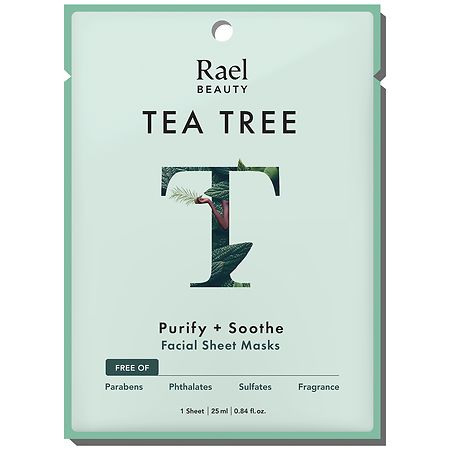

Rael Beauty Tea Tree Purifying Facial Sheet Mask 1ct
Analysis updated July 2026 · How Scout scores
At a glance
Summary
This facial sheet mask contains beneficial ingredients like tea tree oil, chamomile extract, and centella asiatica extract, which are known for their soothing and anti-inflammatory properties. The formulation avoids harsh chemicals such as parabens, sulfates, and synthetic fragrances, contributing to its safety profile. However, the presence of polysorbate 80, a synthetic emulsifier, slightly lowers the score due to its moderate processing level.
Key ingredients 14
Melaleuca Alternifolia (Tea Tree) Leaf OilVery Good
Tea Tree Oil is known for its antimicrobial and anti-inflammatory properties, making it effective in treating acne and other skin conditions. It is a natural ingredient that can help reduce redness and swelling.
Risks
Tea Tree Oil can cause irritation or allergic reactions in some individuals, especially if used in high concentrations.
Benefits
Tea Tree Oil helps in treating acne and reducing redness and swelling due to its antimicrobial properties.
PanthenolVery Good
Panthenol, also known as provitamin B5, is a moisturizing agent that improves skin hydration and elasticity. It has anti-inflammatory properties that help soothe irritated skin.
Risks
Panthenol is generally safe, but it may cause mild irritation in very sensitive skin.
Benefits
Panthenol improves skin hydration and elasticity and soothes irritated skin.
Chamomile ExtractVery Good
Chamomile Extract is known for its soothing and anti-inflammatory properties, making it beneficial for sensitive and irritated skin. It also has antioxidant properties that protect the skin from environmental damage.
Risks
Chamomile Extract is generally safe, but it may cause allergic reactions in individuals sensitive to the Asteraceae family.
Benefits
Chamomile Extract soothes and protects the skin with its anti-inflammatory and antioxidant properties.
Centella Asiatica (Cica) ExtractVery Good
Centella Asiatica Extract is renowned for its healing and anti-inflammatory properties, promoting skin repair and reducing redness. It is rich in antioxidants, which help protect the skin from environmental stressors.
Risks
Centella Asiatica Extract is generally safe, but it may cause irritation in very sensitive skin.
Benefits
Centella Asiatica Extract promotes skin repair and provides antioxidant protection.
GlycerinGood
Glycerin is a humectant that attracts moisture to the skin, helping to keep it hydrated. It is well-tolerated by most skin types and enhances the skin's barrier function.
Risks
There are minimal risks associated with glycerin, though it may cause irritation in very sensitive skin.
Benefits
Glycerin helps to keep the skin hydrated and improves its barrier function.
PropanediolGood
Propanediol is a glycol that acts as a solvent and humectant, enhancing the absorption of other ingredients. It is derived from corn sugar and is considered safe for use in cosmetics.
Risks
Propanediol is generally safe, but it may cause mild irritation in sensitive individuals.
Benefits
Propanediol enhances the absorption of other ingredients and helps to keep the skin hydrated.
ArginineGood
Arginine is an amino acid that helps in skin hydration and repair. It supports collagen production, which can improve skin elasticity and firmness.
Risks
Arginine is generally safe, but excessive use may lead to skin irritation.
Benefits
Arginine supports collagen production and improves skin hydration and repair.
BetaineGood
Betaine is a natural osmolyte that helps maintain skin hydration and protects against environmental stress. It is derived from sugar beets and is known for its soothing properties.
Risks
Betaine is generally safe, but it may cause irritation in very sensitive skin.
Benefits
Betaine helps maintain skin hydration and provides soothing properties.
TrehaloseGood
Trehalose is a sugar that acts as a humectant, helping to retain moisture in the skin. It also has antioxidant properties that protect the skin from environmental damage.
Risks
Trehalose is generally safe, but it may cause mild irritation in sensitive individuals.
Benefits
Trehalose helps retain moisture and provides antioxidant protection.
EthylhexylglycerinGood
Ethylhexylglycerin is a conditioning agent and preservative enhancer that helps improve the skin feel of cosmetic formulations. It also has mild antimicrobial properties.
Risks
Ethylhexylglycerin is generally safe, but it may cause mild irritation in sensitive skin.
Benefits
Ethylhexylglycerin improves skin feel and provides mild antimicrobial properties.
WaterNeutral
Water is a common solvent used in cosmetics to dissolve other ingredients. It helps in the application and absorption of the product. It does not provide direct benefits or risks.
Risks
There are no significant risks associated with water in cosmetics.
Benefits
Water helps in the application and absorption of the product.
CarbomerNeutral
Carbomer is a thickening agent used to stabilize and control the viscosity of cosmetic products. It does not provide direct skin benefits but helps in the formulation of the product.
Risks
Carbomer is generally safe, but it can cause mild irritation if not properly neutralized.
Benefits
Carbomer helps in stabilizing and controlling the viscosity of the product.
Caprylyl GlycolNeutral
Standard formulation ingredient — neither beneficial nor harmful at typical use.
Risks
Caprylyl Glycol is generally safe, but it may cause irritation in very sensitive skin.
Benefits
Caprylyl Glycol provides antimicrobial properties and helps keep the skin hydrated.
Polysorbate 80Bad
Processed additive flagged under Scout's ingredient doctrine.
Risks
Polysorbate 80 is generally safe, but it may cause mild irritation in sensitive skin.
Benefits
Polysorbate 80 helps in mixing oil and water-based ingredients in formulations.
Get the full breakdown in the Scout appTake Scout shopping
Scan any product to see lab results, healthy alternatives, and your personalized analysis.
Download on theApp Store GET IT ONGoogle PlayAmazon pricing & content
Amazon price as of . Product prices and availability are accurate as of the date/time indicated and are subject to change. Any price and availability information displayed on Amazon.com at the time of purchase will apply to the purchase of this product.
CERTAIN CONTENT THAT APPEARS ON THIS SITE COMES FROM AMAZON. THIS CONTENT IS PROVIDED “AS IS” AND IS SUBJECT TO CHANGE OR REMOVAL AT ANY TIME.