
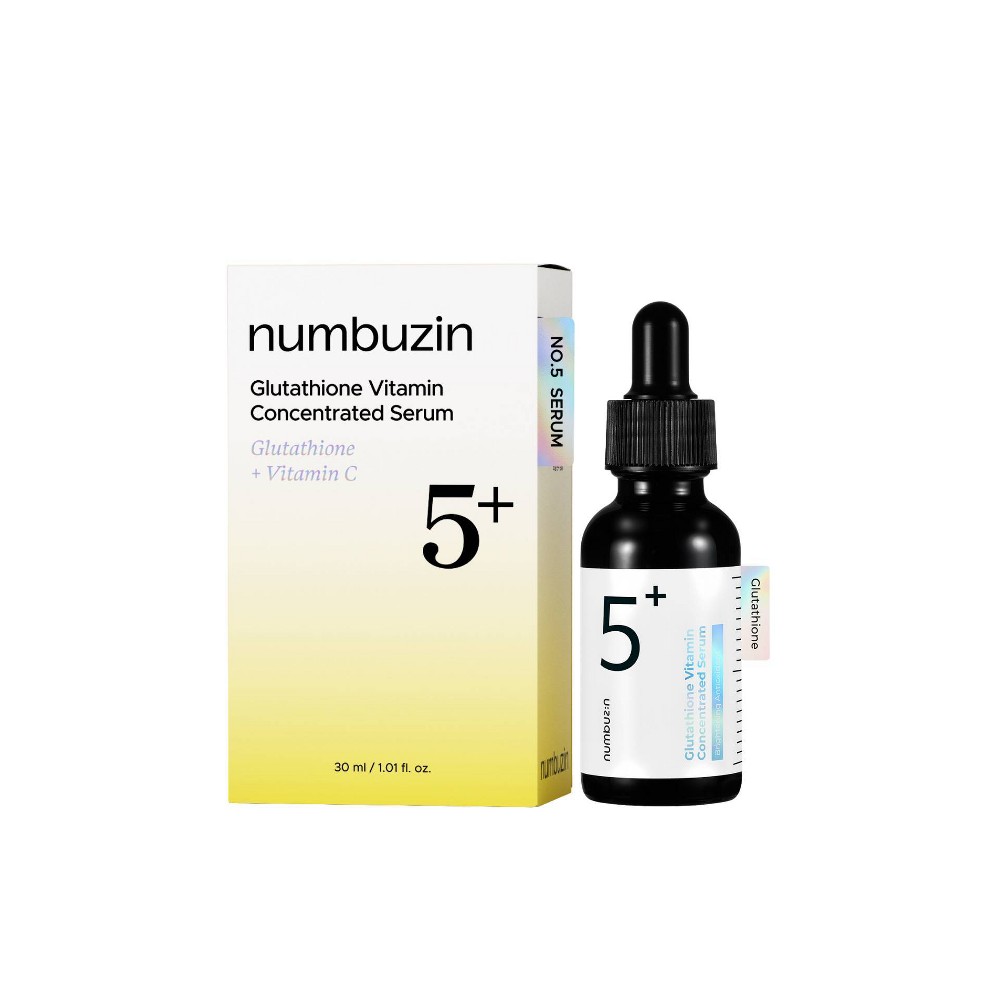
numbuzin No.5+ Glutathione Vitamin Concentrated Face Serum - Travel Size - 1.01 fl oz: Dark Spot Reduction, Brightening, Contains Vitamin E & C
Analysis updated July 2026 · How Scout scores
At a glance
Summary
This face serum contains beneficial ingredients such as niacinamide, shea butter, and various botanical extracts that support skin health and brightening. It avoids harsh chemicals like parabens and synthetic fragrances, which are often linked to skin irritation and endocrine disruption. However, the presence of some synthetic stabilizers and emulsifiers slightly reduces its overall score, though they are generally considered safe.
Key ingredients 45
PanthenolVery Good
Panthenol is a provitamin of B5 that acts as a moisturizer and anti-inflammatory agent. It helps in improving skin hydration and reducing irritation. It is beneficial for maintaining skin barrier function.
Risks
There are no significant risks associated with panthenol.
Benefits
It enhances skin hydration and soothes irritated skin.
Butyrospermum Parkii (Shea) ButterVery Good
Shea Butter is a natural fat extracted from the nuts of the shea tree. It is used for its excellent moisturizing and skin-conditioning properties. It is beneficial for its ability to nourish and protect the skin.
Risks
There are no significant risks associated with shea butter.
Benefits
It deeply moisturizes and nourishes the skin.
GlutathioneVery Good
Glutathione is used for its antioxidant and skin-brightening properties. It helps in reducing oxidative stress and improving skin radiance. It is beneficial for its ability to brighten and protect the skin.
Risks
There are no significant risks associated with glutathione.
Benefits
It brightens the skin and provides antioxidant protection.
NiacinamideGood
Niacinamide is a form of Vitamin B3 that is known for its anti-inflammatory and skin-brightening properties. It helps in reducing redness and improving skin texture. It is widely used for its ability to improve the appearance of enlarged pores and uneven skin tone.
Risks
There are minimal risks associated with niacinamide, though overuse may cause mild irritation.
Benefits
It helps in improving skin texture, reducing redness, and brightening the skin.
Tranexamic AcidGood
Tranexamic Acid is used in skincare for its ability to reduce hyperpigmentation and dark spots. It works by inhibiting melanin synthesis. It is effective in brightening the skin and evening out skin tone.
Risks
There are minimal risks, though it may cause irritation in sensitive skin.
Benefits
It helps in reducing hyperpigmentation and brightening the skin.
Caprylic/Capric TriglycerideGood
Caprylic/Capric Triglyceride is derived from coconut oil and glycerin. It is used as an emollient and helps in improving the spreadability of the product. It is beneficial for its moisturizing properties.
Risks
There are no significant risks associated with this ingredient.
Benefits
It provides moisturizing benefits and improves product spreadability.
Chondrus Crispus ExtractGood
Chondrus Crispus Extract, also known as Irish Moss, is used for its moisturizing and skin-soothing properties. It helps in maintaining skin hydration. It is beneficial for its ability to soothe and protect the skin.
Risks
There are no significant risks associated with this ingredient.
Benefits
It provides moisturizing and soothing benefits to the skin.
Saccharum Officinarum (Sugarcane) ExtractGood
Sugarcane Extract is used for its exfoliating and skin-brightening properties. It contains glycolic acid, which helps in removing dead skin cells. It is beneficial for improving skin texture and radiance.
Risks
There are minimal risks, though it may cause irritation in sensitive skin.
Benefits
It helps in exfoliating and brightening the skin.
Alpha-ArbutinGood
Alpha-Arbutin is used for its skin-brightening properties. It helps in reducing the appearance of dark spots and hyperpigmentation. It is effective in evening out skin tone.
Risks
There are minimal risks, though it may cause irritation in sensitive skin.
Benefits
It helps in reducing dark spots and brightening the skin.
Bifida Ferment LysateGood
Bifida Ferment Lysate is a probiotic ingredient used for its skin-soothing and barrier-strengthening properties. It helps in improving skin resilience and reducing sensitivity. It is beneficial for maintaining a healthy skin barrier.
Risks
There are no significant risks associated with this ingredient.
Benefits
It strengthens the skin barrier and soothes the skin.
Sodium HyaluronateGood
Sodium Hyaluronate is a form of hyaluronic acid that is used for its excellent moisturizing properties. It helps in retaining moisture and plumping the skin. It is beneficial for its ability to hydrate and improve skin elasticity.
Risks
There are no significant risks associated with sodium hyaluronate.
Benefits
It provides deep hydration and improves skin elasticity.
Melia Azadirachta Flower ExtractGood
Melia Azadirachta Flower Extract is used for its antioxidant and skin-soothing properties. It helps in protecting the skin from environmental stressors. It is beneficial for its ability to calm and protect the skin.
Risks
There are no significant risks associated with this ingredient.
Benefits
It provides antioxidant protection and soothes the skin.
Ocimum Sanctum Leaf ExtractGood
Ocimum Sanctum Leaf Extract, also known as Holy Basil, is used for its antioxidant and anti-inflammatory properties. It helps in protecting the skin from environmental damage. It is beneficial for its ability to soothe and protect the skin.
Risks
There are no significant risks associated with this ingredient.
Benefits
It provides antioxidant protection and soothes the skin.
Melia Azadirachta Leaf ExtractGood
Melia Azadirachta Leaf Extract is used for its antibacterial and skin-soothing properties. It helps in reducing skin irritation and protecting against environmental stressors. It is beneficial for its ability to calm and protect the skin.
Risks
There are no significant risks associated with this ingredient.
Benefits
It provides antibacterial protection and soothes the skin.
Curcuma Longa (Turmeric) Root ExtractGood
Turmeric Root Extract is used for its anti-inflammatory and antioxidant properties. It helps in reducing redness and protecting the skin from environmental damage. It is beneficial for its ability to soothe and brighten the skin.
Risks
There are no significant risks associated with turmeric extract.
Benefits
It reduces inflammation and provides antioxidant protection.
Corallina Officinalis ExtractGood
Corallina Officinalis Extract is used for its mineral-rich and skin-conditioning properties. It helps in maintaining skin hydration and improving texture. It is beneficial for its ability to nourish and protect the skin.
Risks
There are no significant risks associated with this ingredient.
Benefits
It nourishes the skin and improves texture.
Tremella Fuciformis (Mushroom) ExtractGood
Tremella Fuciformis Extract is used for its excellent moisturizing and skin-soothing properties. It helps in retaining moisture and improving skin elasticity. It is beneficial for its ability to hydrate and soothe the skin.
Risks
There are no significant risks associated with this ingredient.
Benefits
It provides deep hydration and soothes the skin.
GlycerinGood
Glycerin is a well-known humectant used for its excellent moisturizing properties. It helps in attracting and retaining moisture in the skin. It is beneficial for its ability to hydrate and improve skin barrier function.
Risks
There are no significant risks associated with glycerin.
Benefits
It provides deep hydration and improves skin barrier function.
3-O-Ethyl Ascorbic AcidGood
3-O-Ethyl Ascorbic Acid is a stable form of Vitamin C used for its antioxidant and skin-brightening properties. It helps in reducing the appearance of dark spots and protecting the skin from environmental damage. It is beneficial for its ability to brighten and protect the skin.
Risks
There are minimal risks, though it may cause irritation in sensitive skin.
Benefits
It brightens the skin and provides antioxidant protection.
BisabololGood
Bisabolol is used for its anti-inflammatory and skin-soothing properties. It helps in reducing redness and irritation. It is beneficial for its ability to calm and soothe the skin.
Risks
There are no significant risks associated with bisabolol.
Benefits
It soothes the skin and reduces inflammation.
AdenosineGood
Adenosine is used for its anti-aging and skin-soothing properties. It helps in reducing the appearance of wrinkles and improving skin smoothness. It is beneficial for its ability to improve skin elasticity and texture.
Risks
There are no significant risks associated with adenosine.
Benefits
It reduces wrinkles and improves skin smoothness.
AllantoinGood
Allantoin is used for its skin-soothing and moisturizing properties. It helps in reducing irritation and promoting skin healing. It is beneficial for its ability to soothe and protect the skin.
Risks
There are no significant risks associated with allantoin.
Benefits
It soothes the skin and promotes healing.
Ceramide NPGood
Ceramide NP is used for its skin barrier-strengthening and moisturizing properties. It helps in maintaining skin hydration and protecting against environmental stressors. It is beneficial for its ability to strengthen the skin barrier and improve moisture retention.
Risks
There are no significant risks associated with ceramide NP.
Benefits
It strengthens the skin barrier and improves moisture retention.
Beta-GlucanGood
Beta-Glucan is used for its moisturizing and skin-soothing properties. It helps in reducing redness and irritation. It is beneficial for its ability to soothe and hydrate the skin.
Risks
There are no significant risks associated with beta-glucan.
Benefits
It soothes the skin and provides hydration.
Dipotassium GlycyrrhizateGood
Dipotassium Glycyrrhizate is used for its anti-inflammatory and skin-soothing properties. It helps in reducing redness and irritation. It is beneficial for its ability to calm and soothe the skin.
Risks
There are no significant risks associated with dipotassium glycyrrhizate.
Benefits
It soothes the skin and reduces inflammation.
TocopherolGood
Tocopherol, also known as Vitamin E, is used for its antioxidant properties. It helps in protecting the skin from environmental damage. It is beneficial for its ability to nourish and protect the skin.
Risks
There are no significant risks associated with tocopherol.
Benefits
It provides antioxidant protection and nourishes the skin.
Ascorbic AcidGood
Ascorbic Acid, also known as Vitamin C, is used for its antioxidant and skin-brightening properties. It helps in reducing the appearance of dark spots and protecting the skin from environmental damage. It is beneficial for its ability to brighten and protect the skin.
Risks
There are minimal risks, though it may cause irritation in sensitive skin.
Benefits
It brightens the skin and provides antioxidant protection.
Ascorbyl GlucosideGood
Ascorbyl Glucoside is a stable form of Vitamin C used for its antioxidant and skin-brightening properties. It helps in reducing the appearance of dark spots and protecting the skin from environmental damage. It is beneficial for its ability to brighten and protect the skin.
Risks
There are minimal risks, though it may cause irritation in sensitive skin.
Benefits
It brightens the skin and provides antioxidant protection.
Tocopheryl AcetateGood
Tocopheryl Acetate is a form of Vitamin E used for its antioxidant properties. It helps in protecting the skin from environmental damage. It is beneficial for its ability to nourish and protect the skin.
Risks
There are no significant risks associated with tocopheryl acetate.
Benefits
It provides antioxidant protection and nourishes the skin.
UbiquinoneGood
Ubiquinone, also known as Coenzyme Q10, is used for its antioxidant properties. It helps in protecting the skin from environmental damage and reducing the appearance of fine lines. It is beneficial for its ability to nourish and protect the skin.
Risks
There are no significant risks associated with ubiquinone.
Benefits
It provides antioxidant protection and reduces fine lines.
Thioctic AcidGood
Thioctic Acid, also known as Alpha Lipoic Acid, is used for its antioxidant properties. It helps in protecting the skin from environmental damage and improving skin texture. It is beneficial for its ability to brighten and protect the skin.
Risks
There are no significant risks associated with thioctic acid.
Benefits
It provides antioxidant protection and improves skin texture.
WaterNeutral
Water is a common solvent used in cosmetics to dissolve other ingredients. It helps in the formulation of the product by providing a base. It does not have any direct benefits or risks.
Risks
There are no known risks associated with water in cosmetics.
Benefits
Water acts as a solvent and helps in the application of the product.
Butylene GlycolNeutral
Butylene Glycol is used as a solvent and conditioning agent in cosmetics. It helps in improving the texture and spreadability of the product. It is generally considered safe for use in cosmetics.
Risks
In rare cases, it may cause irritation in sensitive skin.
Benefits
It helps in improving the texture and moisture retention of the product.
1, 2-HexanediolNeutral
1, 2-Hexanediol is used as a preservative and humectant in cosmetics. It helps in maintaining the stability of the product. It is generally considered safe for use in cosmetics.
Risks
There are no significant risks associated with 1, 2-Hexanediol.
Benefits
It helps in preserving the product and maintaining moisture.
Neopentyl Glycol DiacaprateNeutral
Neopentyl Glycol Diacaprate is used as an emollient in cosmetics. It helps in improving the texture and feel of the product. It is generally considered safe for use in cosmetics.
Risks
There are no significant risks associated with this ingredient.
Benefits
It improves the texture and feel of the product.
Pentylene GlycolNeutral
Pentylene Glycol is used as a solvent and humectant in cosmetics. It helps in improving the texture and moisture retention of the product. It is generally considered safe for use in cosmetics.
Risks
There are no significant risks associated with pentylene glycol.
Benefits
It helps in preserving moisture and improving product texture.
TromethamineNeutral
Tromethamine is used as a pH adjuster in cosmetics. It helps in maintaining the stability and effectiveness of the product. It is generally considered safe for use in cosmetics.
Risks
There are no significant risks associated with tromethamine.
Benefits
It helps in maintaining product stability and effectiveness.
EthylhexylglycerinNeutral
Ethylhexylglycerin is used as a preservative and skin-conditioning agent in cosmetics. It helps in enhancing the efficacy of other preservatives. It is generally considered safe for use in cosmetics.
Risks
There are no significant risks associated with ethylhexylglycerin.
Benefits
It enhances preservative efficacy and conditions the skin.
Hydrogenated LecithinNeutral
Hydrogenated Lecithin is used as an emulsifier and skin-conditioning agent in cosmetics. It helps in improving the texture and stability of the product. It is generally considered safe for use in cosmetics.
Risks
There are no significant risks associated with hydrogenated lecithin.
Benefits
It improves product texture and stability.
Hydroxypropyl CyclodextrinNeutral
Hydroxypropyl Cyclodextrin is used as a stabilizer and solubilizer in cosmetics. It helps in improving the stability and delivery of active ingredients. It is generally considered safe for use in cosmetics.
Risks
There are no significant risks associated with hydroxypropyl cyclodextrin.
Benefits
It improves product stability and delivery of active ingredients.
Potassium HydroxideNeutral
Potassium Hydroxide is used as a pH adjuster in cosmetics. It helps in maintaining the stability and effectiveness of the product. It is generally considered safe for use in cosmetics.
Risks
There are no significant risks associated with potassium hydroxide.
Benefits
It helps in maintaining product stability and effectiveness.
Behenyl AlcoholNeutral
Behenyl Alcohol is used as an emulsifier and thickener in cosmetics. It helps in improving the texture and stability of the product. It is generally considered safe for use in cosmetics.
Risks
There are no significant risks associated with behenyl alcohol.
Benefits
It improves product texture and stability.
CarbomerNeutral
Carbomer is used as a thickening agent in cosmetics. It helps in improving the texture and consistency of the product. It is generally considered safe for use in cosmetics.
Risks
There are no significant risks associated with carbomer.
Benefits
It improves product texture and consistency.
Xanthan GumNeutral
Xanthan Gum is used as a thickening and stabilizing agent in cosmetics. It helps in improving the texture and consistency of the product. It is generally considered safe for use in cosmetics.
Risks
There are no significant risks associated with xanthan gum.
Benefits
It improves product texture and consistency.
Disodium EDTABad
Processed additive flagged under Scout's ingredient doctrine.
Risks
There are no significant risks associated with disodium EDTA.
Benefits
It improves product stability and effectiveness.
Get the full breakdown in the Scout appTake Scout shopping
Scan any product to see lab results, healthy alternatives, and your personalized analysis.
Download on theApp Store GET IT ONGoogle PlayAmazon pricing & content
Amazon price as of . Product prices and availability are accurate as of the date/time indicated and are subject to change. Any price and availability information displayed on Amazon.com at the time of purchase will apply to the purchase of this product.
CERTAIN CONTENT THAT APPEARS ON THIS SITE COMES FROM AMAZON. THIS CONTENT IS PROVIDED “AS IS” AND IS SUBJECT TO CHANGE OR REMOVAL AT ANY TIME.