
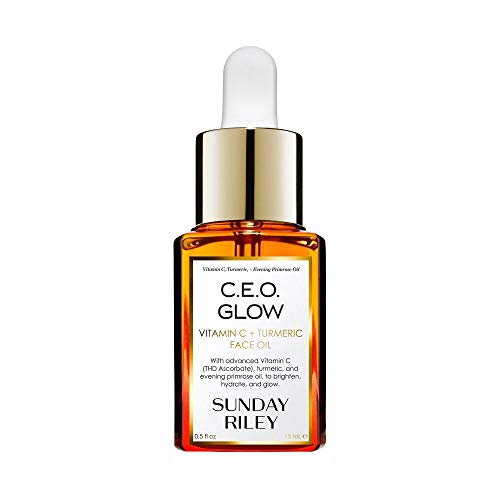


Sunday Riley C.e.o. Glow Vitamin C & Turmeric Face Oil, 0.5 Fl Oz
Analysis updated August 2026 · How Scout scores
At a glance
Summary
This face oil contains a variety of beneficial natural oils and extracts, such as jojoba, red raspberry seed oil, and turmeric root extract, which provide moisturizing and antioxidant benefits. However, the presence of multiple fragrance components like linalool, limonene, and geraniol, which can cause skin irritation or sensitization, detracts from its overall safety profile. The product's processing level and inclusion of potential allergens limit its score despite the presence of many skin-beneficial ingredients.
Key ingredients 40
Rubus Idaeus (Red Raspberry) Seed OilVery Good
Red Raspberry Seed Oil is rich in essential fatty acids and antioxidants. It is known for its moisturizing and anti-inflammatory properties. It is highly beneficial for maintaining healthy skin.
Risks
Generally considered safe with no significant risks.
Benefits
Provides antioxidant protection and moisturizes the skin.
Simmondsia Chinensis (Jojoba) Seed OilVery Good
Jojoba Oil is a natural oil known for its moisturizing and skin conditioning properties. It closely resembles the skin's natural sebum, making it highly beneficial for all skin types. It is widely used for its ability to balance oil production and provide hydration.
Risks
Generally considered safe with no significant risks.
Benefits
Balances oil production and provides deep hydration to the skin.
Punica Granatum (Pomegranate) Seed OilVery Good
Pomegranate Seed Oil is rich in antioxidants and punicic acid, known for its anti-inflammatory and anti-aging properties. It is highly beneficial for skin health, providing protection against environmental stressors. It helps to improve skin elasticity and reduce signs of aging.
Risks
Generally considered safe with no significant risks.
Benefits
Provides antioxidant protection and improves skin elasticity.
Vaccinium Macrocarpon (Cranberry) Seed OilVery Good
Cranberry Seed Oil is rich in essential fatty acids and antioxidants. It is known for its moisturizing and anti-aging properties. It helps to protect the skin from environmental damage and improve skin texture.
Risks
Generally considered safe with no significant risks.
Benefits
Provides antioxidant protection and improves skin texture.
Oenothera Biennis (Evening Primrose) SeedVery Good
Evening Primrose Oil is rich in gamma-linolenic acid, known for its anti-inflammatory and skin conditioning properties. It is beneficial for maintaining healthy skin and reducing inflammation. It helps to improve skin elasticity and hydration.
Risks
Generally considered safe with no significant risks.
Benefits
Reduces inflammation and improves skin elasticity and hydration.
Tetrahexyldecyl AscorbateVery Good
Tetrahexyldecyl Ascorbate is a stable form of Vitamin C known for its antioxidant and skin brightening properties. It is highly beneficial for reducing signs of aging and improving skin tone. It helps to protect the skin from environmental damage and promote collagen production.
Risks
Generally considered safe with no significant risks.
Benefits
Brightens skin tone and promotes collagen production, providing antioxidant protection.
TocopherolVery Good
Tocopherol, or Vitamin E, is a powerful antioxidant known for its skin conditioning and protective properties. It is highly beneficial for maintaining healthy skin and preventing oxidative damage. It helps to improve skin texture and hydration.
Risks
Generally considered safe with no significant risks.
Benefits
Provides antioxidant protection and improves skin texture and hydration.
Curcuma Longa (Turmeric) Root ExtractVery Good
Turmeric Root Extract is known for its anti-inflammatory and antioxidant properties. It is highly beneficial for soothing irritated skin and reducing signs of aging. It helps to improve skin tone and texture.
Risks
Generally considered safe with no significant risks.
Benefits
Soothes irritated skin and provides antioxidant protection, improving skin tone and texture.
Ribes Nigrum (Black Current) Seed OilVery Good
Black Currant Seed Oil is rich in essential fatty acids and antioxidants. It is known for its anti-inflammatory and skin conditioning properties. It helps to improve skin elasticity and hydration.
Risks
Generally considered safe with no significant risks.
Benefits
Reduces inflammation and improves skin elasticity and hydration.
BisabololVery Good
Bisabolol is known for its anti-inflammatory and soothing properties. It is highly beneficial for calming irritated skin and reducing redness. It helps to improve skin texture and comfort.
Risks
Generally considered safe with no significant risks.
Benefits
Calms irritated skin and reduces redness, improving skin texture.
Helianthus Annuus (Sunflower) Seed Oil UnsaponifiablesVery Good
Sunflower Seed Oil Unsaponifiables are known for their emollient and skin conditioning properties. They are highly beneficial for maintaining skin barrier function and providing hydration. They help to improve skin texture and elasticity.
Risks
Generally considered safe with no significant risks.
Benefits
Improves skin barrier function and provides deep hydration.
Helianthus Annuus (Sunflower) Seed OilVery Good
Sunflower Seed Oil is known for its emollient and skin conditioning properties. It is highly beneficial for maintaining skin barrier function and providing hydration. It helps to improve skin texture and elasticity.
Risks
Generally considered safe with no significant risks.
Benefits
Improves skin barrier function and provides deep hydration.
Moringa Oleifera Seed OilVery Good
Moringa Seed Oil is rich in antioxidants and essential fatty acids. It is known for its moisturizing and anti-aging properties. It helps to protect the skin from environmental damage and improve skin texture.
Risks
Generally considered safe with no significant risks.
Benefits
Provides antioxidant protection and improves skin texture.
Brassica Campestris (Rapeseed) SterolsGood
Rapeseed sterols are used for their emollient and skin conditioning properties. They are derived from natural sources and are considered beneficial for skin health. They help to maintain the skin's barrier function.
Risks
Generally considered safe with no significant risks.
Benefits
Improves skin barrier function and provides moisturizing benefits.
Cardiospermum HalicacabumGood
Cardiospermum Halicacabum is a plant extract known for its anti-inflammatory properties. It is used in cosmetics to soothe irritated skin. It is considered beneficial for sensitive skin types.
Risks
Generally safe, but potential for allergic reactions in sensitive individuals.
Benefits
Provides anti-inflammatory benefits, soothing irritated skin.
Cucumis Sativus (Cucumber) Seed OilGood
Cucumber Seed Oil is known for its soothing and moisturizing properties. It is rich in linoleic acid and vitamin E, which are beneficial for skin health. It helps to calm and hydrate the skin.
Risks
Generally considered safe with no significant risks.
Benefits
Soothes and hydrates the skin, providing antioxidant protection.
Eclipta Prostrata (False Daisy) ExtractGood
False Daisy Extract is known for its anti-inflammatory and antioxidant properties. It is used in cosmetics to soothe and protect the skin. It is beneficial for maintaining healthy skin.
Risks
Generally considered safe with no significant risks.
Benefits
Soothes and protects the skin, providing antioxidant benefits.
Melia Azadirachta (Neem) Leaf ExtractGood
Neem Leaf Extract is known for its antibacterial and anti-inflammatory properties. It is used in cosmetics to soothe and protect the skin. It is beneficial for maintaining healthy skin and reducing inflammation.
Risks
Generally considered safe with no significant risks.
Benefits
Soothes and protects the skin, providing antibacterial benefits.
Zingiber OfficinaleGood
Ginger Extract is known for its anti-inflammatory and antioxidant properties. It is used in cosmetics to soothe and protect the skin. It is beneficial for maintaining healthy skin and reducing inflammation.
Risks
Generally considered safe with no significant risks.
Benefits
Soothes and protects the skin, providing antioxidant benefits.
Rosmarinus Officinalis (Rosemary) Leaf ExtractGood
Rosemary Leaf Extract is known for its antioxidant and anti-inflammatory properties. It is used in cosmetics to protect and soothe the skin. It is beneficial for maintaining healthy skin and reducing inflammation.
Risks
Generally considered safe with no significant risks.
Benefits
Provides antioxidant protection and soothes the skin.
PalmitamideNeutral
Palmitamide is a fatty acid amide that can help with skin conditioning. It is generally considered safe for use in cosmetics. However, its benefits are not well-documented compared to other more active ingredients.
Risks
There are no significant risks associated with Palmitamide in cosmetic use.
Benefits
It may provide some emollient properties to the skin.
HexyldecanolNeutral
Hexyldecanol is an alcohol used as an emollient and skin conditioning agent. It is generally considered safe for use in cosmetics. However, it does not provide significant active benefits beyond basic moisturization.
Risks
Potential for minor skin irritation in sensitive individuals.
Benefits
Provides emollient properties, helping to soften and smooth the skin.
Hydroxyphenyl Propamidobenzoic AcidNeutral
This ingredient is used for its skin conditioning properties. It is considered safe for use in cosmetics. However, its specific benefits are not well-documented in scientific literature.
Benefits
May help in conditioning the skin.
Stearic AcidNeutral
Stearic Acid is a fatty acid used as an emulsifier and thickener in cosmetics. It is generally safe and widely used in skincare products. However, it does not provide significant active benefits beyond its functional role in formulations.
Risks
May cause minor irritation in sensitive skin types.
Benefits
Helps stabilize and thicken formulations, improving texture.
Caprylyl Caprylate/CaprateNeutral
This ingredient is used as an emollient and skin conditioning agent. It is derived from coconut oil and glycerin. It is generally considered safe and effective for moisturizing the skin.
Benefits
Helps to moisturize and condition the skin.
Neopentyl Glycol DiethylhexanoateNeutral
This ingredient is used as an emollient and skin conditioning agent. It is considered safe for use in cosmetics. However, it does not provide significant active benefits beyond basic moisturization.
Benefits
Provides emollient properties, helping to soften and smooth the skin.
OctyldodecanolNeutral
Octyldodecanol is an alcohol used as an emollient and skin conditioning agent. It is generally considered safe for use in cosmetics. However, it does not provide significant active benefits beyond basic moisturization.
Risks
Potential for minor skin irritation in sensitive individuals.
Benefits
Provides emollient properties, helping to soften and smooth the skin.
Citrus Aurantium Amara (Bitter Orange) Flower OilNeutral
Bitter Orange Flower Oil is used for its fragrance and potential skin conditioning properties. It is generally considered safe for use in cosmetics. However, it may cause photosensitivity in some individuals.
Risks
Potential for photosensitivity and allergic reactions in sensitive individuals.
Benefits
Provides a pleasant fragrance and may offer skin conditioning benefits.
Pentylene GlycolNeutral
Pentylene Glycol is used as a humectant and skin conditioning agent. It is generally considered safe for use in cosmetics. However, it does not provide significant active benefits beyond basic moisturization.
Benefits
Helps to moisturize and condition the skin.
4-T-ButylcyclohexanolNeutral
4-T-Butylcyclohexanol is used as a skin conditioning agent. It is generally considered safe for use in cosmetics. However, its specific benefits are not well-documented in scientific literature.
Benefits
May help in conditioning the skin.
Cetylhydroxyproline PalmitamideNeutral
Cetylhydroxyproline Palmitamide is used as a skin conditioning agent. It is generally considered safe for use in cosmetics. However, its specific benefits are not well-documented in scientific literature.
Benefits
May help in conditioning the skin.
LinaloolBad
Linalool is a fragrance component that can cause allergic reactions in sensitive individuals. It is used for its pleasant scent in cosmetics. However, it is a known allergen and can cause skin irritation.
Risks
Potential for allergic reactions and skin irritation.
Benefits
Provides a pleasant fragrance to cosmetic products.
LimoneneBad
Limonene is a fragrance component that can cause allergic reactions in sensitive individuals. It is used for its citrus scent in cosmetics. However, it is a known allergen and can cause skin irritation.
Risks
Potential for allergic reactions and skin irritation.
Benefits
Provides a citrus fragrance to cosmetic products.
GeraniolBad
Geraniol is a fragrance component that can cause allergic reactions in sensitive individuals. It is used for its floral scent in cosmetics. However, it is a known allergen and can cause skin irritation.
Risks
Potential for allergic reactions and skin irritation.
Benefits
Provides a floral fragrance to cosmetic products.
FarnesolBad
Farnesol is a fragrance component that can cause allergic reactions in sensitive individuals. It is used for its pleasant scent in cosmetics. However, it is a known allergen and can cause skin irritation.
Risks
Potential for allergic reactions and skin irritation.
Benefits
Provides a pleasant fragrance to cosmetic products.
CitronellolBad
Citronellol is a fragrance component that can cause allergic reactions in sensitive individuals. It is used for its pleasant scent in cosmetics. However, it is a known allergen and can cause skin irritation.
Risks
Potential for allergic reactions and skin irritation.
Benefits
Provides a pleasant fragrance to cosmetic products.
CitralBad
Citral is a fragrance component that can cause allergic reactions in sensitive individuals. It is used for its lemon scent in cosmetics. However, it is a known allergen and can cause skin irritation.
Risks
Potential for allergic reactions and skin irritation.
Benefits
Provides a lemon fragrance to cosmetic products.
Benzyl BenzoateBad
Benzyl Benzoate is a fragrance component that can cause allergic reactions in sensitive individuals. It is used for its pleasant scent in cosmetics. However, it is a known allergen and can cause skin irritation.
Risks
Potential for allergic reactions and skin irritation.
Benefits
Provides a pleasant fragrance to cosmetic products.
Benzyl SalicylateBad
Benzyl Salicylate is a fragrance component that can cause allergic reactions in sensitive individuals. It is used for its pleasant scent in cosmetics. However, it is a known allergen and can cause skin irritation.
Risks
Potential for allergic reactions and skin irritation.
Benefits
Provides a pleasant fragrance to cosmetic products.
EugenolBad
Eugenol is a fragrance component that can cause allergic reactions in sensitive individuals. It is used for its spicy scent in cosmetics. However, it is a known allergen and can cause skin irritation.
Risks
Potential for allergic reactions and skin irritation.
Benefits
Provides a spicy fragrance to cosmetic products.
Processing
Processed Foods
Get the full breakdown in the Scout appTake Scout shopping
Scan any product to see lab results, healthy alternatives, and your personalized analysis.
Download on theApp Store GET IT ONGoogle PlayAmazon pricing & content
Amazon price as of . Product prices and availability are accurate as of the date/time indicated and are subject to change. Any price and availability information displayed on Amazon.com at the time of purchase will apply to the purchase of this product.
CERTAIN CONTENT THAT APPEARS ON THIS SITE COMES FROM AMAZON. THIS CONTENT IS PROVIDED “AS IS” AND IS SUBJECT TO CHANGE OR REMOVAL AT ANY TIME.