
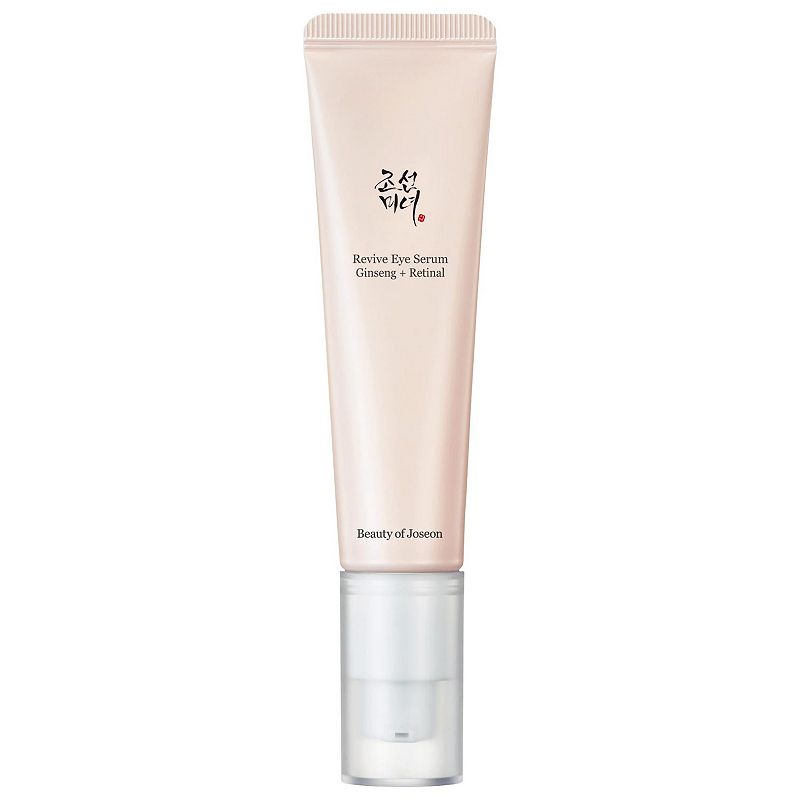


Beauty of Joseon Korean Skincare Revive Eye Serum for Anti-Aging and Firming the Eye Area with Ginseng + Retinal - 30ml
Analysis updated August 2026 · How Scout scores
At a glance
Summary
This eye serum contains a blend of beneficial ingredients such as Panax Ginseng Root Extract, Niacinamide, and Retinal, which are known for their anti-aging and skin-rejuvenating properties. The inclusion of natural oils like Macadamia Ternifolia Seed Oil and moisturizing agents like Glycerin contribute to its skin-nourishing qualities. However, the presence of some synthetic emulsifiers and stabilizers slightly lowers its score, reflecting a moderate level of processing.
Key ingredients 36
Panax Ginseng Root ExtractVery Good
Panax Ginseng Root Extract is known for its antioxidant properties and ability to improve skin elasticity. It is often used in anti-aging products for its rejuvenating effects.
Risks
There are minimal risks, though some individuals may experience mild irritation.
Benefits
It helps to reduce the appearance of wrinkles and improve skin firmness.
Macadamia Ternifolia Seed OilVery Good
Macadamia Ternifolia Seed Oil is a natural oil rich in fatty acids that nourish and moisturize the skin. It is known for its ability to improve skin barrier function.
Risks
It is generally safe, but may cause breakouts in acne-prone skin.
Benefits
It provides deep hydration and helps to restore the skin's natural barrier.
AdenosineVery Good
Adenosine is a skin-soothing and anti-aging ingredient that helps to improve the appearance of fine lines and wrinkles. It is known for its ability to energize the skin.
Risks
It is generally safe with minimal risk of irritation.
Benefits
It helps to reduce the appearance of wrinkles and improve skin smoothness.
RetinalVery Good
Retinal is a form of Vitamin A that is effective in reducing the appearance of fine lines and improving skin texture. It is known for its anti-aging benefits.
Risks
It can cause irritation and sensitivity, especially in high concentrations.
Benefits
It promotes cell turnover and helps to improve skin firmness and smoothness.
Palmitoyl Tripeptide-5Very Good
Palmitoyl Tripeptide-5 is a peptide that helps to stimulate collagen production and improve skin elasticity. It is used for its anti-aging benefits.
Risks
It is generally safe with minimal risk of irritation.
Benefits
It helps to reduce the appearance of wrinkles and improve skin firmness.
GlycerinGood
Glycerin is a humectant that attracts moisture to the skin, helping to keep it hydrated. It is widely used in skincare for its moisturizing properties.
Risks
Glycerin is generally safe, but in very high concentrations, it may cause irritation.
Benefits
It helps to maintain skin hydration and improve barrier function.
Caprylic/Capric TriglycerideGood
Caprylic/Capric Triglyceride is an emollient derived from coconut oil and glycerin. It helps to smooth and soften the skin.
Risks
It is generally safe, but may cause breakouts in acne-prone skin.
Benefits
It provides a lightweight, non-greasy moisturizing effect.
NiacinamideGood
Niacinamide is a form of Vitamin B3 that is known for its anti-inflammatory and brightening properties. It helps to improve skin texture and tone.
Risks
It is generally well-tolerated, but high concentrations may cause irritation.
Benefits
It reduces redness, improves skin elasticity, and brightens the complexion.
Theobroma Cacao (Cocoa) ExtractGood
Theobroma Cacao Extract is rich in antioxidants and helps to protect the skin from environmental stressors. It is known for its moisturizing and soothing properties.
Risks
It is generally safe, but may cause irritation in sensitive skin.
Benefits
It provides antioxidant protection and helps to hydrate the skin.
Sodium HyaluronateGood
Sodium Hyaluronate is a form of hyaluronic acid that helps to retain moisture in the skin. It is known for its excellent hydrating properties.
Risks
It is generally safe with minimal risk of irritation.
Benefits
It provides deep hydration and helps to plump the skin.
TocopherolGood
Tocopherol, or Vitamin E, is an antioxidant that helps to protect the skin from free radical damage. It is commonly used for its moisturizing and protective properties.
Risks
It is generally safe, but high concentrations may cause irritation.
Benefits
It provides antioxidant protection and helps to nourish the skin.
Ceramide NPGood
Ceramide NP is a lipid that helps to restore the skin's natural barrier and retain moisture. It is known for its ability to improve skin hydration and barrier function.
Risks
It is generally safe with minimal risk of irritation.
Benefits
It helps to strengthen the skin barrier and improve hydration.
WaterNeutral
Water is a common solvent used in cosmetics to dissolve other ingredients. It does not provide direct benefits or risks in skincare formulations.
Risks
There are no significant risks associated with water in cosmetics.
Benefits
Water helps to dissolve and distribute other ingredients evenly.
Dipropylene GlycolNeutral
Dipropylene Glycol is used as a solvent and skin conditioning agent in cosmetics. It helps to improve the texture and spreadability of products.
Risks
It is generally considered safe, but can cause irritation in sensitive individuals.
Benefits
It enhances the absorption of other ingredients and improves product texture.
1, 2-HexanediolNeutral
1, 2-Hexanediol is used as a preservative and humectant in cosmetics. It helps to maintain product stability and moisture.
Risks
It is generally safe, but can cause irritation in sensitive skin.
Benefits
It helps to preserve the product and maintain skin hydration.
Pentaerythrityl TetraethylhexanoateNeutral
Pentaerythrityl Tetraethylhexanoate is an emollient that provides a smooth application and enhances skin feel. It is used to improve the texture of cosmetic products.
Risks
It is generally considered safe with low risk of irritation.
Benefits
It improves the spreadability and feel of the product on the skin.
Butyleneglycol Dicaprylate/DicaprateNeutral
Butyleneglycol Dicaprylate/Dicaprate is an emollient that helps to improve the texture and spreadability of skincare products. It provides a silky feel to the skin.
Risks
It is generally safe, but may cause mild irritation in sensitive individuals.
Benefits
It enhances the texture and application of the product.
Cetearyl AlcoholNeutral
Cetearyl Alcohol is a fatty alcohol used as an emollient and thickening agent in cosmetics. It helps to stabilize and thicken formulations.
Risks
It is generally safe, but may cause irritation in very sensitive skin.
Benefits
It provides a creamy texture and helps to soften the skin.
Sorbitan OlivateNeutral
Sorbitan Olivate is an emulsifier derived from olive oil. It helps to blend oil and water-based ingredients in formulations.
Risks
It is generally safe with low risk of irritation.
Benefits
It helps to stabilize emulsions and improve product consistency.
Cetearyl OlivateNeutral
Cetearyl Olivate is an emulsifier that helps to blend oil and water components in skincare products. It is derived from olive oil.
Risks
It is generally safe with minimal risk of irritation.
Benefits
It improves the texture and stability of emulsions.
Butylene GlycolNeutral
Butylene Glycol is a solvent and humectant that helps to retain moisture in the skin. It is commonly used to improve the texture and spreadability of products.
Risks
It is generally safe, but can cause irritation in sensitive skin.
Benefits
It helps to maintain skin hydration and improve product texture.
Hydrogenated LecithinNeutral
Hydrogenated Lecithin is an emulsifier and skin conditioning agent. It helps to stabilize formulations and improve skin feel.
Risks
It is generally safe with low risk of irritation.
Benefits
It enhances the texture and stability of skincare products.
TromethamineNeutral
Tromethamine is used as a pH adjuster in cosmetics. It helps to maintain the stability and effectiveness of formulations.
Risks
It is generally safe, but can cause irritation in sensitive skin.
Benefits
It helps to stabilize the pH of the product, ensuring its efficacy.
CarbomerNeutral
Carbomer is a thickening agent used to create gel-like textures in cosmetics. It helps to stabilize and thicken formulations.
Risks
It is generally safe, but can cause irritation if not properly neutralized.
Benefits
It provides a smooth, gel-like consistency to products.
Glyceryl StearateNeutral
Glyceryl Stearate is an emulsifier and emollient that helps to blend ingredients and soften the skin. It is commonly used to improve product texture.
Risks
It is generally safe with low risk of irritation.
Benefits
It enhances the texture and moisturizing properties of skincare products.
DextrinNeutral
Dextrin is used as a binding agent and texture enhancer in cosmetics. It helps to improve the consistency of formulations.
Risks
It is generally safe with low risk of irritation.
Benefits
It helps to stabilize formulations and improve texture.
CholesterolNeutral
Cholesterol is a lipid that helps to maintain the skin's natural barrier and improve hydration. It is used in skincare for its moisturizing properties.
Risks
It is generally safe with low risk of irritation.
Benefits
It helps to strengthen the skin barrier and retain moisture.
Polyglyceryl-10 OleateNeutral
Polyglyceryl-10 Oleate is an emulsifier that helps to blend oil and water components in formulations. It is derived from natural sources.
Risks
It is generally safe with minimal risk of irritation.
Benefits
It helps to stabilize emulsions and improve product consistency.
Brassica Campestris (Rapeseed) SterolsNeutral
Brassica Campestris Sterols are used as emollients and skin conditioning agents. They help to improve the texture and feel of skincare products.
Risks
They are generally safe with low risk of irritation.
Benefits
They help to soften the skin and improve product texture.
Phytosteryl/Behenyl/Octyldodecyl Lauroyl GlutamateNeutral
This ingredient is used as an emollient and skin conditioning agent. It helps to improve the texture and spreadability of formulations.
Risks
It is generally safe with minimal risk of irritation.
Benefits
It enhances the moisturizing properties and feel of the product.
SilicaNeutral
Silica is used as an absorbent and anti-caking agent in cosmetics. It helps to improve the texture and mattify the skin.
Risks
It is generally safe, but inhalation of fine particles can be harmful.
Benefits
It helps to control oil and improve product texture.
Aluminum/Magnesium Hydroxide StearateNeutral
This ingredient is used as a thickening and stabilizing agent in cosmetics. It helps to improve the texture and consistency of formulations.
Risks
It is generally safe with low risk of irritation.
Benefits
It helps to stabilize formulations and improve product texture.
Potassium Cetyl PhosphateNeutral
Potassium Cetyl Phosphate is an emulsifier that helps to blend oil and water components in formulations. It is used to improve product stability.
Risks
It is generally safe with minimal risk of irritation.
Benefits
It helps to stabilize emulsions and improve product consistency.
Pentaerythrityl Tetra-Di-T-Butyl HydroxyhydrocinnamateNeutral
This ingredient is an antioxidant used to stabilize formulations and prevent oxidation. It helps to extend the shelf life of products.
Risks
It is generally safe with low risk of irritation.
Benefits
It helps to protect formulations from oxidative damage.
EthylhexylglycerinNeutral
Ethylhexylglycerin is used as a preservative and skin conditioning agent in cosmetics. It helps to enhance the efficacy of other preservatives.
Risks
It is generally safe with low risk of irritation.
Benefits
It helps to preserve the product and improve skin feel.
Disodium EDTABad
Processed additive flagged under Scout's ingredient doctrine.
Risks
It is generally safe, but can cause irritation in sensitive skin.
Benefits
It helps to stabilize formulations and enhance product performance.
Processing
Processed Foods
Get the full breakdown in the Scout appTake Scout shopping
Scan any product to see lab results, healthy alternatives, and your personalized analysis.
Download on theApp Store GET IT ONGoogle PlayAmazon pricing & content
Amazon price as of . Product prices and availability are accurate as of the date/time indicated and are subject to change. Any price and availability information displayed on Amazon.com at the time of purchase will apply to the purchase of this product.
CERTAIN CONTENT THAT APPEARS ON THIS SITE COMES FROM AMAZON. THIS CONTENT IS PROVIDED “AS IS” AND IS SUBJECT TO CHANGE OR REMOVAL AT ANY TIME.