
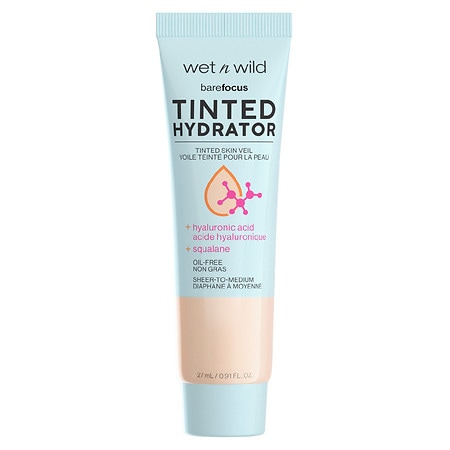


Wet n Wild Bare Focus Tinted Hydrator - Light Medium - 0.91 fl oz: Contains Hyaluronic Acid, Medium Sheer Coverage Liquid Foundation
Analysis updated September 2026 · How Scout scores
At a glance
Summary
This product contains beneficial ingredients like squalane, sodium hyaluronate, and glycerin, which are known for their excellent moisturizing and skin-conditioning properties. However, the presence of phenoxyethanol, a preservative that can cause irritation in some individuals, slightly lowers the score. The formulation is mostly safe with a few synthetic components, but it lacks major harmful chemicals, making it a relatively good choice for skincare.
Key ingredients 17
SqualaneVery Good
Squalane is a highly effective emollient and natural antioxidant. It helps in maintaining skin hydration and improving skin texture. It is well-tolerated by most skin types and is considered very beneficial in skincare.
Risks
There are minimal risks associated with squalane.
Benefits
Excellent for moisturizing and improving skin elasticity.
Hydrolyzed Hyaluronic AcidVery Good
Hydrolyzed Hyaluronic Acid is a smaller molecule form of hyaluronic acid that penetrates deeper into the skin. It provides intense hydration and helps in reducing the appearance of fine lines. It is highly regarded for its moisturizing benefits.
Risks
There are minimal risks associated with hydrolyzed hyaluronic acid.
Benefits
Deeply hydrates and improves skin elasticity.
GlycerinGood
Glycerin is a well-known humectant that attracts moisture to the skin. It helps in keeping the skin hydrated and soft. It is widely used in skincare for its moisturizing properties.
Risks
Rarely, it may cause irritation in very sensitive skin.
Benefits
Excellent for maintaining skin moisture and improving skin barrier function.
Sodium HyaluronateGood
Sodium Hyaluronate is a form of hyaluronic acid that is highly effective in retaining moisture. It helps in keeping the skin hydrated and plump. It is widely used in skincare for its excellent moisturizing properties.
Risks
There are minimal risks associated with sodium hyaluronate.
Benefits
Provides deep hydration and improves skin texture.
Iron Oxides/CI 77491, CI 77492, CI 77499Good
Beneficial ingredient — whole-food or functional value in this product class.
Risks
There are no significant risks associated with iron oxides.
Benefits
Provide stable and non-toxic pigmentation.
Water/EauNeutral
Water is a common solvent used in cosmetics to dissolve other ingredients. It helps in the application and absorption of the product. It does not provide any direct benefits or risks.
Risks
There are no significant risks associated with water in cosmetics.
Benefits
Water helps in the even distribution of other active ingredients.
CyclopentasiloxaneNeutral
Cyclopentasiloxane is a silicone used to provide a smooth application and silky feel. It evaporates quickly, leaving no residue. It is generally considered safe for use in cosmetics.
Risks
There are minimal risks, though some may experience sensitivity to silicones.
Benefits
It enhances the texture and spreadability of the product.
Butylene GlycolNeutral
Butylene Glycol is a common humectant that helps retain moisture in the skin. It also improves the texture of the product. It is generally considered safe for use in cosmetics.
Risks
May cause irritation in sensitive individuals.
Benefits
Helps in maintaining skin hydration.
Disteardimonium HectoriteNeutral
Disteardimonium Hectorite is a thickening agent used to stabilize emulsions. It helps in maintaining the consistency of the product. It is generally considered safe for use in cosmetics.
Risks
There are no significant risks associated with this ingredient.
Benefits
Contributes to the stability and texture of the product.
Cetyl PEG/PPG-10/1 DimethiconeNeutral
This is a silicone-based surfactant that helps in emulsifying and spreading the product. It provides a smooth application. It is generally considered safe for use in cosmetics.
Risks
May cause irritation in individuals sensitive to silicones.
Benefits
Improves the texture and application of the product.
Lauryl PEG-10 Tris(Trimethylsiloxy)Silylethyl DimethiconeNeutral
This ingredient is a silicone-based surfactant that aids in emulsifying and spreading the product. It enhances the feel and application. It is generally considered safe for use in cosmetics.
Risks
Potential for irritation in those sensitive to silicones.
Benefits
Improves product texture and application.
Magnesium SulfateNeutral
Magnesium Sulfate is used as a thickening agent and to enhance the texture of the product. It is generally considered safe for use in cosmetics. It does not provide significant direct benefits or risks.
Risks
There are no significant risks associated with this ingredient.
Benefits
Contributes to the texture and stability of the product.
TriethoxycaprylylsilaneNeutral
Triethoxycaprylylsilane is a silicone-based ingredient used to improve the adhesion of pigments. It helps in the even application of color. It is generally considered safe for use in cosmetics.
Risks
Minimal risk of irritation for those sensitive to silicones.
Benefits
Enhances pigment adhesion and application.
EthylhexylglycerinNeutral
Ethylhexylglycerin is used as a skin conditioning agent and preservative enhancer. It helps in improving the efficacy of preservatives. It is generally considered safe for use in cosmetics.
Risks
May cause mild irritation in sensitive individuals.
Benefits
Enhances preservative efficacy and provides skin conditioning.
Titanium Dioxide/CI 77891Neutral
Titanium Dioxide is a mineral used as a pigment and sunscreen agent. It provides UV protection and is commonly used in cosmetics for its opacity. It is generally considered safe for use in cosmetics.
Risks
Inhalation of fine particles may pose respiratory risks.
Benefits
Provides UV protection and enhances product opacity.
PhenoxyethanolBad
Phenoxyethanol is a preservative used to prevent microbial growth in cosmetics. It is effective but can cause irritation in some individuals. It is considered safe in low concentrations but has raised concerns over potential toxicity.
Risks
May cause skin irritation and allergic reactions in sensitive individuals.
Benefits
Prevents microbial contamination, extending product shelf life.
Dimethicone/Vinyl Dimethicone CrosspolymerBad
Processed additive flagged under Scout's ingredient doctrine.
Risks
Potential for irritation in individuals sensitive to silicones.
Benefits
Improves product texture and provides a smooth finish.
Get the full breakdown in the Scout appTake Scout shopping
Scan any product to see lab results, healthy alternatives, and your personalized analysis.
Download on theApp Store GET IT ONGoogle PlayAmazon pricing & content
Amazon price as of . Product prices and availability are accurate as of the date/time indicated and are subject to change. Any price and availability information displayed on Amazon.com at the time of purchase will apply to the purchase of this product.
CERTAIN CONTENT THAT APPEARS ON THIS SITE COMES FROM AMAZON. THIS CONTENT IS PROVIDED “AS IS” AND IS SUBJECT TO CHANGE OR REMOVAL AT ANY TIME.