
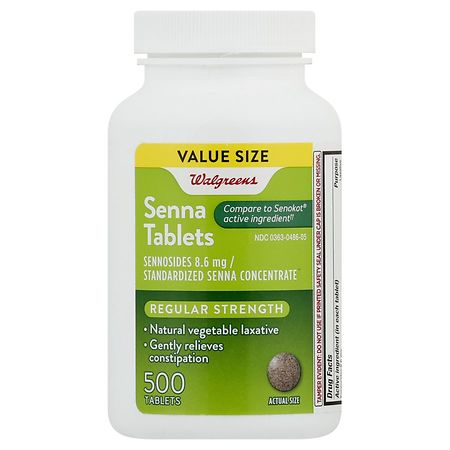


Walgreens Senna Tablets Regular Strength - 300.0 ea
Analysis updated September 2026 · How Scout scores
At a glance
Summary
The product contains sennosides, which are effective for short-term relief of constipation, making it beneficial for its intended use. However, the presence of talc, which has potential health risks due to contamination concerns, is a notable drawback. The formulation includes several additives typical for tablet manufacturing, contributing to a moderate level of processing.
Key ingredients 9
SennosidesGood
Sennosides are the active compounds in senna, known for their laxative effects which help relieve constipation. They work by stimulating the muscles of the colon to promote bowel movements. This ingredient is effective for short-term use in managing constipation.
Risks
Overuse can lead to dependency and potential electrolyte imbalance.
Benefits
Effective in promoting bowel movements and relieving constipation.
Anhydrous Dibasic Calcium PhosphateNeutral
Anhydrous dibasic calcium phosphate is commonly used as a dietary supplement and a tableting agent. It provides calcium and phosphorus, which are essential for bone health. However, in this context, it primarily serves as a filler with no significant health impact.
Benefits
Provides calcium and phosphorus, essential for bone health, though minimal in this context.
Croscarmellose SodiumNeutral
Croscarmellose sodium is used as a disintegrant in tablets, helping them dissolve quickly for better absorption. It is a chemically modified cellulose compound. It does not contribute any nutritional value but aids in the effectiveness of the tablet.
Benefits
Improves the disintegration and absorption of the tablet.
HypromelloseNeutral
Hypromellose is a cellulose derivative used as a binder and coating agent in tablets. It helps control the release of the active ingredient. It is inert and does not provide any nutritional benefits.
Benefits
Helps in controlling the release of the active ingredient in the tablet.
Magnesium StearateNeutral
Magnesium stearate is a common lubricant used in tablet manufacturing to prevent ingredients from sticking to equipment. It is generally recognized as safe in small amounts. It does not provide nutritional benefits but is essential for manufacturing efficiency.
Benefits
Improves manufacturing efficiency by preventing sticking during tablet production.
Microcrystalline CelluloseNeutral
Microcrystalline cellulose is used as a bulking agent and binder in tablets. It is derived from plant fibers and is inert, providing no nutritional value. It helps in forming the tablet structure.
Benefits
Aids in forming the tablet structure and ensuring consistency.
Silicon DioxideNeutral
Silicon dioxide is used as an anti-caking agent to prevent clumping in powdered ingredients. It is naturally occurring and considered safe in small amounts. It does not provide nutritional benefits but ensures product stability.
Benefits
Prevents clumping and ensures stability of the product.
TriacetinNeutral
Triacetin is used as a plasticizer and solvent in pharmaceutical formulations. It helps in the coating process of tablets. It is generally recognized as safe and does not provide nutritional benefits.
Benefits
Assists in the coating process of tablets, enhancing their stability.
TalcBad
Talc is used as a glidant to improve powder flow in tablet manufacturing. There are concerns about contamination with asbestos, a known carcinogen, although cosmetic-grade talc is generally considered safe. Its use is controversial due to potential health risks.
Risks
Potential contamination with asbestos, which is a known carcinogen.
Benefits
Improves powder flow during manufacturing, though benefits are overshadowed by potential risks.
Processing
Processed Foods
Get the full breakdown in the Scout appTake Scout shopping
Scan any product to see lab results, healthy alternatives, and your personalized analysis.
Download on theApp Store GET IT ONGoogle Play