
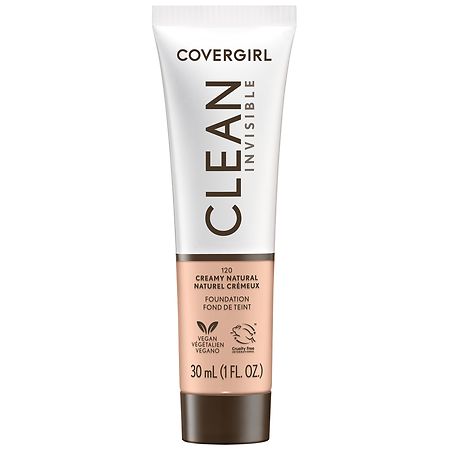


COVERGIRL Clean Invisible Foundation - Creamy - 1 fl oz: Buildable Light Coverage, Liquid, Warm Undertone, Finish
Analysis updated July 2026 · How Scout scores
At a glance
Summary
This foundation contains a mix of synthetic ingredients such as dimethicone and PEG compounds, which are common in cosmetics but can be concerning for sensitive skin. It does not contain any heavily penalized ingredients like parabens or formaldehyde releasers, which is positive. However, the presence of synthetic fragrance and other chemical additives lowers its score due to potential skin irritation and contamination risks.
Key ingredients 24
GlycerinGood
Glycerin is a powerful humectant that attracts moisture to the skin, improving hydration. It is widely used in cosmetics for its moisturizing properties. It is beneficial for maintaining skin's moisture balance.
Risks
Generally considered safe with minimal risk.
Benefits
Attracts moisture to the skin, improving hydration.
Tocopheryl AcetateGood
Tocopheryl Acetate is a form of Vitamin E, an antioxidant that helps protect the skin from free radical damage. It is used for its skin conditioning properties. It supports skin health and improves texture.
Risks
Generally considered safe with minimal risk.
Benefits
Protects skin from free radical damage and conditions the skin.
TocopherolGood
Tocopherol is a form of Vitamin E, an antioxidant that helps protect the skin from free radical damage. It is used for its skin conditioning properties. It supports skin health and improves texture.
Risks
Generally considered safe with minimal risk.
Benefits
Protects skin from free radical damage and conditions the skin.
MicaGood
Beneficial ingredient — whole-food or functional value in this product class.
Risks
Inhalation risk in powder form; minimal risk in liquid formulations.
Benefits
Adds shimmer and enhances visual appeal.
Aqua/Water/EauNeutral
Water is a common solvent used in cosmetics to dissolve other ingredients. It is essential for the formulation but does not provide direct benefits or risks. It acts as a base for the product.
Risks
There are no significant risks associated with water in cosmetics.
Benefits
Water helps in the even distribution of other ingredients.
Caprylyl MethiconeNeutral
Caprylyl Methicone is a silicone that provides a lightweight feel and enhances the spreadability of the product. It is used to improve the texture and application of cosmetics. It does not offer direct skin benefits.
Risks
Minimal risk; generally considered safe.
Benefits
Enhances product spreadability and provides a lightweight feel.
Dicaprylyl EtherNeutral
Dicaprylyl Ether is an emollient that helps to soften and smooth the skin. It is used to improve the texture of the product. It does not provide significant active benefits.
Risks
Generally considered safe with minimal risk.
Benefits
Softens and smooths the skin, improving texture.
Cetyl PEG/PPG-10/1 DimethiconeNeutral
This ingredient is a silicone-based surfactant that helps to stabilize emulsions and improve the texture of the product. It is used for its conditioning properties. It does not provide direct skin benefits.
Risks
Minimal risk; generally considered safe.
Benefits
Stabilizes emulsions and improves product texture.
SilicaNeutral
Silica is used in cosmetics to improve the texture and absorb excess oil. It provides a matte finish and enhances the product's feel. It does not offer direct skin benefits.
Risks
Inhalation risk in powder form; minimal risk in liquid formulations.
Benefits
Improves texture and provides a matte finish.
PEG-10 DimethiconeNeutral
PEG-10 Dimethicone is a silicone-based surfactant that helps to improve the spreadability of the product. It is used to enhance the texture and application. It does not provide direct skin benefits.
Risks
Minimal risk; generally considered safe.
Benefits
Enhances spreadability and texture of the product.
Sodium ChlorideNeutral
Sodium Chloride is used as a thickening agent in cosmetics. It helps to improve the viscosity of the product. It does not provide direct skin benefits.
Risks
Minimal risk; generally considered safe.
Benefits
Improves product viscosity and texture.
Disteardimonium HectoriteNeutral
Disteardimonium Hectorite is a thickening agent used to stabilize emulsions. It helps to improve the texture and consistency of the product. It does not provide direct skin benefits.
Risks
Minimal risk; generally considered safe.
Benefits
Stabilizes emulsions and improves texture.
TribeheninNeutral
Tribehenin is an emollient that helps to condition and soften the skin. It is used to improve the texture of the product. It does not provide significant active benefits.
Risks
Minimal risk; generally considered safe.
Benefits
Conditions and softens the skin, improving texture.
Triethyl CitrateNeutral
Triethyl Citrate is used as a stabilizer and fragrance ingredient in cosmetics. It helps to improve the stability of the product. It does not provide direct skin benefits.
Risks
Minimal risk; generally considered safe.
Benefits
Improves product stability.
ChlorphenesinNeutral
Chlorphenesin is a preservative used to prevent microbial growth in cosmetics. It helps to extend the shelf life of the product. It does not provide direct skin benefits.
Risks
Potential for skin irritation in sensitive individuals.
Benefits
Prevents microbial growth, extending product shelf life.
MethiconeNeutral
Methicone is a silicone used to improve the texture and spreadability of cosmetics. It provides a smooth application and enhances the feel of the product. It does not offer direct skin benefits.
Risks
Minimal risk; generally considered safe.
Benefits
Improves texture and spreadability of the product.
AluminaNeutral
Alumina is used as an abrasive and thickening agent in cosmetics. It helps to improve the texture and consistency of the product. It does not provide direct skin benefits.
Risks
Minimal risk; generally considered safe.
Benefits
Improves texture and consistency of the product.
Propylene CarbonateNeutral
Propylene Carbonate is used as a solvent and viscosity control agent in cosmetics. It helps to improve the texture and application of the product. It does not provide direct skin benefits.
Risks
Minimal risk; generally considered safe.
Benefits
Improves texture and application of the product.
Pentaerythrityl Tetra-di-t-butyl HydroxyhydrocinnamateNeutral
This ingredient is an antioxidant used to stabilize the product and prevent oxidation. It helps to extend the shelf life of cosmetics. It does not provide direct skin benefits.
Risks
Minimal risk; generally considered safe.
Benefits
Stabilizes the product and prevents oxidation.
Titanium Dioxide (CI 77891)Neutral
Titanium Dioxide is used as a pigment and UV filter in cosmetics. It provides coverage and helps protect the skin from UV radiation. It is beneficial for its protective properties.
Risks
Inhalation risk in powder form; minimal risk in liquid formulations.
Benefits
Provides coverage and UV protection.
Iron Oxides (CI 77491, CI 77492, CI 77499)Neutral
Iron Oxides are used as pigments to provide color in cosmetics. They are stable and non-reactive, making them suitable for sensitive skin. They do not provide direct skin benefits.
Risks
Generally considered safe with minimal risk.
Benefits
Provide stable and non-reactive color.
DimethiconeBad
Occlusive silicone film-former — flagged under clean-beauty doctrine.
Risks
May cause breakouts in some individuals with sensitive skin.
Benefits
Provides a silky texture and helps in moisture retention.
Propylene GlycolBad
Processed additive flagged under Scout's ingredient doctrine.
Risks
Potential for skin irritation in sensitive individuals.
Benefits
Improves skin hydration by attracting moisture.
PhenoxyethanolBad
Processed additive flagged under Scout's ingredient doctrine.
Risks
Potential for skin irritation in sensitive individuals.
Benefits
Prevents microbial growth, extending product shelf life.
Get the full breakdown in the Scout appTake Scout shopping
Scan any product to see lab results, healthy alternatives, and your personalized analysis.
Download on theApp Store GET IT ONGoogle PlayAmazon pricing & content
Amazon price as of . Product prices and availability are accurate as of the date/time indicated and are subject to change. Any price and availability information displayed on Amazon.com at the time of purchase will apply to the purchase of this product.
CERTAIN CONTENT THAT APPEARS ON THIS SITE COMES FROM AMAZON. THIS CONTENT IS PROVIDED “AS IS” AND IS SUBJECT TO CHANGE OR REMOVAL AT ANY TIME.