
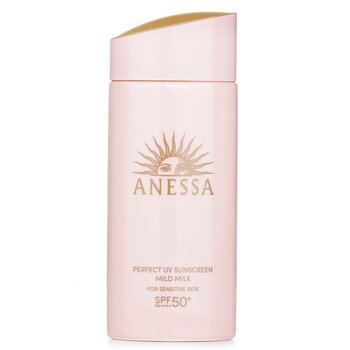
AnessaAnessa Perfect UV Sunscreen Mild Milk Sensitive Skin 90ml
Summary
This sunscreen contains beneficial ingredients such as zinc oxide, which is a safe and effective mineral UV filter, and natural extracts like peony root and cherry leaf. However, it includes synthetic compounds like dimethicone and cyclopentasiloxane, which are common in processed skincare products. The presence of these synthetic ingredients and the overall processing level prevent it from achieving a top-tier score.
At a glance
Key ingredients 14
Water
Water is a universal solvent used to dissolve other ingredients. It helps in the even distribution of the product on the skin. It is generally considered safe and non-irritating.
Risks
There are no significant risks associated with water in cosmetics.
Benefits
Water hydrates the skin and helps in the absorption of other beneficial ingredients.
Dimethicone
Dimethicone is a type of silicone used to create a smooth application and form a protective barrier on the skin. It helps to lock in moisture and improve the texture of the product. It is widely used in skincare for its non-comedogenic properties.
Risks
Some individuals may experience irritation or allergic reactions, although this is rare.
Benefits
Dimethicone provides a silky feel and helps to protect the skin from environmental damage.
Diisopropyl Sebacate
Diisopropyl Sebacate is an emollient that helps to soften and smooth the skin. It enhances the spreadability of the product. It is considered safe for use in cosmetics.
Risks
There are minimal risks associated with this ingredient, though it may cause mild irritation in sensitive individuals.
Benefits
It improves the texture of the skin and enhances the product's application.
Butylene Glycol
Butylene Glycol is a humectant that helps to retain moisture in the skin. It also acts as a solvent and improves the penetration of other ingredients. It is generally recognized as safe for use in cosmetics.
Risks
In rare cases, it may cause irritation or allergic reactions.
Benefits
It hydrates the skin and enhances the efficacy of other active ingredients.
Cyclopentasiloxane
Cyclopentasiloxane is a silicone that provides a silky, smooth feel and helps to spread the product evenly. It evaporates quickly, leaving no residue. It is considered safe for use in cosmetics.
Risks
There are minimal risks, though it may cause irritation in sensitive skin types.
Benefits
It improves the texture and application of the product without leaving a greasy feel.
Zinc Oxide
Zinc Oxide is a mineral sunscreen agent that provides broad-spectrum UV protection. It is non-irritating and suitable for sensitive skin. It is considered a safe and effective sunscreen ingredient.
Risks
There are minimal risks, though it may leave a white cast on the skin.
Benefits
It protects the skin from harmful UV rays and is gentle on sensitive skin.
Glycerin
Glycerin is a humectant that attracts moisture to the skin, keeping it hydrated. It is a common ingredient in skincare products due to its moisturizing properties. It is considered safe and effective.
Risks
There are no significant risks associated with glycerin.
Benefits
It helps to maintain skin hydration and improve skin barrier function.
Thiotaurine
Thiotaurine is an antioxidant that helps to protect the skin from oxidative stress. It is used in skincare for its protective properties. It is considered safe for use in cosmetics.
Risks
There are minimal risks associated with thiotaurine.
Benefits
It helps to neutralize free radicals and protect the skin from environmental damage.
Tocopherol
Tocopherol, also known as Vitamin E, is an antioxidant that helps to protect the skin from damage caused by free radicals. It is widely used in skincare for its nourishing properties. It is considered safe and beneficial.
Risks
There are minimal risks, though it may cause irritation in very sensitive skin.
Benefits
It nourishes the skin and provides antioxidant protection.
Dipotassium Glycyrrhizate
Dipotassium Glycyrrhizate is derived from licorice root and is used for its soothing and anti-inflammatory properties. It helps to calm irritated skin. It is considered safe for use in cosmetics.
Risks
There are minimal risks, though it may cause irritation in rare cases.
Benefits
It soothes the skin and reduces redness and irritation.
Prunus Yedoensis Leaf Extract
Prunus Yedoensis Leaf Extract is a botanical ingredient known for its antioxidant properties. It helps to protect the skin from environmental damage. It is considered safe for use in cosmetics.
Risks
There are minimal risks associated with this extract.
Benefits
It provides antioxidant protection and helps to maintain healthy skin.
Peony Root Extract
Peony Root Extract is used for its anti-inflammatory and antioxidant properties. It helps to soothe and protect the skin. It is considered safe for use in cosmetics.
Risks
There are minimal risks, though it may cause irritation in sensitive individuals.
Benefits
It soothes the skin and provides antioxidant protection.
Somei-Yoshino Cherry Extract
Somei-Yoshino Cherry Extract is a botanical ingredient known for its soothing and antioxidant properties. It helps to protect the skin from environmental stressors. It is considered safe for use in cosmetics.
Risks
There are minimal risks associated with this extract.
Benefits
It soothes the skin and provides antioxidant protection.
Angelica Keiskei Extract
Angelica Keiskei Extract is a botanical ingredient with antioxidant and anti-inflammatory properties. It helps to protect and soothe the skin. It is considered safe for use in cosmetics.
Risks
There are minimal risks, though it may cause irritation in sensitive individuals.
Benefits
It provides antioxidant protection and helps to soothe the skin.
Processing
Processed Foods
Get the full breakdown in the Scout app
Scan any product to see lab results, healthy alternatives, and your personalized analysis.
Download on theApp Store