
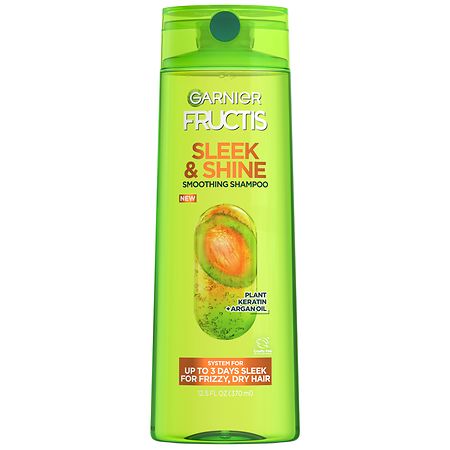

Garnier Fructis Sleek & Shine Fortifying Shampoo for Frizzy Hair - 12.5 fl oz: Aluminum-Free, Paraben-Free, Sulfate-Free, Contains Argan Oil
Analysis updated August 2026 · How Scout scores
At a glance
Summary
This shampoo contains beneficial ingredients like argan oil and apple fruit extract, which provide nourishment and protection for the hair. However, it also includes sodium laureth sulfate, which can strip natural oils, and amodimethicone, a silicone that may cause buildup. The presence of synthetic fragrance and sodium chloride further detracts from its overall safety and hair health impact, leading to a moderate processing level and a mixed ingredient profile.
Key ingredients 26
argania spinosa kernel oilVery Good
Argan oil is rich in essential fatty acids and vitamin E. It provides deep conditioning and nourishment to the hair. It is highly beneficial for improving hair texture and shine.
Risks
Minimal risk of irritation.
Benefits
Deeply conditions and nourishes hair.
pyrus malus fruit extract/apple fruit extractGood
Apple fruit extract is rich in antioxidants and vitamins. It helps to nourish and protect the hair from environmental damage. It is a beneficial ingredient for maintaining healthy hair.
Risks
Minimal risk of irritation.
Benefits
Nourishes and protects hair with antioxidants.
salicylic acidGood
Salicylic acid is a beta hydroxy acid that helps to exfoliate the scalp. It can help to reduce dandruff and improve scalp health. It is beneficial for maintaining a healthy scalp environment.
Risks
May cause irritation if used excessively.
Benefits
Exfoliates scalp and reduces dandruff.
niacinamideGood
Niacinamide is a form of vitamin B3 that helps to improve skin barrier function. It can help to reduce inflammation and improve overall scalp health. It is beneficial for maintaining a healthy scalp environment.
Risks
Minimal risk of irritation.
Benefits
Improves skin barrier and reduces inflammation.
aqua/water/eauNeutral
Water is a common solvent used in cosmetic formulations. It helps dissolve other ingredients and provides a base for the product. It does not have any direct risks or benefits.
Benefits
Provides a medium for other ingredients to be applied to the hair.
coco-betaineNeutral
Coco-betaine is a mild surfactant derived from coconut oil. It is used to enhance the foaming properties of shampoos. It is generally considered safe and non-irritating.
Risks
Rarely, it may cause mild irritation in sensitive individuals.
Benefits
Helps improve the texture and foaming of the shampoo.
sodium chlorideNeutral
Standard formulation ingredient — neither beneficial nor harmful at typical use.
Risks
May dry out hair and scalp, leading to irritation.
Benefits
Helps to thicken the shampoo formula.
laureth-5 carboxylic acidNeutral
Laureth-5 carboxylic acid is used as a surfactant and emulsifier. It helps to stabilize the formulation and improve texture. It is generally considered safe for use in cosmetics.
Risks
Minimal risk of irritation for sensitive skin.
Benefits
Improves the texture and stability of the shampoo.
cocamide mipaNeutral
Cocamide MIPA is a surfactant and foam booster derived from coconut oil. It helps to stabilize the foam and improve the texture of the shampoo. It is generally considered safe for use in cosmetics.
Risks
May cause mild irritation in sensitive individuals.
Benefits
Enhances foaming and texture of the shampoo.
citric acidNeutral
Citric acid is used to adjust the pH of cosmetic products. It helps to maintain the stability and effectiveness of the formulation. It is generally safe and non-irritating.
Risks
May cause mild irritation in very sensitive skin.
Benefits
Helps maintain product stability and pH balance.
sodium hydroxideNeutral
Sodium hydroxide is used to adjust the pH of cosmetic formulations. It helps to ensure the product is not too acidic or alkaline. It is used in very small amounts to avoid irritation.
Risks
Can cause irritation if used in high concentrations.
Benefits
Helps maintain the desired pH level of the product.
hexylene glycolNeutral
Hexylene glycol is used as a solvent and viscosity agent in cosmetics. It helps to improve the texture and spreadability of the product. It is generally considered safe for use in cosmetics.
Risks
May cause mild irritation in sensitive skin.
Benefits
Improves texture and spreadability of the product.
polyquaternium-7Neutral
Polyquaternium-7 is a conditioning agent that helps to reduce static and frizz. It provides a smooth and silky feel to the hair. It is generally considered safe for use in hair care products.
Risks
May cause buildup with prolonged use.
Benefits
Reduces static and frizz, providing smoothness.
peg-55 propylene glycol oleateNeutral
PEG-55 propylene glycol oleate is used as an emulsifier and surfactant. It helps to stabilize the formulation and improve texture. It is generally considered safe for use in cosmetics.
Risks
May cause irritation in sensitive individuals.
Benefits
Stabilizes formulation and improves texture.
peg-60 hydrogenated castor oilNeutral
PEG-60 hydrogenated castor oil is used as an emulsifier and surfactant. It helps to stabilize the formulation and improve texture. It is generally considered safe for use in cosmetics.
Risks
May cause irritation in sensitive individuals.
Benefits
Stabilizes formulation and improves texture.
pyridoxine hclNeutral
Pyridoxine HCl is a form of vitamin B6 used in cosmetics for its conditioning properties. It helps to maintain healthy hair and scalp. It is generally considered safe for use in cosmetics.
Risks
Minimal risk of irritation.
Benefits
Conditions hair and maintains scalp health.
hexyl cinnamalNeutral
Hexyl cinnamal is a fragrance ingredient used to impart a floral scent. It is commonly used in cosmetic products for its pleasant aroma. It is generally considered safe but can cause allergic reactions in sensitive individuals.
Risks
Potential for allergic reactions.
Benefits
Provides a pleasant floral scent.
saccharum officinarum extract/sugarcane extractNeutral
Sugarcane extract is used for its moisturizing and conditioning properties. It helps to hydrate and soften the hair. It is generally considered safe for use in cosmetics.
Risks
Minimal risk of irritation.
Benefits
Moisturizes and conditions hair.
amyl cinnamalNeutral
Amyl cinnamal is a fragrance ingredient used to impart a floral scent. It is commonly used in cosmetic products for its pleasant aroma. It is generally considered safe but can cause allergic reactions in sensitive individuals.
Risks
Potential for allergic reactions.
Benefits
Provides a pleasant floral scent.
sodium laureth sulfateBad
Sodium laureth sulfate is a surfactant that can strip natural oils from the hair and scalp. It may cause dryness and irritation for some users. It is often used for its effective cleansing properties.
Risks
Can cause dryness and irritation, especially for sensitive scalps.
Benefits
Provides effective cleansing and foaming action.
amodimethiconeBad
Amodimethicone is a silicone used for conditioning and smoothing hair. It can cause buildup over time, leading to dull and brittle hair. It is effective in providing a smooth and shiny finish.
Risks
Can cause buildup, making hair dull and brittle.
Benefits
Provides smoothness and shine to hair.
sodium benzoateBad
Synthetic preservative that can form benzene in the presence of vitamin C.
Risks
May cause irritation in sensitive individuals.
Benefits
Prevents microbial growth, extending product shelf life.
propylene glycolBad
Processed additive flagged under Scout's ingredient doctrine.
Risks
May cause irritation in sensitive skin.
Benefits
Retains moisture and improves product texture.
benzyl alcoholBad
Benzyl alcohol is used as a preservative and solvent in cosmetics. It can be drying and irritating to the skin and scalp. It is effective in preventing microbial growth but can cause sensitivity.
Risks
Can cause dryness and irritation.
Benefits
Prevents microbial growth in the product.
linaloolBad
Processed additive flagged under Scout's ingredient doctrine.
Risks
Potential for allergic reactions.
Benefits
Provides a pleasant floral scent.
parfum/fragranceVery Bad
Synthetic fragrances can cause allergic reactions and irritation. They are often composed of undisclosed chemicals. While they provide a pleasant scent, they can be problematic for sensitive individuals.
Risks
Potential for allergic reactions and irritation.
Benefits
Adds a pleasant scent to the product.
Processing
Processed Foods
Get the full breakdown in the Scout appTake Scout shopping
Scan any product to see lab results, healthy alternatives, and your personalized analysis.
Download on theApp Store GET IT ONGoogle PlayAmazon pricing & content
Amazon price as of . Product prices and availability are accurate as of the date/time indicated and are subject to change. Any price and availability information displayed on Amazon.com at the time of purchase will apply to the purchase of this product.
CERTAIN CONTENT THAT APPEARS ON THIS SITE COMES FROM AMAZON. THIS CONTENT IS PROVIDED “AS IS” AND IS SUBJECT TO CHANGE OR REMOVAL AT ANY TIME.