
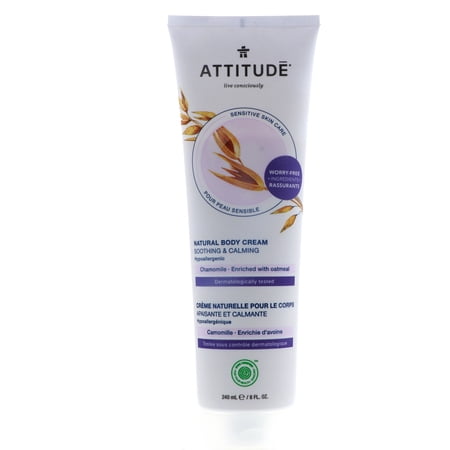


Attitude Sensitive Skin Care Soothing And Calming Natural Body Cream Chamomile 8.1 oz
Analysis updated October 2026 · How Scout scores
At a glance
Summary
This body cream features a predominantly natural ingredient list with beneficial components like shea butter, olive oil, and grape seed oil, which are known for their moisturizing and soothing properties. The absence of synthetic fragrances, parabens, and other harsh chemicals contributes to its high rating. The inclusion of natural emulsifiers and preservatives ensures a gentle formulation suitable for sensitive skin.
Key ingredients 20
Butyrospermum Parkii (Shea) ButterVery Good
Shea butter is a natural fat extracted from the nuts of the shea tree. It is known for its moisturizing and anti-inflammatory properties. It is highly beneficial for dry and sensitive skin.
Risks
There are minimal risks, though some individuals may experience allergic reactions.
Benefits
Shea butter deeply moisturizes the skin and can help soothe irritation.
Avena Sativa (Oat) Kernel FlourVery Good
Oat kernel flour is known for its soothing and anti-inflammatory properties. It is beneficial for sensitive and irritated skin. It helps to calm and protect the skin barrier.
Risks
There are minimal risks, though some individuals may experience allergic reactions.
Benefits
It helps to soothe and calm irritated skin.
Olea Europaea (Olive) Fruit OilVery Good
Olive fruit oil is rich in antioxidants and fatty acids. It is known for its moisturizing and nourishing properties. It helps to protect and hydrate the skin.
Risks
There are minimal risks, though it may cause breakouts in very oily skin.
Benefits
It deeply moisturizes and nourishes the skin.
Vitis Vinifera (Grape) Seed OilVery Good
Grape seed oil is rich in antioxidants and fatty acids. It is known for its moisturizing and anti-inflammatory properties. It helps to protect and nourish the skin.
Risks
There are minimal risks, though it may cause breakouts in very oily skin.
Benefits
It helps to moisturize and protect the skin.
Caprylic/Capric TriglycerideGood
This ingredient is derived from coconut oil and glycerin. It is used as an emollient and helps to create a smooth and non-greasy texture. It is generally well-tolerated by most skin types.
Risks
There are minimal risks, though it may cause breakouts in very sensitive skin.
Benefits
It helps to moisturize and soften the skin without leaving a greasy residue.
GlycerinGood
Glycerin is a humectant that attracts moisture to the skin. It is widely used in skincare for its hydrating properties. It helps to maintain the skin's moisture balance.
Risks
There are minimal risks associated with glycerin.
Benefits
Glycerin helps to keep the skin hydrated and soft.
Cetearyl OlivateGood
Cetearyl olivate is derived from olive oil and used as an emulsifier. It helps to blend oil and water-based ingredients. It is known for its moisturizing properties.
Risks
There are minimal risks, though it may cause irritation in very sensitive skin.
Benefits
It helps to hydrate and soften the skin.
Sorbitan OlivateGood
Sorbitan olivate is an emulsifier derived from olive oil. It helps to blend oil and water-based ingredients. It is known for its moisturizing properties.
Risks
There are minimal risks, though it may cause irritation in very sensitive skin.
Benefits
It helps to hydrate and soften the skin.
Aqua / Water / EauNeutral
Water is a common solvent used in cosmetic formulations. It helps to dissolve other ingredients and provides a base for the cream. It does not have any direct benefits or risks.
Risks
There are no significant risks associated with water in cosmetics.
Benefits
Water helps in hydrating the skin by providing moisture.
Cetearyl AlcoholNeutral
Cetearyl alcohol is a fatty alcohol used as an emollient and thickener in cosmetics. It helps to stabilize and thicken formulations. It is not drying like other alcohols.
Risks
There are minimal risks, though it may cause irritation in very sensitive skin.
Benefits
It helps to improve the texture and consistency of the product.
Dicaprylyl EtherNeutral
Dicaprylyl ether is used as an emollient and solvent in cosmetics. It helps to improve the spreadability of the product. It is generally considered safe for use.
Risks
There are minimal risks, though it may cause irritation in very sensitive skin.
Benefits
It provides a lightweight feel and enhances the application of the product.
Tapioca StarchNeutral
Tapioca starch is used as a thickening agent and to absorb excess oil. It helps to improve the texture of the product. It is generally safe for use in cosmetics.
Risks
There are minimal risks associated with tapioca starch.
Benefits
It helps to create a smooth and matte finish on the skin.
OctyldodecanolNeutral
Octyldodecanol is a fatty alcohol used as an emollient and thickener. It helps to improve the texture and feel of the product. It is generally considered safe for use.
Risks
There are minimal risks, though it may cause irritation in very sensitive skin.
Benefits
It provides a smooth application and enhances the product's texture.
Caprylyl GlycolNeutral
Caprylyl glycol is used as a skin conditioning agent and preservative. It helps to improve the shelf life of the product. It is generally considered safe for use.
Risks
There are minimal risks, though it may cause irritation in very sensitive skin.
Benefits
It helps to condition the skin and preserve the product.
HonokiolNeutral
Honokiol is a compound derived from magnolia bark. It is used for its antioxidant and anti-inflammatory properties. It is generally considered safe for use in cosmetics.
Risks
There are minimal risks, though it may cause irritation in very sensitive skin.
Benefits
It helps to protect the skin from oxidative stress.
MagnololNeutral
Magnolol is a compound derived from magnolia bark. It is used for its antioxidant and anti-inflammatory properties. It is generally considered safe for use in cosmetics.
Risks
There are minimal risks, though it may cause irritation in very sensitive skin.
Benefits
It helps to protect the skin from oxidative stress.
Citric AcidNeutral
Citric acid is used to adjust the pH of cosmetic formulations. It helps to maintain the stability and effectiveness of the product. It is generally considered safe for use in low concentrations.
Risks
There are minimal risks, though it may cause irritation in very sensitive skin.
Benefits
It helps to maintain the product's pH balance.
Sodium HydroxideNeutral
Sodium hydroxide is used to adjust the pH of cosmetic formulations. It helps to maintain the stability and effectiveness of the product. It is generally considered safe for use in low concentrations.
Risks
There are minimal risks, though it may cause irritation in very sensitive skin.
Benefits
It helps to maintain the product's pH balance.
Sodium BenzoateBad
Synthetic preservative that can form benzene in the presence of vitamin C.
Risks
There are minimal risks, though it may cause irritation in very sensitive skin.
Benefits
It helps to preserve the product and extend its shelf life.
Potassium SorbateBad
Synthetic preservative — flagged in daily-use products.
Risks
There are minimal risks, though it may cause irritation in very sensitive skin.
Benefits
It helps to preserve the product and extend its shelf life.
Get the full breakdown in the Scout appTake Scout shopping
Scan any product to see lab results, healthy alternatives, and your personalized analysis.
Download on theApp Store GET IT ONGoogle PlayAmazon pricing & content
Amazon price as of . Product prices and availability are accurate as of the date/time indicated and are subject to change. Any price and availability information displayed on Amazon.com at the time of purchase will apply to the purchase of this product.
CERTAIN CONTENT THAT APPEARS ON THIS SITE COMES FROM AMAZON. THIS CONTENT IS PROVIDED “AS IS” AND IS SUBJECT TO CHANGE OR REMOVAL AT ANY TIME.