
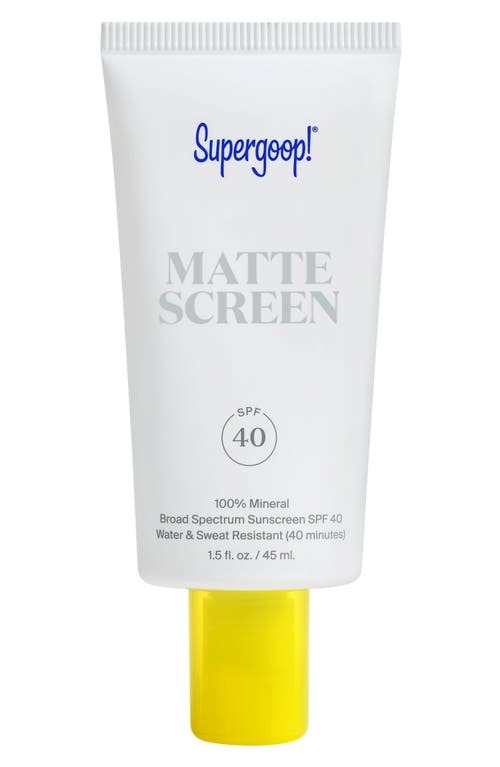



Supergoop! Mineral Mattescreen Broad Spectrum SPF 40 / LOTION
Analysis updated August 2026 · How Scout scores
At a glance
Summary
This sunscreen features mineral UV filters, titanium dioxide and zinc oxide, which are considered safe and effective for broad-spectrum protection. The formulation includes beneficial ingredients like glycerin for hydration and lacks harmful chemical UV filters or synthetic fragrances. However, the presence of dimethicone and other synthetic compounds indicates a moderate level of processing, which slightly limits its score.
Key ingredients 21
Zinc OxideGood
Zinc Oxide is a mineral sunscreen agent known for its broad-spectrum UV protection. It is considered safe and effective, especially in cream or lotion form. It is non-irritating and suitable for sensitive skin.
Risks
There are minimal risks associated with Zinc Oxide in lotion form.
Benefits
Provides broad-spectrum UV protection and is suitable for sensitive skin.
GlycerinGood
Glycerin is a humectant that attracts moisture to the skin, helping to keep it hydrated. It is widely used in cosmetics for its moisturizing properties. It is generally considered safe and effective.
Risks
Rarely, it may cause irritation in very sensitive skin.
Benefits
Helps to keep the skin hydrated and improves moisture retention.
Titanium DioxideNeutral
Titanium Dioxide is a mineral sunscreen agent that provides broad-spectrum UV protection. It is generally considered safe and effective for use in sunscreens. However, there are concerns about inhalation risks when used in powder form.
Risks
Inhalation of Titanium Dioxide in powder form can pose respiratory risks.
Benefits
It offers broad-spectrum UV protection and is photostable.
Dimethicone CrosspolymerNeutral
Dimethicone Crosspolymer is used to enhance the texture and spreadability of products. It provides a silky feel and helps to fill in fine lines. It is generally considered safe for use in cosmetics.
Risks
May cause skin build-up with prolonged use.
Benefits
Improves product texture and provides a silky feel.
Caprylic/Capric TriglycerideNeutral
Caprylic/Capric Triglyceride is an emollient derived from coconut oil and glycerin. It helps to moisturize and condition the skin. It is generally considered safe and non-irritating.
Risks
Rarely, it may cause skin irritation in sensitive individuals.
Benefits
Moisturizes and conditions the skin effectively.
Methyl DihydroabietateNeutral
Methyl Dihydroabietate is used as a fragrance ingredient and fixative in cosmetics. It helps to stabilize the scent of the product. It is generally considered safe for use in cosmetics.
Risks
May cause allergic reactions in sensitive individuals.
Benefits
Stabilizes fragrance and enhances product scent.
Polyhydroxystearic AcidNeutral
Polyhydroxystearic Acid is used as an emulsifier and thickening agent in cosmetics. It helps to stabilize formulations and improve texture. It is generally considered safe for use in cosmetics.
Risks
May cause mild irritation in sensitive skin.
Benefits
Stabilizes formulations and improves product texture.
C9-12 AlkaneNeutral
C9-12 Alkane is used as an emollient and solvent in cosmetics. It provides a lightweight feel and helps to dissolve other ingredients. It is generally considered safe for use in cosmetics.
Risks
May cause mild irritation in sensitive skin.
Benefits
Provides a lightweight feel and enhances product spreadability.
EthylhexylglycerinNeutral
Ethylhexylglycerin is used as a skin-conditioning agent and preservative enhancer. It helps to improve the efficacy of preservatives in formulations. It is generally considered safe for use in cosmetics.
Risks
May cause mild irritation in sensitive skin.
Benefits
Enhances preservative efficacy and conditions the skin.
WaterNeutral
Water is used as a solvent in cosmetics, helping to dissolve other ingredients. It is a fundamental component in many formulations. It is generally considered safe and non-irritating.
Benefits
Acts as a solvent and hydrates the skin.
Coco-Caprylate/CaprateNeutral
Coco-Caprylate/Caprate is an emollient derived from coconut oil, used to enhance skin feel. It provides a silky, non-greasy finish. It is generally considered safe for use in cosmetics.
Risks
May cause mild irritation in sensitive skin.
Benefits
Enhances skin feel and provides a silky finish.
SilicaNeutral
Silica is used as an absorbent and anti-caking agent in cosmetics. It helps to control oil and improve product texture. It is generally considered safe for use in cosmetics.
Risks
Inhalation of silica particles can pose respiratory risks.
Benefits
Controls oil and improves product texture.
Stearic AcidNeutral
Stearic Acid is used as an emulsifier and thickening agent in cosmetics. It helps to stabilize formulations and improve texture. It is generally considered safe for use in cosmetics.
Risks
May cause mild irritation in sensitive skin.
Benefits
Stabilizes formulations and improves product texture.
Hedychium Coronarium Root ExtractNeutral
Hedychium Coronarium Root Extract is used for its potential antioxidant and soothing properties. It is derived from a plant and is generally considered safe for use in cosmetics. However, its efficacy in skincare is not well-documented.
Risks
May cause allergic reactions in sensitive individuals.
Benefits
Potential antioxidant and soothing properties.
Lactobacillus/Arundinaria Gigantea Leaf Ferment FiltrateNeutral
This ingredient is used for its potential probiotic and skin-conditioning properties. It is derived from fermentation and is generally considered safe for use in cosmetics. However, its efficacy in skincare is not well-documented.
Risks
May cause allergic reactions in sensitive individuals.
Benefits
Potential probiotic and skin-conditioning properties.
Leuconostoc/Radish Root Ferment FiltrateNeutral
This ingredient is used for its potential antimicrobial and skin-conditioning properties. It is derived from fermentation and is generally considered safe for use in cosmetics. However, its efficacy in skincare is not well-documented.
Risks
May cause allergic reactions in sensitive individuals.
Benefits
Potential antimicrobial and skin-conditioning properties.
CI 77492Neutral
CI 77492 is an iron oxide used as a colorant in cosmetics. It provides pigmentation and is generally considered safe for use. However, it does not offer any skincare benefits.
Risks
May cause allergic reactions in sensitive individuals.
Benefits
Provides pigmentation and color to the product.
CI 77491Neutral
CI 77491 is an iron oxide used as a colorant in cosmetics. It provides pigmentation and is generally considered safe for use. However, it does not offer any skincare benefits.
Risks
May cause allergic reactions in sensitive individuals.
Benefits
Provides pigmentation and color to the product.
CI 77499Neutral
CI 77499 is an iron oxide used as a colorant in cosmetics. It provides pigmentation and is generally considered safe for use. However, it does not offer any skincare benefits.
Risks
May cause allergic reactions in sensitive individuals.
Benefits
Provides pigmentation and color to the product.
CI 77891Neutral
CI 77891, also known as Titanium Dioxide, is used as a colorant and UV filter in cosmetics. It provides pigmentation and UV protection. It is generally considered safe for use.
Risks
Inhalation of Titanium Dioxide in powder form can pose respiratory risks.
Benefits
Provides pigmentation and UV protection.
DimethiconeBad
Occlusive silicone film-former — flagged under clean-beauty doctrine.
Risks
May cause build-up on the skin with prolonged use.
Benefits
Provides a smooth application and helps retain skin moisture.
Get the full breakdown in the Scout appTake Scout shopping
Scan any product to see lab results, healthy alternatives, and your personalized analysis.
Download on theApp Store GET IT ONGoogle PlayAmazon pricing & content
Amazon price as of . Product prices and availability are accurate as of the date/time indicated and are subject to change. Any price and availability information displayed on Amazon.com at the time of purchase will apply to the purchase of this product.
CERTAIN CONTENT THAT APPEARS ON THIS SITE COMES FROM AMAZON. THIS CONTENT IS PROVIDED “AS IS” AND IS SUBJECT TO CHANGE OR REMOVAL AT ANY TIME.