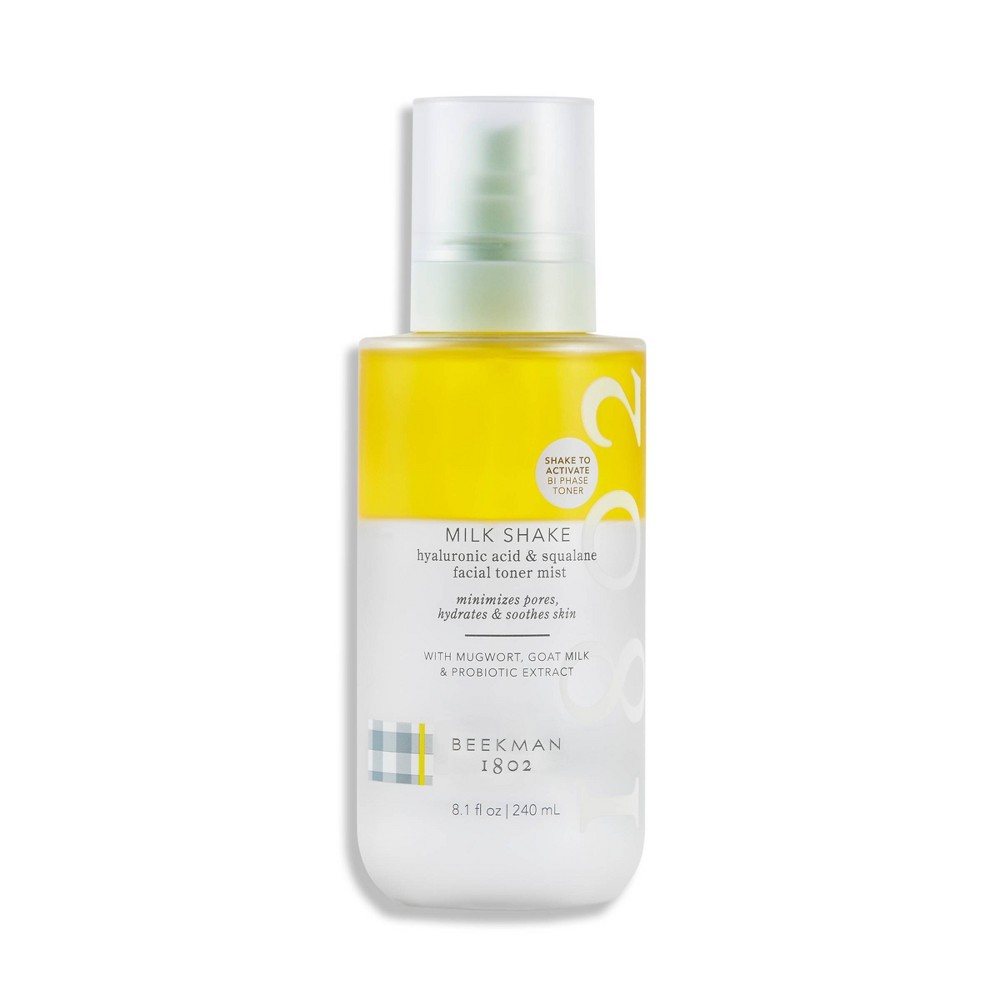
Beekman 1802 Milk Shake Hyaluronic Acid & Squalane Facial Toner Mist - 8.1 fl oz - Ulta Beauty: Alcohol-Free, Sensitive Skin, Dry Skin
At a glance
Summary
This toner mist features a blend of natural and beneficial ingredients such as jojoba oil, goat milk, hyaluronic acid, and squalane, which are known for their moisturizing and soothing properties. The product avoids harsh chemicals and synthetic fragrances, making it suitable for sensitive skin. Its formulation is primarily composed of natural oils and extracts, contributing to a high score for ingredient safety and minimal processing. Its plastic packaging can shed microplastics into the product and lowers its score.
Key ingredients 31
Simmondsia Chinensis (Jojoba) Seed OilVery Good
Jojoba oil is a natural oil that closely resembles the skin's own sebum. It is highly moisturizing and helps to balance oil production. It is well-tolerated by most skin types.
Risks
Generally considered safe with minimal risk of irritation.
Benefits
Provides deep hydration and helps to soothe and protect the skin.
SqualaneVery Good
Squalane is a natural emollient that mimics the skin's natural oils. It is highly moisturizing and helps to improve skin texture. It is non-comedogenic and suitable for all skin types.
Risks
Generally considered safe with minimal risk of irritation.
Benefits
Provides deep hydration and helps to protect the skin barrier.
Aloe Barbadensis Leaf WaterVery Good
Aloe vera is known for its soothing and hydrating properties. It helps to calm irritated skin and provides moisture. It is suitable for sensitive and dry skin types.
Risks
Generally considered safe with minimal risk of irritation.
Benefits
Soothes and hydrates the skin, reducing redness and irritation.
Chamomilla Recutita (Matricaria) Flower ExtractVery Good
Chamomile extract is known for its calming and anti-inflammatory properties. It helps to soothe irritated skin and reduce redness. It is suitable for sensitive skin types.
Risks
Generally considered safe with minimal risk of irritation.
Benefits
Calms and soothes the skin, providing relief from irritation and redness.
Hippophae Rhamnoides (Sea Buckthorn) OilVery Good
Sea buckthorn oil is rich in vitamins and antioxidants. It helps to nourish and protect the skin from environmental damage. It is suitable for most skin types.
Risks
Generally considered safe with minimal risk of irritation.
Benefits
Nourishes and protects the skin, providing antioxidant benefits.
Whey ProteinVery Good
Whey protein is rich in amino acids and helps to nourish the skin. It has moisturizing and conditioning properties. It is suitable for most skin types.
Risks
May cause allergic reactions in individuals with milk allergies.
Benefits
Improves skin texture and provides hydration and nourishment.
Caprylic/Capric TriglycerideGood
Caprylic/Capric Triglyceride is derived from coconut oil and glycerin. It is used as an emollient and helps to replenish the skin's surface. It is well-tolerated by most skin types.
Risks
Rarely, it may cause mild irritation in very sensitive skin.
Benefits
Helps to moisturize and soften the skin, enhancing the skin barrier function.
Coco-Caprylate/CaprateGood
Coco-Caprylate/Caprate is a natural emollient derived from coconut oil. It is used to improve the spreadability of products and provide a silky feel. It is considered safe and non-irritating.
Risks
Minimal risk of irritation, generally safe for all skin types.
Benefits
Provides a lightweight, non-greasy feel and enhances skin hydration.
Caprae Lac (Goat Milk)Good
Goat milk is rich in vitamins and minerals beneficial for the skin. It has moisturizing and anti-inflammatory properties. It is suitable for sensitive skin types.
Risks
Rarely, it may cause allergic reactions in individuals with dairy allergies.
Benefits
Nourishes the skin and helps to improve its texture and appearance.
ColostrumGood
Colostrum is a nutrient-rich fluid that contains growth factors and antibodies. It is used in skincare for its regenerative and healing properties. It is generally well-tolerated by the skin.
Risks
Minimal risk of irritation, but may not be suitable for vegans.
Benefits
Promotes skin renewal and helps to improve skin elasticity.
Bifida Ferment LysateGood
Bifida Ferment Lysate is a probiotic ingredient that helps to strengthen the skin barrier. It is known for its soothing and protective properties. It is considered safe for most skin types.
Risks
Generally safe, but may cause mild irritation in very sensitive skin.
Benefits
Enhances skin resilience and helps to reduce sensitivity.
Milk ProteinGood
Milk protein is rich in amino acids and helps to nourish the skin. It has moisturizing and conditioning properties. It is suitable for most skin types.
Risks
May cause allergic reactions in individuals with milk allergies.
Benefits
Improves skin texture and provides hydration and nourishment.
Artemisia Capillaris (Mugwort) ExtractGood
Mugwort extract is known for its soothing and anti-inflammatory properties. It is used in skincare to calm irritated skin and reduce redness. It is generally well-tolerated by sensitive skin.
Risks
Minimal risk of irritation, generally safe for all skin types.
Benefits
Helps to soothe and calm the skin, reducing inflammation and redness.
Hyaluronic AcidGood
Hyaluronic acid is a powerful humectant that attracts and retains moisture in the skin. It is known for its ability to hydrate and plump the skin. It is suitable for all skin types and is non-irritating.
Risks
Generally considered safe with no significant risks.
Benefits
Provides intense hydration and helps to improve skin elasticity and smoothness.
Eryngium Alpinum (Blue Thistle) Flower ExtractGood
Blue thistle extract is known for its antioxidant and anti-aging properties. It helps to protect the skin from environmental damage. It is generally well-tolerated by most skin types.
Risks
Minimal risk of irritation, generally safe for all skin types.
Benefits
Provides antioxidant protection and helps to improve skin firmness.
Honey ExtractGood
Honey extract is a natural humectant that helps to retain moisture in the skin. It has antibacterial and soothing properties. It is suitable for most skin types.
Risks
May cause allergic reactions in individuals with honey allergies.
Benefits
Moisturizes and soothes the skin, providing antibacterial benefits.
Symphytum Officinale (Comfrey) Leaf ExtractGood
Comfrey extract is known for its healing and anti-inflammatory properties. It helps to soothe and repair damaged skin. It is generally well-tolerated by most skin types.
Risks
Minimal risk of irritation, generally safe for all skin types.
Benefits
Promotes skin healing and reduces inflammation.
Hydrolyzed Jojoba EstersGood
Hydrolyzed jojoba esters are derived from jojoba oil and provide moisturizing benefits. They help to improve skin texture and hydration. They are generally considered safe for all skin types.
Risks
Minimal risk of irritation, generally safe for all skin types.
Benefits
Enhances skin hydration and provides a smooth texture.
GlycerinGood
Glycerin is a humectant that attracts moisture to the skin. It helps to hydrate and soften the skin. It is suitable for all skin types and is non-irritating.
Risks
Generally considered safe with no significant risks.
Benefits
Provides hydration and helps to maintain skin moisture balance.
TocopherolGood
Tocopherol, or Vitamin E, is an antioxidant that helps to protect the skin from free radical damage. It is known for its moisturizing and healing properties. It is suitable for most skin types.
Risks
Generally considered safe with minimal risk of irritation.
Benefits
Provides antioxidant protection and helps to moisturize and heal the skin.
Water (Aqua)Neutral
Water is a common solvent used in cosmetic formulations. It helps dissolve other ingredients and provides a base for the product. It is generally considered safe and non-irritating.
Risks
There are no significant risks associated with water in cosmetic products.
Benefits
Water helps hydrate the skin and acts as a carrier for other beneficial ingredients.
Ethylhexyl PalmitateNeutral
Ethylhexyl Palmitate is an ester of 2-ethylhexyl alcohol and palmitic acid. It is used as an emollient and thickening agent in cosmetics. It is generally considered safe for use in skincare products.
Risks
May cause mild irritation in sensitive individuals.
Benefits
Provides a smooth, soft feel to the skin and helps improve the texture of the product.
1,2-HexanediolNeutral
1,2-Hexanediol is a synthetic preservative and moisture-binding agent. It helps to stabilize formulations and prevent microbial growth. It is generally considered safe for use in cosmetics.
Risks
May cause mild irritation in sensitive skin.
Benefits
Helps to maintain product integrity and extend shelf life.
LactoseNeutral
Lactose is a sugar derived from milk. It is used as a humectant and conditioning agent in cosmetics. It is generally considered safe for topical use.
Risks
May cause irritation in individuals with lactose intolerance if ingested.
Benefits
Helps to hydrate the skin and improve product texture.
Sodium ChlorideNeutral
Sodium chloride, or salt, is used as a thickening agent in cosmetics. It helps to improve the texture and stability of the product. It is generally considered safe for topical use.
Risks
May cause mild irritation in very sensitive skin.
Benefits
Improves product texture and stability.
HydroxyacetophenoneNeutral
Hydroxyacetophenone is an antioxidant and preservative used in cosmetics. It helps to protect the product from degradation. It is generally considered safe for use in skincare products.
Risks
May cause mild irritation in sensitive skin.
Benefits
Provides antioxidant protection and helps to maintain product integrity.
Pentaerythrityl Tetra-di-I-butyl HydroxyhydrocinnamateNeutral
This ingredient is an antioxidant used to stabilize cosmetic formulations. It helps to prevent the oxidation of other ingredients. It is generally considered safe for use in cosmetics.
Risks
May cause mild irritation in sensitive skin.
Benefits
Helps to maintain product stability and extend shelf life.
EthylhexylglycerinNeutral
Ethylhexylglycerin is a preservative and skin conditioning agent. It helps to enhance the efficacy of other preservatives. It is generally considered safe for use in cosmetics.
Risks
May cause mild irritation in sensitive skin.
Benefits
Improves product preservation and provides skin conditioning benefits.
PropanediolNeutral
Propanediol is a glycol used as a solvent and humectant in cosmetics. It helps to improve the texture and hydration of the product. It is generally considered safe for use in skincare products.
Risks
May cause mild irritation in sensitive skin.
Benefits
Enhances product texture and provides hydration benefits.
C10-18 TriglyceridesNeutral
C10-18 Triglycerides are used as emollients and thickeners in cosmetics. They help to improve the texture and spreadability of the product. They are generally considered safe for use in skincare products.
Risks
May cause mild irritation in sensitive skin.
Benefits
Enhances product texture and provides emollient benefits.
LecithinBad
Processed additive flagged under Scout's ingredient doctrine.
Risks
Generally considered safe with minimal risk of irritation.
Benefits
Improves skin hydration and texture, providing conditioning benefits.
Get the full breakdown in the Scout appTake Scout shopping
Scan any product to see lab results, healthy alternatives, and your personalized analysis.
Are you Beekman 1802? Fix an error Get the badge Get tested
Amazon pricing & content
Amazon price as of . Product prices and availability are accurate as of the date/time indicated and are subject to change. Any price and availability information displayed on Amazon.com at the time of purchase will apply to the purchase of this product.
CERTAIN CONTENT THAT APPEARS ON THIS SITE COMES FROM AMAZON. THIS CONTENT IS PROVIDED “AS IS” AND IS SUBJECT TO CHANGE OR REMOVAL AT ANY TIME.